
Custodial vs Non-Custodial Wallets: What’s The Difference?
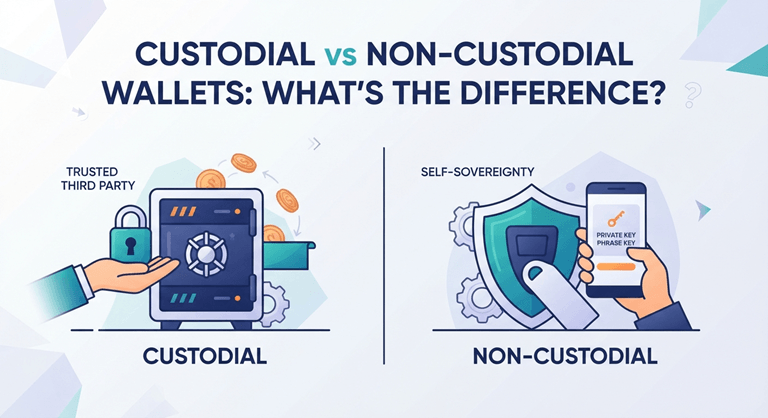
Custodial wallets manage your private keys for you, while non-custodial wallets encrypt the private key locally on your own device. There’s a time and place for both approaches, but one is a lot more secure than the other — and arguably much more faithful to the spirit of blockchain, which was designed for anonymity and total control of your own funds.
In this article, we’ll explain the difference between custodial vs non-custodial wallets, using.
Atomic Wallet, one of the most popular non-custodial wallets, as an example. Let’s get started.
What is a private key?
Before we dive into custodial vs non-custodial wallets, it’s worth taking a minute to understand the concept of keys in cryptography.
In cryptographic encryption, every wallet has two keys:
- A public key.
- A private key.
The private key is a hexadecimal alphanumeric code — a digital signature — and whoever holds the private key controls access to a wallet.
If we draw a parallel with traditional banking, the public key is essentially your account number — you can share it to receive funds, and even if people know it, they won’t be able to do anything with your account. The private key, on the other hand, is your account’s password — knowing it lets anyone control your wallet: execute transactions, move funds out. That’s why it must be kept strictly confidential.
A private key looks something like this: E8C5F60C6CCCD437D71597401C6A808F96C5EE74AEA6C4BCD8F24883A0DFC858.
Note: The key above is made up and doesn’t belong to a real wallet.
Because that string of numbers is near impossible to remember — or even write down without errors — most modern wallets don’t ask you to save one. Instead, wallets use something called a seed phrase (also known as a recovery phrase, or a mnemonic phrase).
A seed phrase is a list of 12–24 randomly generated words, which deterministically generate the private key of your wallet. It’s like a master key to your wallet, and you can think about it as a more human-friendly version of the private key.
Essentially, you never want anyone to know your private key, or indeed your seed phrase, as it exposes your wallet to the outside world.
And this brings us to the topic of custodial vs non-custodial wallets, because the difference between them boils down to this: who generates and holds the keys.
Custodial wallets
A custodial wallet uses a third party to manage the private key. For example, most centralised cryptocurrency exchanges belong to this group: Binance, Coinbase, ByBit — all of these are custodial platforms.
When you open a Binance account, it is the platform that creates a wallet on your behalf, while generating and storing the private key. This is very convenient, because you can log into your account and access your wallet the usual way — with a login–password. However, it arguably goes against the premise of cryptocurrency, as you are not really in control of your keys. Should the platform, for some reason, need to, for example, freeze your funds due to geopolitical restrictions, they can do this easily, and there’s nothing you can do about it.
In this scenario, rather than holding the actual asset (the cryptocurrency), you hold a claim to it, while the platform physically signs transactions on the blockchain on your behalf. This mechanic exposes you to several risks, such as:
- If the platform where you store the funds commits fraud, any legal action against them can freeze your balance as collateral damage.
- The platform can freeze your account and block the money from moving if the custodian becomes a target of government sanctions, is affected by regulatory changes, or if the legal compliance system raises a flag on your account, which can happen by error.
- If the platform gets hacked, the hacker will obtain access to your funds. And large cryptocurrency exchanges are often targets of hacks, due to the concentration of funds in a single place.
Of course, this is not to scare you or say that you should never use CEXs (Centralized Cryptocurrency Exchanges) — they’re amazingly convenient platforms with some of the largest liquidity pools and lowest slippages, making them perfect for active crypto trading.
However, when it comes to storing your cryptocurrency long-term, there’s a better alternative — non-custodial (or decentralized wallets, so let’s talk about them.
NNon-custodialwallets
A non-custodial wallet is one where both public and private keys are generated on your device, and the private key is never exposed to the outside.
Usually, a wallet like this shows you the seed phrase only once, and you’re asked to write it down on a piece of paper. Store it securely and only use it when you need to restore access to the wallet.
When you send a transaction, you sign it on your device using that key, which is encrypted on your hardware. And because nobody but you knows the private key, absolutely no one, not even the company that made the app, can access or freeze your funds.
This eliminates every risk that we’ve talked about above:
- Even if the developer of your chosen wallet were to close its doors tomorrow, you’d remain in full control of your funds forever — just keep using the app; the only thing that will change is that it will probably stop receiving updates.
- You can also easily migrate your wallet to another app using the seed phrase to “import” it from the blockchain at any moment.
- Your funds live directly in the blockchain, in a fully decentralized network, and since there’s no central account, nobody can freeze it or block it.
- It’s highly unlikely that a single wallet, one of millions on the blockchain, attracts attention from hackers.
- Usually, unless you want to deposit or withdraw funds from a bank, you don’t even need to pass identity verification to use a non-custodial wallet. Thus, it’s not only safe, but also completely anonymous. Many non-custodial wallets require no identity verification to install and use, so access doesn’t depend on a company’s policy or your location.
For example, Atomic Wallet is a popular example of a non-custodial wallet. Atomic Wallet has been on the market since 2017, supports over 1,500 tokens and more than 50 blockchains, has a built-in atomic swap (allowing you to exchange cryptocurrency without a CEX), and has stacking — a feature where you can earn passive income just from holding cryptocurrency, sort of like a savings account in a bank, except fully decentralised.
Bottom Line
It’s hard to make an argument that custodial wallets don’t break the biggest promise of cryptocurrency — total anonymity and being in control of your own funds. However, there’s a reason they’re more popular than non-custodial wallets — you don’t need to know anything about blockchain or cryptocurrencies to use them, because the company running them has obscured that technical layer and replaced it with a familiar online experience. That being said, now that you know what the difference between these two wallet types is, you can decide which one is right for you — and keep your cryptocurrency safe with peace of mind.
Popular on OTW Right Now!
-
 How To Sell USDT In Nigeria: A Complete Guide For 2026
-
 Best Wallet for Crypto in 2026: 5 Wallets We Tested for Everyday Use
-
 SHR Miner has launched a free cloud mining service for holders of BTC, XRP, and ETH, offering daily earnings of $10,700 or more
-
 Crypto UX in 2026: Why Trust, Speed, and Transparency Now Matter More Than Hype



About The Author

Gagan Bhangu
Founder of otechworld.com and managing editor. He is a tech geek, web-developer, and blogger. He holds a master's degree in computer applications and making money online since 2015.