
How FMCG Brands Use Market Intelligence to Expand Faster
The FMCG industry moves fast. Consumer preferences shift overnight, new competitors enter markets without warning, and retail shelves are more contested than ever. “Brands which grow steadily are those that make more intelligent choices, quicker, not necessarily the ones with the biggest budgets in this environment.”
The key that separates a brand from another that can’t keep scaling up is the intelligence behind all of its decisions. That intelligence begins on the ground; how products get to consumers, how they get there, and how much it costs.
That’s where the growth engine that most FMCG leaders miss out on is going to come in handy – market intelligence.
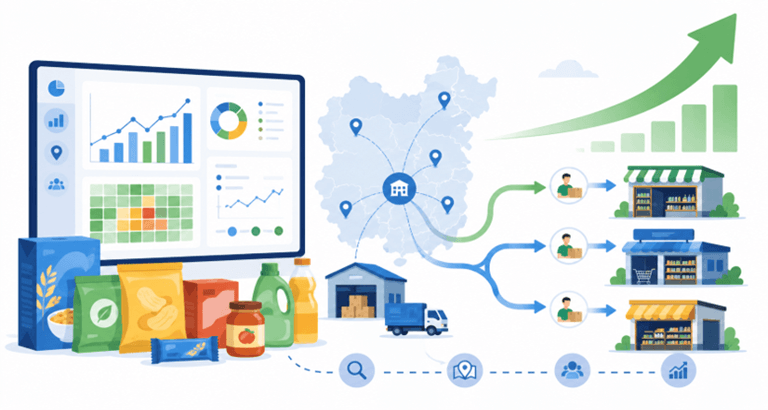
The Challenge of Scaling Without Visibility
Once many FMCG brands attempt to grow beyond their market, they’re stuck at the level they reached. They invest in expansion in new areas, recruit new distributors, and move products into new distribution channels only to see visibility disappear when they leave the warehouse.
Without the information on product movement in the supply chain, brands are flying blind. They are unable to know which are not working as well as they could be, which distributors are failing to do their job, or which markets are primed for a greater marketing thrust.
The result? Wasted budgets, lost opportunities, and slow growth in markets that could have yielded so much more.
What Market Intelligence Actually Means for FMCG
Selling is not the only purpose of market intelligence for FMCG. It’s all about comprehending the big picture: consumer behavior, distributor behavior, presence on retail shelves, competitor activity at retail outlets.
Leading brands now rely on what is known as Route to Market Intelligence, a systematic approach to collecting, analysing, and acting on data at every stage of the distribution journey. This is more than just standard sales reporting. It brings field execution data, channel performance metrics, and market-level data into one view that’s actionable.
This level of intelligence provides a clear view of what’s going on in every territory, and enables a sales leader and brand manager to take action before minor issues turn into big problems.
How Fast-Growing FMCG Brands Put Intelligence Into Practice
Here is how market-leading FMCG brands are using intelligence to outpace their competition:
- Identifying high-potential territories before committing a budget. Instead of spreading resources thin, smart brands use market data to pinpoint which regions show the strongest demand signals, buying power, and retailer readiness before investing in expansion.
- Optimising distributor and sales rep performance. With field intelligence tools, brands can track outlet coverage, call frequency, and order conversion rates across every distributor and sales team. Underperforming routes get attention before they cost the brand’s market share.
- Improving retail execution and in-store visibility. In the FMCG, shelf presence plays a huge part. Market intelligence is used by brands to ensure planogram compliance, product placement, and promotional displays are done right in thousands of outlets.
- Responding to competitor moves in real time. When the team in the field has the right intelligence tools, they can log competitor pricing, new product launches, and promotions as they occur, providing brand managers with the information they need in a timely and strategic fashion.
The Role of Technology in Modern Market Intelligence
Mobile-first field tools, AI-powered analytics platforms, and real-time dashboards that deliver insights directly to the decision makers are helping to drive the move from manual reporting to smart, data-driven decision making.
Field sales representatives can now record their visits to outlets, take shelf information,n and report problems in the moment using mobile applications. That information is transmitted in real-time to the central teams, closing the gap between on-the-ground actions and what leadership can see and do.
This type of visibility is no longer an option for brands with hundreds or thousands of SKUs across multiple territories. It is the low water mark in competition.
Common Pitfalls That Hold FMCG Brands Back
Although it is evident that there are benefits, there are still a number of FMCG brands that are using the old Market Intelligence or delayed Market Intelligence.
- Measuring performance at the SKU or brand level without looking at channel-level efficiency
- Lacking a structured approach to turning field data into an actionable strategy
- Treating market intelligence as a reporting exercise rather than a strategic tool
Building a Smarter Distribution Strategy
The FMCG brands that are winning in today’s market are not only creating better products, but they are also better at marketing and selling them. They are creating more intelligent systems to get these products to the consumer.
A robust Route to Market Intelligence tool enables brands to coordinate their sales, distribution, and channel initiatives in the context of a solid, market-centred view based on facts and data. It makes sure that every decision, whether it’s territory planning or promotional spending, is based on facts, not assumptions.
It is the core for sustainable and scalable growth for growth of FMCG brands.
Final Thoughts
Brands that can be agile and act quickly in the FMCG landscape benefit. That is the advantage that a brand has with market intelligence – it can see what is happening in the entire distribution network, understand the situation in context, and take positive action before the competition does.
Regional brands that need to expand beyond their areas of operation to new regions, or established brands seeking to defend and expand market share, can make progress through improved intelligence.
In this fiercely competitive market, the brands that know the market and are the quickest to adapt are the ones that win.
Popular on OTW Right Now!


About The Author

Gagan Bhangu
Founder of otechworld.com and managing editor. He is a tech geek, web-developer, and blogger. He holds a master's degree in computer applications and making money online since 2015.