
Top 5 AI Gateways for Managing MCP Costs at Scale
Evaluate the leading AI gateways for managing MCP costs in 2026, covering approaches from Code Mode token optimization to virtual key governance, and identify the best fit for production-grade agent workflows.
AI production agents use the Model Context Protocol (MCP) to interact with multiple tools. Without a gatekeeper AI gateway to manage the cost of the Model Context Protocol (MCP), every agent request loads all tool definitions into the large language model (LLM) context window. For instance, five servers, each with 30 tools, would load 150 tool definitions into the context window before the prompt is processed. At the scale Gartner predicts – 40% of enterprise applications will have task-specific AI agents integrated by 2026 – this is a serious infrastructure issue.
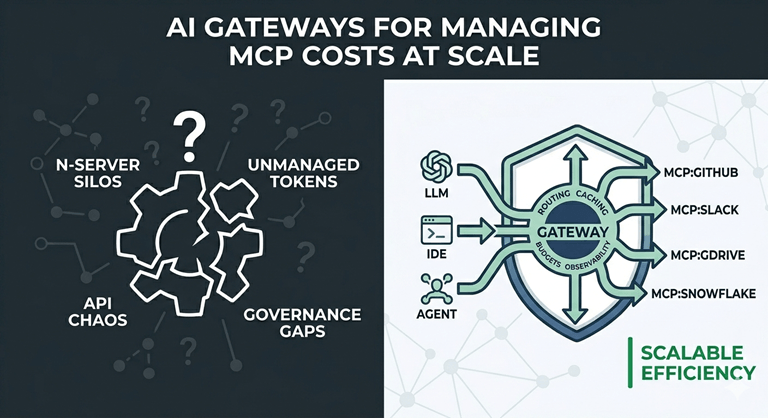
The MCP gateway acts as a centralised authenticating, routing, monitoring, and cost control point between AI agent clients and MCP tool servers. It effectively serves as a control plane for AI agents, helping teams manage how agents access tools, route requests, and control costs. But gateways vary in their approach to MCP costs. Some prioritise token optimisation through code execution techniques, whereas others prioritise access governance and rate limiting to indirectly limit costs. Here are the five main strategies for managing MCP costs at scale in 2026, as represented by these five gateways, rated on token efficiency, governance features, performance,e and production readiness.
Key Criteria for Evaluating AI Gateways for MCP Cost Management
Before selecting a gateway, teams should assess each option against the following cost-focused criteria:
- Token optimization: The greatest cost reduction factor. Gateways with lower tokens MC requests, especially code execution patterns where the LLM writes the orchestration code rather than calling out of the box, can save 50% or more.
- Tool-level access control: Controlling access to tools per consumer reduces the size of the tool definitions provided in the context window and eliminates unauthorized or unintentional tool use.
- Per-tool cost tracking: The cost of using MCP is more than just tokens. Tools calling external services incur additional costs. Per-tool cost analysis offers transparency into agent costs.
- Budget management and rate limiting: Cost controls at the user, team, or project level ensure that unexpected costs are avoided due to misconfigured agents.
- Performance overhead: Time added by the gateway applies to all requests. Longer time-to-first-token and inference times can lead to higher costs.
- Audit and observability: Logging of calls, inputs, outputs, latency,y and ownership is crucial for tracing and monitoring inefficiencies and bottlenecks.
Bifrost is a high-performance, open-source AI gateway developed in Go by Maxim AI. It is an MCP client and server that communicates with external MCP servers via STDIO, HT, P, or SSE, and provides access to all tools through a single endpoint. The key benefit for MCP cost management is that it integrates the es LLM gateway with the MCP gateway and Code Mode, a very effective token optimization tool.
MCP cost management capabilities:
- Code Mode: Instead of appending the tool catalog to the LM context, Code Mode includes just four meta-tools. The LLM identifies needed tools, fetches the definitions of what’s needed, and produces a Python script that runs in a sandboxed Starlark interpreter. At large scale (500 tools, 16 servers), this approach reduces the number of tokens per query 14x (from 1.15M to 83K tokens), representing a 92% reduction with no loss in accuracy. At a smaller scale, it’s common to see a 50% reduction, with fewer LLM calls.
- Virtual key governance: Virtual keys control tool access per consumer, context size, and usage limits. This, along with rate limiting and hierarchical budgets, allows for fine-grained cost control.
- Per-tool cost tracking: Bifrost logs tool-level token consumption and external API costs with user-defined pricing (token and API costs) using configurable pricing, providing a consolidated cost view in logs.
- MCP tool filtering: Tool filtering enforces strict allow-lists, ensuring only authorized tools are included in the model context.
- Audit logs: Detailed logs provide tool execution details, including tool arguments, results, latency, and virtual keys, with support for compliance standards like SOC 2 Type II, GDPR, HIPAA, and ISO 27001.
- Performance: Introduces approximately 11 microseconds of overhead at high throughput, minimizing latency impact.
- Unified architecture: Brings LLM routing capabilities (failover, load balancing, semantic caching) and MCP orchestration together.
Bifrost is open source (Apache 2.0) and on GitHub. Enterprise features include clustering, In-VPC deployment, vault, and guardrails.
Best for: Companies with multiple MCP instances that need advanced token optimizations, cost control, and governance without lock-in.
2. Cloudflare MCP Server Portals
Cloudflare recently expanded its Workers platform with MCP Server Portals, a fully managed gateway that bundles multiple MCP servers into a single endpoint. Servers are registered with Cloudflare to help clients. In April 2026, Cloudflare launched its own Code Mode with a JavaScript-based sandbox on Workers.
MCP cost management capabilities:
- Code Mode (recently introduced): Produces JavaScript run in a sandboxed Worker. Tests demonstrate over 32% fewer tokens, with a constant token cost regardless of the number of APIs used.
- AI Gateway integration: Offers rate limiting and cost control (based on tokens) for LLM calls, including user-based limits.
- Zero Trust access control: Integrates with Cloudflare Access for identity-based authorization across MCP servers.
- Shadow MCP detection: Detects shadow MCP usage using DLP to track down hidden costs.
Limitations: MCP features are spread across different Cloudflare products, rather than a dedicated control plane. Per-tool filtering and cost analysis are not as granular as MCP gateways. Code Mode is a new feature.
3. Kong AI Gateway
In Gateway 3.12, Kong added support for MCP via the AI MCP Proxy plugin. The plugin converts MCP into HTTP, enabling clients to access existing REST APIs with MCP, without requiring MCP server support.
MCP cost management capabilities:
- Rate limiting: Kong plugins manage the number of requests and tokens per consumer.
- ACL-based tool filtering: Offers default and per-tool ACL filtering.
- Prometheus metrics: Offers MCP-specific monitoring and metrics that can be integrated with Grafana and Datadog.
- OAuth 2.1 support: Handles authentication for MCP.
- REST-to-MCP conversion: Allows existing APIs to be leveraged as MCP tools, which may avoid infrastructure costs.
Limitations: Does not support token optimisation features like Code Mode. Lacks tool-level cost visibility and other sophisticated cost management features of MCP-native tools.
4. Docker MCP Gateway
Docker MCP Gateway uses container technology to orchestrate MCP servers. It uses containers to encapsulate MCP servers and provides basic routing, credential management, and policy enforcement.
MCP cost management capabilities:
- Container isolation: Per-container resource limits ensure that MCP servers don’t over-consume the host’s compute resources.
- Centralized credential management: Mitigates the risk of tool sprawl through credential sprawl.
- Basic routing and policies: Basic request router with enforcement capabilities.
Limitations: Lacks token optimization, cost breakdown, and cost budget features. External systems needed for advanced cost governance.
5. MCPX (Lunar.dev)
MCPX is an open-source MCP gateway from Lunar.dev, which focuses on governance, security, and auditability. It is a single point of contact between agents and tools.
MCP cost management capabilities:
- Granular access control: Limits access (to both servers and tools) to prevent squandering of tokens.
- Audit trails: Provide logs that allow for cost analysis and fraud detection.
- Policy enforcement: Supports custom rules to prevent costly or unsafe operations.
- Low latency: Claims 4 ms p99 latency.
Limitations: No token-level optimisation or cost reporting. Has limited capabilities for budget enforcement, focusing primarily on governance.
Comparing MCP Cost Management Across Gateways
Each gateway takes a distinct approach to MCP cost management:
- Token optimization: Bifrost has the most advanced implementation, offering a reduction between 50% and 92%. Cloudflare has a newer version with savings greater than 32%. Kong, Docker, and MCPX do not support token optimization.
- Per-tool cost tracking: Bifrost is the only tool that unifies the costing of token and external API cost tracking at the tool level.
- Budget controls: Bifrost supports nested budgets. Kong offers rate limiting. Cloudflare has token limits in its AI Gateway. Docker and MCPX need external components.
- Unified LLM and MCP gateway: Bifrost combines both functions. Kong offers both, but separately. Cloudflare offers them as separate services, while Docker and MCPX only support MCP.
For many using LLMs, the cost of token usage is the major driver, so Code Mode is an important consideration. Anthropic’s engineering team demonstrated that code execution can reduce context from 150,000 tokens to 2,000 tokens in sophisticated workflows, reducing inference costs.
The LLM Gateway Buyer’s Guide offers a matrix to compare governance, performance, and MCP features.
Start Managing MCP Costs with Bifrost
To get the most cost efficiency, Bifrost offers up to 92% reduction in token costs through Code Mode, plus unified visibility into LLM and MCP costs, cost tracking for each tool, and enterprise security and governance in a single open-source platform. To learn how Bifrost’s MCP gateway can help reduce agent infrastructure costs, schedule a demo with Bifrost.
Popular on OTW Right Now!


About The Author

Gagan Bhangu
Founder of otechworld.com and managing editor. He is a tech geek, web-developer, and blogger. He holds a master's degree in computer applications and making money online since 2015.