
Why Marketing Leaders Should Use Mapping Software Before Expanding Into New Markets
Target opened 133 stores across Canada in under two years, then closed every one and wrote off $2.1 billion. The collapses started with the choice of market to go into, as this was done on a chart that appeared to show that the biggest markets were the most secure. Typically, the market that you’re entering is the one that has real demand, few competitors, and the brand’s strength is in the vicinity that can assist. It’s a comparison of places, and a column of national totals can’t do this.
The pattern is common. Some 70% of expansions fail to deliver their expected return in three years or less, and 65% of those that don’t succeed do so because the research and analysis that led to their decision were poor. An average direct loss of $60 million is incurred when they push into a new region and fail. That money is squandered even before the first store gets opened for business,s in the choice of location.
The Pre-Entry Research Gap
The basis for most decisions of expansion is very thin. The market’s size, the competition is thought to be easy to overcome, the region is believed to be a good fit, and the budget has been approved on that impression. The companies that do not fall into this pit invest in research first. Companies spending at least 10% of their entry budget on analysis are 30% more likely to gain early acceptance from the market than those that do not spend anything at all on analysis.
Don’t feel overwhelmed by the consulting experience; research doesn’t need to be a six-month appointment. A lot of the marketing data a marketing leader should have is geospatial data. All the demand is on the map, and all the competitors are on the map: spatial data is the most important dimension of data, and a spreadsheet is its flattening. The team that reads their options as places, rather than rows, has an advantage in making a decision.
A Map of the Candidate Markets
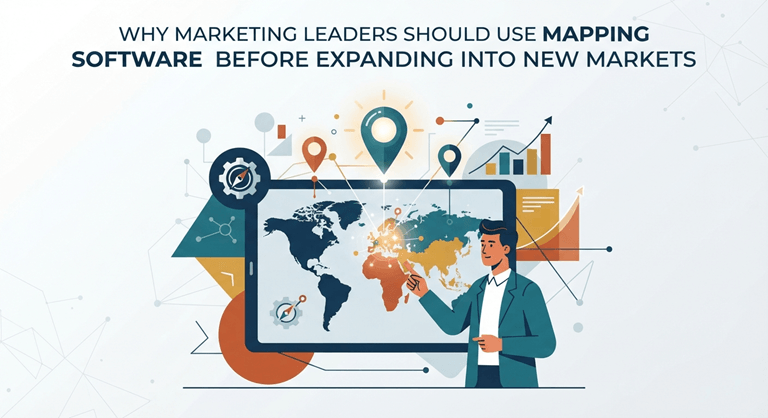
Before committing to a new region, a marketing leader can see the whole field at once. Good mapping software places candidate markets, existing customers, and competitor locations on one view, so the decision is made against the actual geography rather than a ranked list of metro names. Once the map indicates that the market is adjacent to the brand’s strongest market, but has half the number of competitors as the larger market, it will be the third-largest market that will take first place.
The candidates who are viewed together also negate the effect of the anchoring bias that is created by raw size. A list sorts by a single number and hides all other numbers. A map will display size, proximity, competition, and fit in the same frame,e which means a leader considers them together instead of using the “largest market” approach.
Market Size by Geography
The raw population is an overestimation of demand. The real number that counts is the serviceable market and what portion of the total this brand can access with its product and channels. A map narrows the total addressable market down to the households a company can realistically serve, which is often a fraction of the headline figure and concentrated in specific pockets rather than spread evenly across a metro.
Rankings can vary based on the geographic location of the serviceable market. A mid-size area with a high density of reachable customers and proximity to an existing distribution can compensate for a large metro area with a wide distribution of reachable customers and a great distance from the existing distribution. The map indicates the difference between a big market and a winnable market – and most budgets in expansions go to the wrong end.
Competitor Density and Saturation
There’s no room and a strong demand in the market; it’s a trap. Competitor mapping overlaid on demand helps identify those areas that are saturated and those that are not. If there are 20 competitors in one metro area, there’s fierce competition for each share of the market; if there are three competitors, there’s ample room to expand. The picture takes minutes to read, and could take weeks to build up from individual market reports.
This is the analysis that separates a sound entry from a hopeful one. A brand that enters where competition is thin and demand is proven starts with an advantage it did not have to buy. The reason why a brand is the biggest name on the list is that it is spending all its budget on gaining attention that could be achieved for a much lower price somewhere else.
Two final checks belong on the same map. The first is demographic fit, layering the traits of a brand’s best existing customers onto each candidate region to find the places where that profile is common. A market with the right people is more valuable than a larger market with the wrong people, and not being a good fit is one of the most frequent excuses for a high-dollar entry being a failure. The second is cannibalisation – whether the new campaign or new place would take business away from the brand’s existing footprints, which is always a possibility when expansion takes place in proximity to existing business.
The two checks are geographical, and both are hard to see on a spreadsheet. A new region that overlaps an existing region on the map is not pure growth, and a region with a customer profile is more likely to have growth than its size would indicate. The fact doesn’t make the journey to the ranked table.
The Market Is Worth the Move
Expansion is a wager made with a huge budget and a prolonged timeframe – a physical entry can take 12 to 24 months to come up. The marketing leader’s question to ask is which market (regardless of raw size) is the evidence for? If the answer is taken from a ranked list of the populations, the chances are 70% that they will miss their answer. Where it is from a map which has demand, competition, fit, and proximity all in one view, the odds shift. Who would survive the second look in the market, and what would the price have been to find out after the launch rather than before it?
Popular on OTW Right Now!



About The Author

Gagan Bhangu
Founder of otechworld.com and managing editor. He is a tech geek, web-developer, and blogger. He holds a master's degree in computer applications and making money online since 2015.