
What is a trolling motor battery, and what size do you actually need?
TL;DR
Short version: the battery is usually the expensive half of the system, and the number that decides everything is amp draw at full throttle, which almost nobody looks up before they buy. |
A trolling motor battery is a deep-cycle battery, usually lead-acid or lithium iron phosphate, designed to supply a steady current for hours and then be recharged. The distinction that matters is not marine versus automotive. It is deep-cycle versus starting. A starting battery delivers a huge burst for a second or two and expects to be topped up immediately; asking it to run a motor all afternoon shortens its life to a season or less.
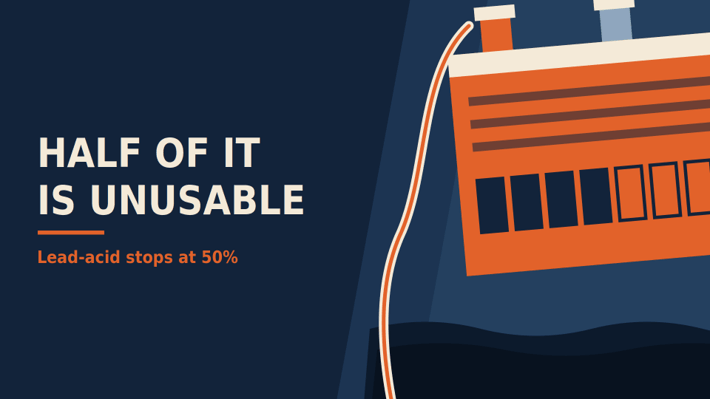
A deep-cycle battery does the opposite job to a starting battery
Inside a starting battery, the lead plates are thin and numerous, which maximizes surface area and lets the battery dump several hundred amps into a starter motor instantly. Drain it deeply and those thin plates buckle.
A deep-cycle battery uses thicker plates and less surface area. It cannot produce the same instant burst, and it does not need to. It is built to give up most of its stored energy gradually, then take it all back, over and over.
Lithium iron phosphate, usually written LiFePO4, changes the arithmetic again. There are no plates to buckle, the usable capacity is close to the rated capacity rather than half of it, and the weight drops sharply. That last point turns out to matter more than most buyers expect.
What a trolling motor battery costs, and what the money buys
Prices have moved a long way in three years. A trolling motor battery in the common 12V 100Ah Group 31 size now sits around $355 with Bluetooth monitoring built in, where the same thing was well over $600 not long ago. Smaller 50Ah packs start near $240, and the 24V and 36V units that high-thrust motors need run from roughly $340 to $635 depending on capacity.
| Configuration | Typical capacity | Suits motors around | Indicative price |
| 12V | 50Ah | 30 to 45 lb thrust | $240 |
| 12V | 100Ah | 45 to 70 lb thrust | $335 to $375 |
| 24V | 50Ah | 70 to 100 lb thrust | $350 |
| 24V | 100Ah | 80 to 112 lb thrust | $485 to $635 |
| 36V | 45 to 50Ah | 100 to 112 lb thrust | $340 to $456 |
Prices are indicative and move with promotions. What is worth checking rather than assuming is the warranty term and the cycle rating, because those two numbers are what convert a purchase price into a cost per season.
Size it on amps, not on thrust
Thrust is a marketing number. Amp draw is the engineering one, and it is printed on the motor or in its manual. Divide capacity by draw and you have runtime.
| Motor amp draw at full throttle | 50Ah battery | 100Ah battery |
| 30 A | 1.7 hours | 3.3 hours |
| 42 A | 1.2 hours | 2.4 hours |
| 50 A | 1.0 hour | 2.0 hours |
| 60 A | 0.8 hours | 1.7 hours |
Two things about that table. First, nobody runs a trolling motor flat out all day, so real runtime is typically two to four times these figures. Second, the numbers assume you can use the whole battery. With lead-acid you cannot: draining below about half destroys it, so a 100Ah lead-acid battery is really a 50Ah battery that weighs twice as much.
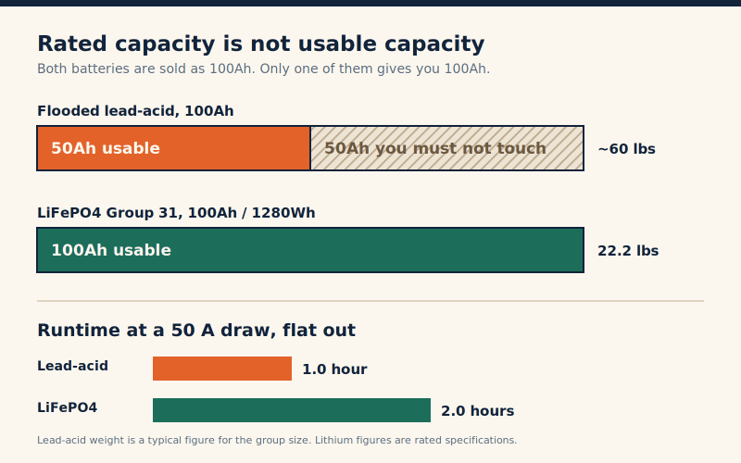
The weight you get back
A Group 31 LiFePO4 pack at 22.2 lbs replaces a flooded lead-acid battery of the same group size weighing roughly three times that. On a 14 foot aluminium boat carrying three batteries for a 36V motor, that difference runs into well over a hundred pounds.
This is not just about lifting. Monohull boats under 20 feet built after 31 October 1972 carry a manufacturer’s capacity plate stating maximum persons, maximum weight, and combined weight of persons and gear, as the USCG Auxiliary explains in its guidance on capacity plates. Every pound of battery comes out of that allowance. Kayaks, canoes, sailboats and inflatables are exempt from the plate requirement, but the physics does not exempt them.
24V and 36V motors need series wiring, not a bigger battery
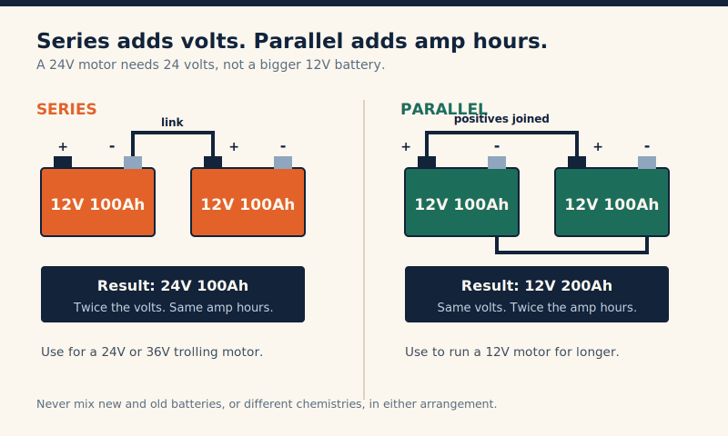
A common and expensive misunderstanding: a 24V motor does not want a 200Ah 12V battery. It wants 24 volts. You get there either with two 12V batteries wired in series, or with a single purpose-built 24V pack.
Series wiring adds voltage and keeps capacity the same. Parallel wiring adds capacity and keeps voltage the same. Mixing the two up is how people let the smoke out of a new motor on its first outing.
Lithium installations on boats have their own conventions covering things like battery management, disconnects and charging sources. The American Boat & Yacht Council publishes the relevant technical guidance through its standards library, and it is worth a look before wiring anything permanent into a hull rather than strapping it to the deck.
What actually kills them
Most batteries that die early are killed rather than worn out. The usual causes:
- Charging a lithium pack below freezing. Many packs, including LiFePO4 units rated with a cutoff below 32°F, will simply refuse to accept charge in the cold, which people mistake for a fault.
- Leaving a lead-acid battery partly discharged over winter. Sulphation does the rest.
- Using an automotive charger with the wrong profile. Lithium and lead-acid want different voltages.
- Water getting into terminals on an unrated pack. An IP65 rating covers dust and low-pressure water jets, which is enough for spray and rain, and not enough for submersion.
The short answer for a first-time buyer
If you are running a 12V motor of 55 lb thrust or less on a small boat, a single 100Ah LiFePO4 pack is close to a default. It fits a Group 31 tray, weighs about what a full cooler weighs, and at 4,000 cycles it will outlast the motor.
If your motor is 24V or 36V, work out the amp draw first, then decide whether you want two or three separate batteries or one integrated pack. And if the boat also has electronics, lights and a fish finder on the same system, treat the whole thing as one power budget rather than a set of separate purchases. It is the same logic that applies to smart home electrical upgrades: the individual component is rarely the thing that decides whether the money was well spent.
Popular on OTW Right Now!




About The Author

Gagan Bhangu
Founder of otechworld.com and managing editor. He is a tech geek, web-developer, and blogger. He holds a master's degree in computer applications and making money online since 2015.