
Vibe Coding vs Part-Time Developer
Introduction to Modern Development Trends
The world of software development is shifting at a pace that feels almost impossible to keep up with. Just a few years ago, businesses relied heavily on full-time, in-office developers working fixed hours. However, today the whole landscape has been transformed due to remote work, access to talent globally, and changed developer expectations. The emergence of new forms of working, such as vibe coding and part-time development, demonstrates that companies are not confined to the usual hiring patterns anymore. Rather, they are considering the elastic methods that are in line with productivity, creativity, and cost-effectiveness.
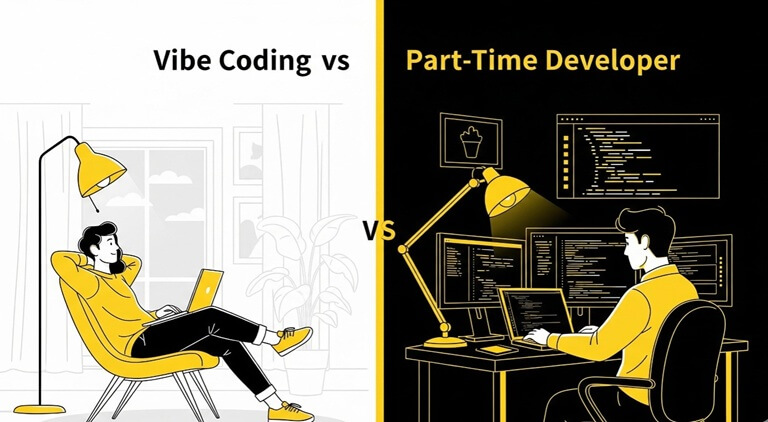
Whether starting a company or growing an online business, you are likely to have wondered: do you take a loose, innovative approach, such as vibe coding, or go with the stability of a part-time developer? It is not as simple as choosing one of the other. It is based on what you want to do in your project, when you want to do it, and the kind of work you want done. We shall divide it into bits to help you make a smart, informed decision.
Rise of Flexible Work Models
The rise of flexible work models has been a trend that has shot up, particularly following the transition to remote work all around the world. The developers are not required to be at the offices or to be on strict schedules, and businesses have realized that they are capable of accessing talent globally without geographical restrictions. This has led to new forms of working, such as freelance, contract-based, and more recently, vibe coding.
Think of it like moving from a traditional classroom to online learning. You still achieve the same goal, but the path is much more adaptable. Developers can now choose when they work best, whether that’s early in the morning or late at night. This has led to higher productivity for many individuals, especially those who thrive in non-traditional environments. Businesses that embrace this flexibility often find themselves ahead of the curve, especially when hiring skilled node js developers who value autonomy and creative freedom.
What Developers Are Looking for Today
The developers of the modern era do not merely pursue a paycheck but freedom, purpose, and flexibility. They desire to work on meaningful projects, control their schedules, and prevent burnout. Such a change of mentality has compelled organizations to re-examine their approach to employment and talent management.
Current developers want a working environment where they can work and concentrate without being interrupted all the time. They also place importance on employer trust; that is, they do not wish to be micromanaged. This is where vibe coding will come in handy; it is exactly what is expected. Meanwhile, there are also developers who still choose to work in a more structured form of work, such as a part-time job, due to the stability and predictability of income. These preferences can be used to understand how businesses can attract and keep the best node js developers in a very competitive environment.
What is Vibe Coding?
Definition and Concept
Vibe coding is the new development tool, where energy, creativity, and mental concentration drive the work, instead of a fixed time schedule. Rather than having to work a certain number of hours every day, the developers code when they are most productive. It is like how musicians produce their finest productions not to a definite schedule but when they feel inspired.
Think about pushing yourself to figure out a complicated coding issue when your brain is tired and it hardly works. So now consider addressing the same problem when you are well energized and concentrated. The difference is huge. This is what vibe coding is all about. It values quality over quantity and urges developers to work in harmony with their natural rhythms.
Key Characteristics of Vibe Coding
The flexibility, autonomy, and deep focus characterize vibe coding. The developers usually do work in bursts and have high quality output within less time. This will remove the needless meetings and distractions and will enable one to be in full concentration.
But it does also entail high self-discipline. The developers do not have a specific schedule, and this situation does not give them the chance to waste time. Communication may also be tricky when team members are operating at various times. Nonetheless, vibe coding can be exceptionally strong in the context of the appropriate application, particularly to complex and creative projects.
What is a Part-Time Developer?
Traditional Role Explained
A part-time developer will work a set number of hours in a week, which is usually 10 to 30 hours. Businesses that require periodic support, but do not need a full-time employee, also utilize this model extensively. It is affordable, yet productive enough, and can be used by small businesses and startups.
Part-time development is structured differently compared to vibe coding. The developers will be supposed to work certain hours and deliver a given task within this period of time. This predictability enhances the ability of businesses to plan and manage projects easily.
Common Work Structure
Part-time developers tend to have a fixed timetable; they may be working four hours a day or a couple of full days weekly. This organization makes sure that the work is done regularly, although the pace of work may be slower than full-time work.
In the case of businesses, the model offers clarity and control. You are aware of when your developer is on-hand, what he is doing, and when you should see results. It’s like having a reliable train that runs on time. It may not be the fastest option, but it’s dependable and steady.
Key Differences Between Vibe Coding and Part-Time Development
Flexibility vs Structure
The largest variation between the two models is flexibility vs structure. Vibe coding entails that developers have the freedom to work at a time when they are best suited to work, whereas part-time development entails following a fixed schedule.
Such a difference can have a great influence on the way in which projects are managed. Flexible models are more innovative and creative, whereas structured models are consistent and reliable. It is like making a choice between a freestyle dance and a choreographed performance; with each being effective, but with different purposes.
Productivity and Output
Vibe coding productivity usually occurs in bursts. The developers can deliver outstanding output within a limited duration but can also experience some downtimes. Part-time developers, on the other hand, offer a consistent, predictable output over time.
Vibe coding may be more suitable if your project needs to be fast-innovating. But when you require steady development and frequent updates, a part-time developer is more appropriate. The trick is to know what is important in your project and what approach to take.
Advantages of Vibe Coding
Creativity and Flow State
The possibility of reaching a flow state is one of the greatest benefits of vibe coding. This is the time when the developers are completely engaged with their work and hence more productive in solving of problems. It is as though you are in the zone when playing; everything just falls into place.
Such kind of attention can lead to new solutions that would not have come into existence in a formal setting. This innovation can be a game-changer to companies dealing with one-of-a-kind or experimental projects.
Better Work-Life Balance
Vibe coding enables developers to work with their own lives, which leads to less stress and burnout. They are able to have breaks when necessary and go back to work with a new attitude.
Such a balance increases job satisfaction, which, in its turn, enhances the quality of work. Satisfied developers are more efficient, more innovative, and more determined to produce great results.
Advantages of Hiring Part-Time Developers
Predictable Scheduling
Part-time developers are also a way of providing consistency, which is essential to many businesses. You are well aware of when they will be working and what they will be doing. This predictability makes it easier to manage projects and meet deadlines.
It particularly comes in handy when doing continuous work such as web maintenance, bug fixes, and upgrades. You do not have to fear unforeseen productivity lapses or time deadlines.
Cost-Effectiveness for Businesses
Part-time developers are usually less expensive to hire compared to full-time workers. You pay per hour, and it is an affordable option to businesses with a tight budget.
The model is especially useful with startups that have to be mindful of costs and, at the same time, retain a high-quality development team.
Challenges in Vibe Coding
Lack of Consistency
Inconsistency is one of the largest vibe coding drawbacks. As developers operate depending on their energy levels, development may be erratic.
This may be troublesome to projects that have a time constraint or have very strict requirements. The businesses might not be able to monitor progress and plan.
Communication Gaps
It may be difficult to communicate with each other when the developers are operating on various schedules. This may cause delays, miscommunication, and coordination problems.
To address this challenge, it is necessary to have good communication tools and clear expectations.
Challenges in Part-Time Development
Limited Availability
Part-time developers are not necessarily there when required, and this can be a challenge in cases of urgent work or unforeseen problems.
This drawback may delay the process of a project and introduce bottlenecks.
Slower Project Progress
Projects can be completed in less time since there are fewer working hours. This may affect schedules and postpone the launch of products.
Companies should strategize on how to avoid missing deadlines.
Which Model is Better for Startups?
Startups should be able to make swift decisions and change easily. Part-time developers are more stable and consistent, whereas vibe coding can offer the flexibility and creativity required to be innovative. The most appropriate decision would be based on the objectives and priorities of your startup.
When to Choose Vibe Coding
Vibe coding is ideal for creative projects, experimentation, and rapid problem-solving. It is best applied when the strict deadlines are not so significant as flexibility and innovation.
When to Hire Part-Time Developers
Structured jobs, maintenance, and projects with a steady flow should be left to part-time developers.
Role of Node.js in Modern Development
Why Businesses Prefer Node.js
Node.js is popular in creating rapid and scalable programs. It is a popular web development technology because of its efficiency and performance.
Hiring Skilled Node JS Developers
Finding the right talent is crucial for success. Platforms like lemon.io help businesses connect with experienced Node.js developers who can deliver high-quality results. Whether you choose vibe coding or part-time development, having skilled Node.js developers ensures your project runs smoothly and efficiently.
Final Verdict: Which One Should You Pick?
The advantages and disadvantages of the two models exist. Vibe coding is more flexible and creative, whereas part-time development is more stable and predictable. The correct option will be determined by your particular needs.
Conclusion
The decision between vibe coding and a part-time developer is not about identifying which is better in all cases; it is about identifying which will best suit your project. All these methods have their own benefits, and by being aware of them, you can make a wiser choice. When you align your business objectives with your hiring strategy, you are likely to get more out of it and maximize productivity.
Popular on OTW Right Now!




About The Author

Gagan Bhangu
Founder of otechworld.com and managing editor. He is a tech geek, web-developer, and blogger. He holds a master's degree in computer applications and making money online since 2015.