
The Real Cost of Building a Mobile App in 2026
The Real Cost of Building a Mobile App in 2026: What Founders Actually Pay For
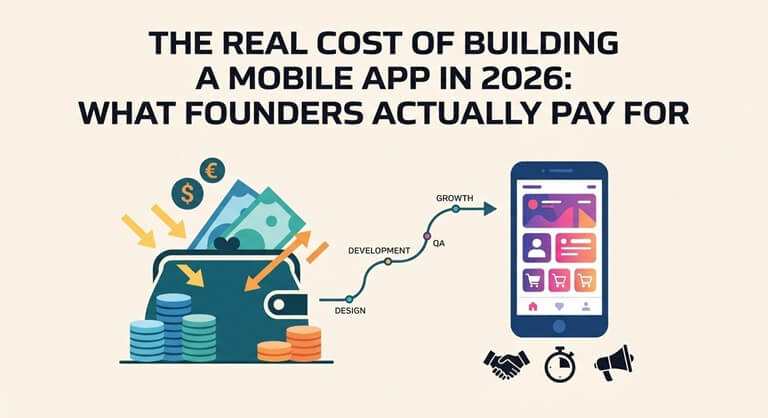
In 2026 the cost of developing a mobile app relies much less on the idea itself and rather on five particular decisions that a founder takes before the first line of code is written. Two founders who have almost identical app concepts can find themselves with budgets differing by $50,000, and in most cases this difference can be traced back to the choice of platform, the level of feature complexity, the extent of the design, the type of team employed, and what is done after the app is launched. When these five factors are understood the general question of “how much does an app cost” can be replaced by a specific figure that is useful for planning.
Platform Choice Sets the Floor
It is cheaper to build for one platform than for two, a fact that seems obvious until a founder has to decide which platform to begin with and realizes what this actually means for the budget.
A framework that is used across platforms such as Flutter develops versions for both iOS and Android from a single codebase, thereby reducing both the time taken to develop the application and the long-term cost of maintenance when compared to creating two separate native apps. However, there is a drawback to this level of efficiency in that deep access to platform-specific features, close integration with hardware, or the achievement of a truly native user experience are still better off with a dedicated native build than with one that is shared.
Founders set on a fully native iOS experience typically work with a dedicated iOS app development services team, since native tooling, Swift-specific optimization, and Apple’s review process all reward real specialization.
Feature Complexity Is the Biggest Multiplier
An app that includes just a login screen and a content feed costs only a small part of what an app involving real-time chat, payment processing, or offline data sync would cost. Authentication alone can amount to a few thousand dollars, while a real-time messaging feature with read receipts and push notifications easily reaches several times that amount. When it comes to payment integration, there is additional compliance overhead on top of the basic engineering work, because PCI compliance and secure transaction handling are not optional extras; they are fundamental requirements as soon as money passes through the app.
The best way to control costs is to separate the features the app needs to launch from those it will need later, and develop only the initial list.
Design Complexity Quietly Adds Up
The use of pre-built UI components and standard layouts helps to reduce design costs when developing the early MVP. Adding custom animations, brand-specific micro-interactions, and a completely tailor-made user flow can add a significant amount to the base build, and this extra cost appears regardless of whether the founder had planned for it initially. Design is not just a cosmetic expense. If an app feels confusing or is generally unimpressive, it will lose users even if the backend is of a high standard, so the real issue is how much refinement the particular product actually requires at launch as opposed to at a later stage.
Team Model Swings the Number More Than Anything Else
Hourly rates differ very greatly depending on where the team is based and its structure. Teams that are based in the United States and are employed directly by a company charge the highest rates. Those from a well-established agency—whether or not it is based in the United States—have rates that are somewhere in the middle. Freelance and offshore teams provide the lowest hourly cost, the quality in these cases depending more on the team’s track record than merely on its geographical location.
A combination of approaches, with the strategy and QA carried out locally while the development work being done overseas, has now become one of the more common methods for founders to keep costs down without losing control over those parts of the project where errors would be expensive to correct later.
Post-Launch Cost Is the One Founders Forget
The release of the app is not the end of the process; after launching the app, bug fixes, updates to the operating system, and further feature developments continue indefinitely, and omitting this aspect from the original budget is one of the most frequent planning errors that founders commit. A reasonable rule of thumb is to set aside a monthly maintenance amount equal to a significant percentage of the original build cost, since an app that is left unattended for a year usually ends up with faults that are more expensive to correct than the cost of regular maintenance would have been.
The Actual Answer
A dependable method leads the founder to a truthful figure by selecting a platform strategy that corresponds with the product’s actual requirements, defining the features around those that are really needed at launch, keeping the design investment at an appropriate level, picking a team structure that fits the budget without sacrificing the most important aspects, and planning for maintenance right from the start because if you leave it out at this stage the unpleasant surprise will be postponed until later. Founders who carefully go through those five decisions end up with a number that is based on the genuine needs of their own project and one that they can actually justify to an investor or to a co-founder.
Popular on OTW Right Now!



About The Author

Gagan Bhangu
Founder of otechworld.com and managing editor. He is a tech geek, web-developer, and blogger. He holds a master's degree in computer applications and making money online since 2015.