
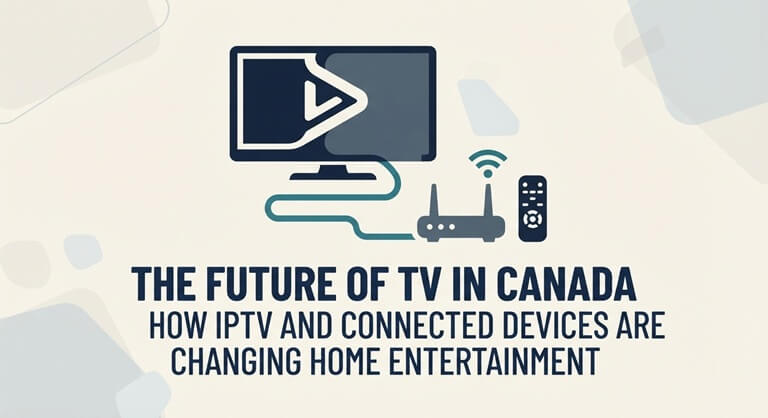
The Future of TV in Canada How IPTV and Connected Devices Are Changing Home Entertainment
The Canadian living room is becoming less dependent on traditional television infrastructure and more connected to the internet. Smart TVs, streaming devices, high-speed broadband, and cloud-based entertainment platforms have changed what viewers expect from their screens.
For anyone researching IPTV Canada, the technology represents an important part of this shift. IPTV delivers television through internet networks, allowing viewers to access live channels and digital content through compatible connected devices. But the bigger story is not simply IPTV itself. It is the transformation of television from a fixed broadcast product into a software-driven entertainment experience.
Consumers looking for the best IPTV experience are increasingly comparing more than channel numbers. They want reliable streaming, intuitive applications, broad device compatibility, and a service that works consistently on the hardware already sitting in their homes.
For Canadians exploring the technology, IPTV platforms such as IPTVApp.ca illustrate how internet-based television is becoming part of the wider connected-home ecosystem.
Television Is Becoming a Technology Platform
For decades, television was relatively simple from a technical perspective.
A signal arrived through an antenna, cable connection, or satellite dish. The viewer selected a channel and watched whatever was being broadcast.
The internet changed that relationship.
Today’s television can function much more like a computer. It can run applications, connect to cloud services, receive software updates, search enormous content libraries, and communicate with other devices around the home.
That means the modern TV experience depends on several technologies working together:
- Broadband internet
- Wi-Fi or Ethernet connectivity
- Smart TV operating systems
- Streaming applications
- Cloud infrastructure
- Content delivery networks
- Video compression
- Authentication systems
IPTV fits naturally into this environment because its fundamental delivery mechanism is already based on internet connectivity.
What Makes IPTV Different From Traditional Television?
At a technical level, IPTV means television delivered using Internet Protocol networks.
The concept is not entirely new. Major telecommunications companies have used IP-based television infrastructure for years.
What has changed is consumer access.
The average household now has devices capable of receiving internet-delivered video without requiring a traditional cable television installation.
A Smart TV can connect directly to a home network. A streaming stick can add internet functionality to an older television. An Android TV device can provide an application-based interface. A smartphone can become another screen entirely.
The result is a much more flexible television environment.
Instead of the television service determining which hardware the viewer must use, the relationship increasingly works in the opposite direction: consumers choose the devices they already own and expect services to adapt to them.
Why Canada Is an Interesting IPTV Market
Canada has several characteristics that make the evolution of internet television particularly interesting.
The country is geographically enormous, while its population is concentrated in a relatively small number of metropolitan areas. Canadian households also have diverse language and entertainment preferences.
A household in Montréal may prioritize French-language programming. A family in Toronto might consume Canadian, American, and international content. A viewer in Vancouver could have completely different preferences.
Internet-based television can potentially accommodate these differences more flexibly than a rigid channel package.
Instead of treating every household identically, digital platforms can organize content around different audiences, languages, and viewing habits.
That flexibility is one of the reasons IPTV has become part of the broader Canadian conversation around cord-cutting and connected entertainment.
The Rise of the Connected TV
One of the biggest changes in television technology is that the screen itself has become connected.
Modern Smart TVs can communicate directly with internet services without requiring a traditional set-top box.
This has changed the role of external streaming hardware as well.
Devices such as Android TV boxes, Apple TV hardware, and other streaming platforms can provide additional applications and functionality.
For consumers, the distinction between television hardware and software is becoming increasingly blurred.
The television is the display.
The operating system is the interface.
The internet is the delivery network.
And applications determine much of what the viewer can actually do.
Why Streaming Stability Matters More Than Channel Numbers
IPTV marketing often focuses heavily on channel counts.
From a technology perspective, however, the number of channels tells only part of the story.
Imagine two services.
The first has a huge channel catalogue but regularly buffers during peak evening hours.
The second has a smaller selection but loads channels quickly and maintains consistent playback.
For many viewers, the second experience will be more useful.
This is because live streaming depends on infrastructure.
A service has to handle concurrent viewers, video encoding, server capacity, network traffic, and content delivery. During a major sporting event, demand can increase dramatically.
That makes peak-hour performance one of the most important characteristics for consumers to evaluate.
What Consumers Should Look For in an IPTV Service
Rather than choosing a service based purely on advertising, Canadian viewers can evaluate several technical and practical factors.
1. Device Compatibility
The first question is simple:
Will it work on your devices?
A household may have Samsung or LG Smart TVs, Android devices, Apple products, Fire TV hardware, or a dedicated streaming box.
Compatibility should be confirmed before subscribing.
2. Application Quality
A good service needs more than a working video stream.
The application should make it easy to navigate channels, search for content, access programme information, and manage settings.
A confusing interface can make even technically excellent infrastructure frustrating to use.
3. Streaming Performance
Consumers should pay attention to buffering, loading times, and playback stability.
Testing the service during the evening can be particularly useful because network and server demand may be higher.
4. Customer Support
Technical problems are inevitable with connected services.
What matters is whether the provider gives customers a practical way to resolve them.
Clear setup instructions and responsive support can make a significant difference.
5. Subscription Transparency
Consumers should know what they are paying for.
Pricing, renewal conditions, cancellation procedures, and refund terms should be clearly explained before payment.
The Role of an IPTV Box
The term IPTV box can describe a range of connected devices used to run streaming applications or receive internet-delivered television.
The hardware itself is not the television service.
That distinction is important.
An IPTV box can provide the operating environment through which an application runs, but the actual content comes from the service being accessed.
This is similar to using a smartphone.
The phone provides the hardware and operating system, while individual applications provide different services.
The same principle applies to connected television.
Consumers should therefore evaluate both the hardware and the service independently.
A powerful device cannot compensate for poor streaming infrastructure, while a reliable service may still provide a poor experience if the hardware is outdated.
Internet Connection vs. IPTV Infrastructure
Another common misconception is that IPTV performance depends entirely on the viewer’s internet speed.
Connection speed certainly matters, but it is only one part of the equation.
Consider the journey of a live video stream:
Content source » Encoding » Provider infrastructure » Network » Home router » Wi-Fi/Ethernet » Device » Display
Every stage can influence the final result.
A household might have an excellent broadband connection but still experience problems if the provider’s infrastructure is overloaded.
Conversely, a well-designed service may perform smoothly on a more modest connection if the stream is efficiently encoded and delivered.
This is why real-world testing is more informative than simply looking at a broadband speed-test result.
Wi-Fi Can Be the Hidden Problem
Sometimes the IPTV provider is not the problem at all.
A television located far from a home’s router may have a weak wireless connection.
Other devices can also compete for bandwidth.
Smartphones, laptops, game consoles, security cameras, and other connected devices can all contribute to network congestion.
For viewers experiencing inconsistent playback, several simple changes can help diagnose the issue:
- Move the router closer to the television
- Use the 5 GHz Wi-Fi band where appropriate
- Reduce unnecessary network traffic
- Restart networking equipment
- Use Ethernet when practical
- Test another device on the same network
These basic checks can prevent users from incorrectly blaming the streaming service for a local network problem.
IPTV and the Multi-Screen Household
Television is no longer restricted to the living room.
A Canadian household might have several televisions, smartphones, tablets, and computers connected to the same network.
That creates a new expectation for entertainment platforms: flexibility across screens.
A modern IPTV experience should therefore be evaluated in terms of the entire household rather than a single television.
Can family members use the supported devices they already own?
Does the application provide a consistent interface?
Are multiple simultaneous connections supported under the subscription terms?
These questions are increasingly relevant as households become more digitally connected.
The Importance of Content Rights
There is another issue that technology alone cannot answer.
IPTV is simply a method of delivering television through internet networks. The legality of a particular service depends on the content it distributes and whether it has the necessary rights to distribute that content.
Consumers should therefore investigate providers before subscribing.
A transparent provider should clearly explain its service, terms, and relevant content arrangements.
This distinction is important because the technology itself should not be confused with every commercial service that uses it.
The Next Stage of Television
The future of television will probably not be defined by one technology replacing another overnight.
Instead, different technologies will continue to converge.
Traditional broadcasters are developing digital platforms.
Streaming companies are adding live programming.
Smart TV manufacturers are building more sophisticated operating systems.
Internet providers are delivering faster connections.
And IPTV platforms are becoming another part of the connected entertainment ecosystem.
The result is a television environment where the boundaries between broadcasting, streaming, and internet services are becoming increasingly difficult to define.
What Could Improve IPTV in the Coming Years?
Several technological developments could further improve the experience.
Better Video Compression
More efficient codecs can reduce the bandwidth required to deliver high-quality video.
Improved Adaptive Streaming
Streaming systems can dynamically adjust video quality according to available bandwidth and network conditions.
Smarter Recommendations
Machine-learning systems can help viewers discover relevant programmes without manually searching through enormous channel lists.
Better Search
Voice and natural-language search could make it easier to find channels, programmes, actors, or genres.
Stronger Device Integration
Future platforms will likely make it easier to move between televisions, phones, tablets, and other connected screens.
These developments are part of a broader trend: television is becoming software-defined.
How Canadians Can Evaluate a Service
The smartest approach is to treat an IPTV subscription like any other technology service.
Do not judge it purely by the promotional headline.
Instead, ask practical questions:
Does it work on my device?
How stable is it during peak hours?
Is the application easy to use?
Are the subscription terms clear?
Does customer support actually respond?
Is the provider transparent about the content it distributes?
Does the service match what my household actually watches?
This approach produces a much more useful evaluation than simply searching for the largest channel number.
IPTV Is Part of the Bigger Connected-Home Revolution
The important story behind IPTV is not simply the replacement of cable.
It is the transformation of the television itself.
The modern TV is becoming a connected computing platform that combines hardware, software, internet infrastructure, and digital content.
For Canadian consumers, this creates more flexibility than previous generations had.
A television can now become whatever the household needs it to be: a traditional broadcast screen, a streaming platform, a gaming display, an IPTV interface, or a gateway to an entire digital entertainment ecosystem.
The technology will continue to evolve, but one principle is unlikely to change:
Viewers want technology that disappears into the experience.
They do not want to think about servers, protocols, codecs, or bandwidth while watching their favourite programme.
They simply want the screen to work.
That is ultimately where the future of IPTV Canada is heading — not just toward more content, but toward a simpler, more connected, and more intelligent television experience.
Popular on OTW Right Now!



About The Author

Gagan Bhangu
Founder of otechworld.com and managing editor. He is a tech geek, web-developer, and blogger. He holds a master's degree in computer applications and making money online since 2015.