
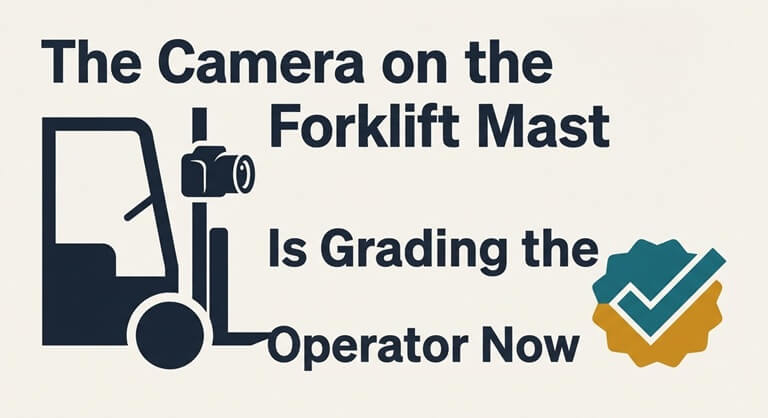
The Camera on the Forklift Mast Is Grading the Operator Now
A forklift operator moves a pallet into position, adjusts the mast and lowers the load safely. Nothing goes wrong, no one gets hurt and the work gets on. However, if that same operation is being recorded by a camera or safety system and it’s a potentially unsafe move, then that moment could well be captured as a video clip or an alert to a supervisor for them to review, depending on the system in use.
AI-powered monitoring is helping some warehouses to identify risks that may have previously gone completely unnoticed. For the employer, the real value isn’t in the amount of video you get; it’s in the quality of the observations and the ability to use those to improve forklift training and prevent incidents.
The Near-Miss That Used to Go Unnoticed
Warehouse supervisors can’t be watching every forklift movement throughout the shift. Even if an employee reports a near miss, it’s often difficult to piece together what actually happened afterward. Safety people have always been of the view that you need to identify hazards before they result in injury. Herbert Heinrich’s famous accident triangle was all about the link between the serious injury, the minor injury and the incident with no injury.
Those exact ratios shouldn’t be treated as universal predictions. A discussion in Professional Safety examines the limitations of traditional accident models and the importance of understanding how incidents develop.
Modern monitoring systems offer another avenue for gathering information on potential safety hazards. Video and sensor data can be used by supervisors to look into situations which might otherwise go unnoticed.
What AI Monitoring Can Actually Detect
Not all forklift cameras are AI safety systems and not every system is looking for the same things. Some use video analytics to detect pedestrians or potential collisions. Others use a combination of cameras with sensors, telematics or location data to monitor how the equipment is being used.
Depending on the system, the employer may get an alert on things such as proximity hazards, impacts, odd movements etc.
A camera on the mast won’t automatically give you the tilt angles, the travel speed or the horn use. That all depends on the hardware, the software, and what data is actually available from the equipment.
AI generated alerts still need a human to look at them. An alert could be pointing to a genuine hazard; it could be a benign action, or it could simply be an error in the way the scene was interpreted. The AI works best when the supervisors know what it can actually see and what it can’t.
Turn Recorded Events Into Better Coaching
A short video clip can be a far more focused way of doing a safety talk. Rather than just telling an operator that someone has reported an unsafe move, the supervisor can actually watch the clip and talk about what occurred.
Was the operator’s view blocked? Did a pedestrian suddenly step into the path? Was the load being handled in the correct manner for that particular truck? Those are the sorts of questions that will tell you whether it’s a personal training issue or a wider workplace issue.
Recorded events can also be used as part of group training if the right footage is selected and shared. A real life example from the facility’s own work can be far more relevant than a standard training video.
A flagged event shouldn’t be automatically assumed to be operator error. The supervisor has to look at what’s actually happened before they can decide whether coaching is required, whether equipment needs to be changed or whether more training is needed.
Monitoring Supports Forklift Certification and Evaluation
Technology can help employers identify training needs, but it doesn’t replace the established requirements for forklift operators. A comprehensive forklift certification training program can provide the formal instruction needed to build essential operating knowledge. Employers must also ensure that operators receive appropriate practical training and performance evaluations.
Under OSHA’s powered industrial truck standard, operator performance must be evaluated at least once every three years.
Refresher training is required in certain circumstances (e.g. where an operator is observed to be operating unsafely, has been involved in an accident or near miss, or has received an evaluation which indicates unsafe practices).
A verified video recording can assist an employer in identifying one of these scenarios. An automated alert in itself doesn’t prove a breach has occurred or that refresher training is required.
The employer still have to look at the event and decide what action to take.
Operators Need to Understand the Cameras
Monitoring technology also raises issues around privacy, fairness and employee trust. If you’re going to install cameras, then you need to be absolutely clear about what is being recorded, how the alerts are checked, who can view the footage, and for how long the information is retained.
A discussion in AI and Ethics addresses ethical considerations surrounding AI-enabled workplace monitoring. Clear policies can help employees understand whether the system is intended primarily for safety coaching, operational oversight, or other purposes.
Employers should also be mindful of their obligations under privacy and employment law and have in place some mechanism for reviewing the alerts that employees dispute.
A monitoring program works at its best when staff know how their information is going to be used and managers stick to the policy.
The Training Record Still Matters
A video clip can show what happened but it doesn’t in any way replace the forklift training certification records that employers are required to keep.
OSHA requires documentation that identifies the operator, the date of training, the date of evaluation and the people who conducted the training or evaluation. Employers may also keep supporting records of refresher training, coaching and corrective actions.
AI monitoring can be used to flag up situations that may require further investigation. The training programmes provide the operators with the necessary knowledge and skills and the documented assessments enable the employer to evaluate their performance.
The best approach is to bring the tools together without using the technology as a stand in for proper teaching and proper human judgement.
A camera can be of use in identifying a potential problem. It’s how the employer chooses to use that information that will determine whether or not it actually leads to any improvement in safety.
Popular on OTW Right Now!
About The Author

Gagan Bhangu
Founder of otechworld.com and managing editor. He is a tech geek, web-developer, and blogger. He holds a master's degree in computer applications and making money online since 2015.