
How Residential Proxies Help Businesses Collect E-Commerce Data More Efficiently
E-commerce is absolutely the most competitive space out there. If you’re an online retailer, you need to be tracking product prices, customer demand, inventory levels, and what your competitors are doing. A lot of that data is out there in the open on the marketplaces and the retail sites themselves, but it’s a real challenge to get it all in a timely fashion, particularly when you’re looking at a number of different locations and thousands of products.
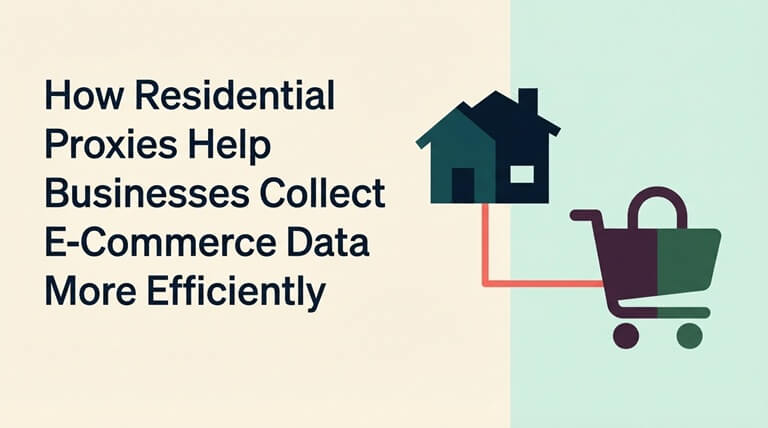
Web scraping is a very practical way of getting data off the web in a structured format. The problem with scraping large volumes of data is that you can hit technical limits, you can run into location-based differences and you can get blocked on automated traffic. Residential proxies help in that they spread your requests out across a number of IP addresses.
Companies doing e-commerce analytics, market research or competitor tracking can actually get their data collection done far more efficiently if they understand how residential proxies work.
What Is E-Commerce Data Scraping?
E-commerce data scraping is the process of scraping publicly available data from e-commerce sites and marketplaces using a script or other automated tool.
Rather than manually opening up hundreds of product pages, a business can use a scraping tool to pull the data they need and then put it into a spreadsheet or database.
Common data points include:
- Product names and descriptions.
- Listed prices and promotional discounts.
- Product availability and stock status.
- Customer review information where publicly accessible.
- Product categories and specifications.
- Shipping information and delivery estimates.
- Search result positions for relevant products.
Once you’ve got this data you can then understand the market far better and make much smarter decisions.
For instance, a retailer selling electronics might track the prices of similar products at other stores. That data would then be used by the pricing team to spot trends and determine when a price change was warranted.
Why Do Businesses Need Residential Proxies?
Websites will often have technical limits in place to deal with bot traffic and protect their systems. If you’re making too many requests from a single IP address you can end up with rate limiting, a temporary block or even some form of extra verification.
Residential proxies provide an alternative routing method. They direct requests through IP addresses associated with residential internet connections rather than relying exclusively on a single office or data-center IP.
This helps the business spread its data collection across a number of connections.
Residential proxies are particularly useful when a company wants to look at data from a range of different countries and regions.
For instance, a product’s price, availability, or delivery options may differ in the US, the UK, or indeed other countries. Using a connection from a particular location enables the researcher to see that more clearly.
Important Ways Residential Proxies Support E-Commerce Research
1. Monitoring Competitor Prices
One of the most common uses of e-commerce data collection is price monitoring.
Online retailers will invariably change prices on the basis of demand, stock levels, seasonal sales, what their competition are doing etc. It’s virtually impossible to keep track of all that price movement by hand if you’ve got hundreds or thousands of products in your range.
A scraping tool can be set up to gather the public pricing information on a regular basis. Residential proxies are useful for spreading out the requests, particularly when you’re checking a lot of sites or different regional versions of the same store.
Businesses can then compare their own prices against the market average and identify products which may need price changes.
However, it is vital to check the data that’s been collected before using it for any automated pricing decisions.
2. Tracking Product Availability
Inventory data can be a useful source of insight into market demand.
If one competitor is regularly running out of a product, then other businesses can use that to look at demand trends or spot supply opportunities.
Automated tools can gather public stock information and track the changes over time.
Residential proxies can be used to do this when you need access to different websites or different regions.
3. Understanding Regional Markets
An online store may display different prices, shipping options and promotions depending on where the visitor is.
A business that’s looking to go international should get to grips with these differences before it enters a new market.
Proxies that are targeted to specific locations allow you to view public pages as if you were located in a different country or region. This is useful for companies who want to compare local pricing, product availability and promotions.
4. Collecting Product Reviews and Market Feedback
Customer reviews are a great source of information on product quality, the sorts of things people complain about and what they actually do like.
Businesses can look at the public reviews to see what the common themes are. A company selling home appliances might well find that durability and energy use are the two issues that come up time and again in the reviews.
This helps the product teams to understand what the customer expects and where they can improve.
Researchers should only collect the information that is permitted and personal data should be handled with care.
5. Monitoring Search Visibility
E-commerce businesses also compete to be seen in search engines.
Product rankings and search results will vary depending on location, language and search settings. SEO teams will do location-based research to see how products and categories are showing in different markets.
Residential proxies can be used to check search results in various regions, but businesses need to use the correct tools and abide by search engine rules.
Choosing the Right Residential Proxy Provider
Not every proxy provider is suitable for every project. Businesses should evaluate several factors before purchasing a subscription.
Geographical coverage: The provider should support the countries and regions relevant to the research project.
IP quality: Connection reliability and IP reputation can influence the consistency of data collection.
Session management: Rotating sessions are useful for distributing requests, while sticky sessions may be more suitable when a workflow requires connection continuity.
Protocol support: Businesses should check whether the service supports the protocols required by their scraping software.
Pricing structure: Pay-per-gigabyte, pay-per-IP, and unlimited plans have different cost implications.
Customer support: Technical assistance can be important when integrating proxies into automated workflows.
Is 711Proxy Worth Considering?
711Proxy is one provider businesses can evaluate when researching residential proxy solutions.
Their offering is pretty much a full suite of proxy types: residential proxies, static residential proxies, mobile proxies, SOCKS5 proxies and unlimited proxies. They have over 100m residential IPs and coverage in over 200 countries and regions.
Their residential proxy products offer both rotating and sticky sessions, and they can bill on a range of different models, including pay per gigabyte and pay per IP.
The provider also have services for e-commerce research, public web data collection and market research.
Any business that wants to compare plans can go to 711Proxy to view the range of products and coverage areas.
Before you pick a plan it’s worth testing the locations that are most important to your project and working out how much data you’re likely to need.
Best Practices for Responsible E-Commerce Scraping
Using proxies in no way gets you off the hook in terms of collecting data properly.
Businesses must comply with the website’s terms of service, privacy laws and data protection rules.
A responsible scraping workflow should include the following practices:
- Collect only information that is necessary for the research.
- Respect applicable access restrictions and rate limits.
- Avoid collecting sensitive personal information.
- Validate data before using it in business reports.
- Use reasonable request frequencies to reduce unnecessary server load.
- Store collected information securely.
- Review the legal requirements that apply to each target website and jurisdiction.
A good system should be about data quality and adhering to the rules rather than simply generating more requests.
Final Thoughts
E-commerce data is now a key resource for retailers who want to understand their competition, track market trends and improve their own pricing. Web scraping makes it far easier to scale this kind of research and residential proxies are a key enabler when it comes to accessing the data from multiple locations and in a regular manner.
To pick the right proxy provider, you need to consider coverage, connection quality, session options, price, and whether it will work with your existing toolset.
711Proxy is worth considering since it offers different proxy types and billing options. With the right setup and responsible data collection, residential proxies can be a valuable part of modern e-commerce research.
Popular on OTW Right Now!



About The Author

Gagan Bhangu
Founder of otechworld.com and managing editor. He is a tech geek, web-developer, and blogger. He holds a master's degree in computer applications and making money online since 2015.