
Stop Buying Software: Why Your Business Needs Better IT Support, Not Another App
As an operations leader, your mornings often start the same way. Before you can even look at your daily goals, you are greeted by a wave of messages from employees complaining about technology. The inventory system is lagging, someone cannot access their email, and the network is down again. You spend the first two hours of your day putting out digital fires instead of driving the business forward.
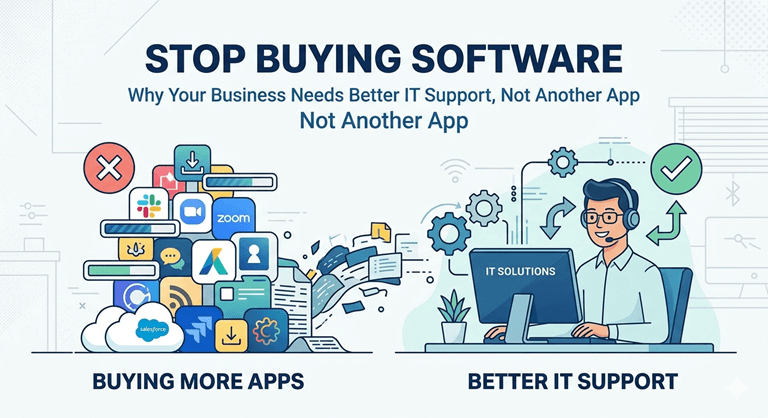
When your team is constantly wrestling with login issues, malfunctioning devices, or confusing updates, the immediate instinct is to look for a quick fix. It is tempting to think a shiny new software platform will solve the problem and instantly streamline your operations. You might believe that migrating to a different project management tool or buying a new communication app will finally silence the complaints.
However, replacing your software rarely fixes the underlying issue. True productivity requires a day-to-day assistance of local experts, like a comprehensive IT support in Wichita that bridges the gap between your staff and the complex systems they rely on. Your employees do not need more features to learn. They need a reliable environment where their current tools actually work.
In this article, we will explore how to diagnose the root cause of your operational bottlenecks. You will learn how to tell if your recurring issues stem from a lack of proper IT support rather than a need for additional applications.
Key Takeaways
- Understand the difference between a missing software feature and a systemic IT support failure.
- Identify the specific business signals indicating your organization has outgrown its current IT infrastructure.
- Learn how transitioning to a strategic, proactive Managed Service Provider differs entirely from an outdated vendor relationship.
The “New Tool” Fallacy: Software vs. IT Support Problems
It is easy to confuse a software problem with an IT support problem. A software problem occurs when an application lacks a specific operational feature that your business needs to function. For example, if your accounting software cannot generate a specific tax report required by your industry, you have a software problem.
This is a different problem altogether when it comes to IT support. This includes substandard network infrastructure, a lack of system integration, and huge gaps in user knowledge. When your team can’t log in to the accounting software due to timeouts with the server, a new accounting program won’t solve the issue.
You see, many operations managers ask themselves why their employees are still having problems with the latest technology that they have installed. Typically, the solution is related to the underlying application on which it is deployed. The latest app out there will fail if your network is slow, if your data migration isn’t done properly, or if your staff has not been properly trained.
New software tools to an already flawed IT foundation lead to new silos of confusion for end-users. There is a limitation to how well technology can work without the human aspects supporting it. If you do not have an expert on-site to fine-tune the settings, integrate the platform, ms and train your staff, the new software will simply become an added cost.
4 Clear Signs You Need a New IT Partner
Identifying when it’s time to upgrade your current IT system is not always easy. While it is common for all businesses, some technical issues are more serious than others. Check whether you fall into the category of “low income, few assets” or “higher income, more assets” by using the comparison table below.
| Normal Day-to-Day Tech Hiccups | Systemic IT Support Failures |
| An employee forgets their password once a month. | Passwords frequently expire without warning across the entire company. |
| The internet briefly drops out during a heavy storm. | The office network disconnects multiple times a week for no obvious reason. |
| A single workstation needs a hard drive replacement. | Multiple computers run painfully slow due to outdated, unpatched operating systems. |
| Submitting a help ticket results in a fix within a few hours. | Help tickets are ignored for days, and the same issues keep returning. |
If your business more closely resembles the right column, it’s time to reassess your IT foundation. Here are some signs that it’s time to find a new technology partner.
Sign 1: Leadership is Doing IT Work
Operations managers and COOs should be pursuing business expansion, forecasting, ing and team development, not dealing with the pressures of operations. One should not have to crawl under desks to check Ethernet cables or sptheir her afternoon dealing with software licenses.
Leading the company into IT work is the company’s doom. Each time you spend trying to fix your printer is an hour that you spend away from work. If it’s part of your daily routine to deal with technology logistics, then you aren’t provided the support your business needs.
Sign 2: Unpredictable Costs are Rising
The budget for technology should be certain. If your monthly IT costs vary from month to month, then you have a big problem. This is often due to a company that is spending money continually on “band-aid” solutions.
But you may be dealing with symptoms, not root causes,s with your current IT setup. It’s a waste of money to pay an hourly rate to fix the same server crash 3 times a month. All of these surprise bills can be avoided by having a flat-rate, proactive IT maintenance strategy.
Sign 3: Rising Security Risks and Complexity
A shiny new security software suite is utterly inadequate when it comes to security if there is no expert to manage it. Cybersecurity isn’t a one-time purchase. It is an ongoing process and needs constant monitoring, threat hunting, and updates.
With no strategic oversight, huge gaps in security remain even after implementing new security tools. Cybercriminals are always changing their strategies to fool automated software. The consequences of not practicing good security management are very high. If you are not working with a dedicated IT partner in charge of your network, you’re essentially relying on luck when it comes to data protection.
Sign 4: End-User Frustration and Human Error
Having the right tools won’t solve operating problems if workers are not adequately trained and supported. When it comes to IT support, no man-centered approach equals errors in judgment, system failure,s and wasted time. When your employees are not aware of how to use the company file-sharing system, they’ll probably be tempted to try other, less secure methods.
These knowledge gaps create massive vulnerabilities. Studies show that human error contributes to approximately 66-80% of all downtime incidents. This often stems from staff failing to follow standard procedures or simply lacking proper guidance.
This is the reason why building relationships with users is a key part of a relationship-based IT partner. Good IT support means signing up, providing practical training, and being patient when answering questions. Human Error significantly declines when employees are confident in their use of tools.
Proactive Managed IT
The only way to break the endless tech support cycle is to get away from the traditional way of providing IT support. The key difference between a proactive Managed Service Provider is that they work very differently. A strategic relationship-based IT partner doesn’t wait for the phone to ring. They’re very aware of your network and detect warning signs before a crash occurs.
Here is what a true Managed Service Provider does differently:
- Tracks Recurring Issues: They look for patterns in helpdesk tickets to eliminate the root cause of frequent problems permanently.
- Aligns Technology with Business Goals: They meet with your leadership team to ensure your IT infrastructure can handle your future growth and expansion plans.
- Focuses on People: They prioritize clear communication and fast resolution times to keep your staff moving forward.
This proactive effort markedly alters the work environment. Having a dedicated IT partner leads to better employee morale. Your team begins to think of technology as a friend, instead of an enemy. The proactive approach to problem-solving adds to the simplifying of daily operations for everyone, in place of just answering the ticket.
Conclusion
You probably need a better IT partner, not another software subscription, if your team is struggling to be productive! It’s easy to install new applications on poor foundations, but you’ll end up spending more money and becoming more frustrated.
Choosing the right time to move to a Managed Services Provider benefits your company in many ways, including saving money, dramatically improving your cybersecurity posture, and even lifting the team’s spirits. You no longer have to cover for reactivedowntimem,e and you begin to invest in consistent uptime.
Moving to a human-first, relationship-based IT partner instead of a vendor changes the whole workplace dynamics. Provide your workers with the dependable assistance they require and observe your delays vanish.
Popular on OTW Right Now!


About The Author

Gagan Bhangu
Founder of otechworld.com and managing editor. He is a tech geek, web-developer, and blogger. He holds a master's degree in computer applications and making money online since 2015.