
SEO Isn’t Dead — It Just Got an AI Rewrite
Something happened to search over the last two years that most business owners felt before they understood. Traffic reports began to seem odd: impressions were up, clicks down, and rankings unchanged – with the telephone buzzing a little less. The rankings weren’t lying; it was just that they were wrong. The results page turned from a list of links into something else!
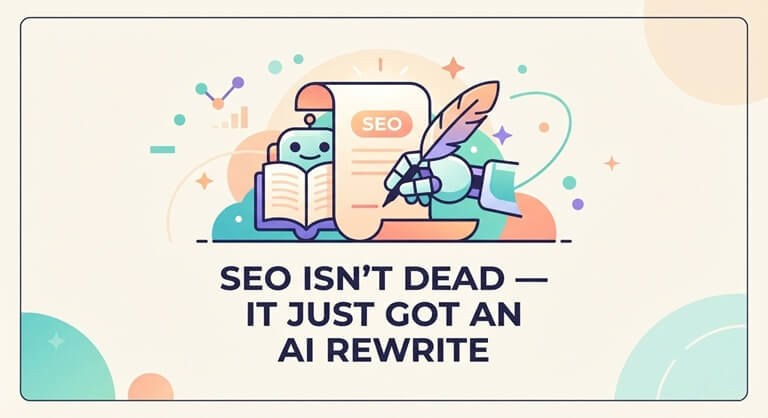
For many queries, Google’s AI Overviews now appear prominently above traditional results, providing answers before users even start scrolling. All legitimate studies that have been designed to measure the effect have shown that the click-through rate drops when an overview is shown—and the drop is very significant, especially by query type and industry, but always in the same direction. Many of today’s searches via Google no longer result in clicks to other websites, although that wasn’t necessarily true before the rise of generative AI; it has been noticeably faster since Google’s AI Overviews have come into existence.
Then, there is the second front: ChatGPT, Perplexity, Copilot, and Google’s AI Mode. Rather than typing into a search bar, the following questions are being asked more and more by users: “best HVAC company near me,” “what does commercial roofing run per square,” “who handles ITAR-compliant machining. Without the answer from your business, then you’re not in the conversation in the first place.
Why this hits Huntsville faster
Huntsville is a highly parlance city for AI. It has been consistently in the top spot on CBRE’s list of up-and-coming tech-talent markets in North America, boasting a tech job growth rate of almost 18% over five years and an average tech salary exceeding $114,000. Your customers and competitors are early adopters between Redstone Arsenal, Cummings Research Park, and a thick stick of aerospace and defense contractors. Any national average is less likely to predict that a Madison County engineer will begin designing a tool with the help of an AI than a Madison County engineer. In slower markets, businesses are not given the grace period that they are here.
What actually works now
Answer the question first. Start each page with a straightforward, concise answer (usually the first 100 words), then elaborate. AI systems rise to the top of the heap for good, quotable quotes, while cutting out the throat clearing.
Build entity clarity. Consistent name/address/phone numbers, a complete Google Business Profile, schema, and named authors with real credentials all help a model determine that your brand is the one to cite. Business Profile information is a key driver of answers from AI for local queries.
Publish something only you can publish. An AI summary makes it futile to visit you if a page has repeated content that’s already ranking. What remains are original pricing, photos of the projects from around the world, and first-hand experience.
Get mentioned elsewhere. AI answers tend to be fed by disproportionately high volumes of Reddit threads, forums for trading, and local publications. Off-site mentions act much like backlinks as they did 10 years ago.
Change what you measure. Monitor AI answers’ brand mentions, AI tool referral traffic, and actual leads and calls, not merely keyword rankings or sessions.
This is not anything that is not considered good SEO. Quick sites, uncomplicated construction, and genuine know-how remain the winners. The difference is where the win is seen, from the click to the citation. Businesses making changes now will be the ones AI recommends two years from now.
Popular on OTW Right Now!
About The Author

Gagan Bhangu
Founder of otechworld.com and managing editor. He is a tech geek, web-developer, and blogger. He holds a master's degree in computer applications and making money online since 2015.