
Practical Guide to Cyber Crisis Management Execution
People don’t care about cyber crises for the most part, so that’s not really a problem for an organization. Issues escalate when things are under pressure, facts constantly change, and leaders simply can’t prioritize quickly enough. Clear authority, prioritized business needs,s and true practice under stress are the keys to strong execution. It’s not too late to have a written plan. A document, however, will not be able to tell you what to do if the emergency is live. When every minute counts, you need a working decision system to ensure the protection of revenue, service, trust, and safety.
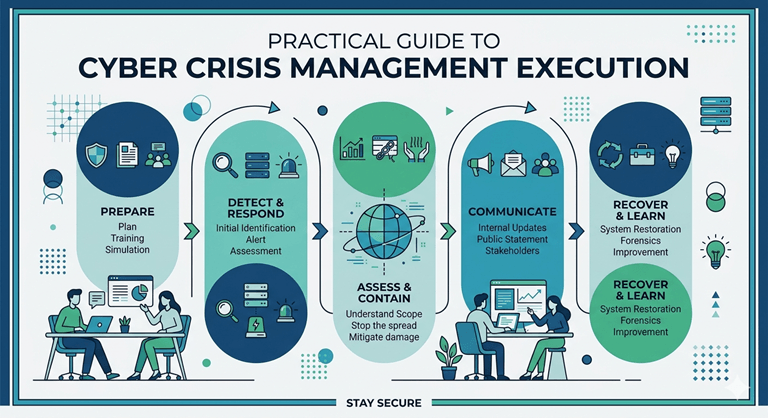
Put Priorities First
Measurements of readiness include the number of plans, checklists, tasks, and exercise dates. But that just demonstrates that they’re not really doing it. In practical cyber crisis management, response improves when finance, operations, legal, communications, and technology enter the event with one shared priority list. This common outlook eliminates debate, decreases confusion,n and allows your efforts to be focused on your most important services.
Define Decision Rights
When it comes to making a decision, it can cause more damage than when it comes to slow tools. A crisis should be declared by the leader. Another should approve shutdowns, public statements, and recovery actions. When things are dangerous, there is no uncertainty under a clear authority. Written ownership also helps to prevent issues within your team when the pressure is on. With every major decision having an owner, the response work proceeds more quickly and without distractions.
Build A Decision Map
Real incidents do NOT happen in an idealized manner. So, you’ll need a decision map rather than a set of tasks in your teams. The common paths that should be included on that map include isolation, reporting, customer notice, and system recovery. It is important to have triggers, owners, and backups for every branch! This helps them to make a better judgment if new facts alter the situation and compel leaders to make a rapid and often informed judgment.
Separate Guidance From Tasks
Task guides aid in repeating technical tasks. Crisis guidance can assist you in making a decision on what might be the next steps. They are both for a different purpose and should be kept apart. There is a task guide that explains how to restore a server. Crisis guidance should include when to wait for recovery, who serves the service first, and who takes the risk of the business. This division imposes an obstacle to team players’ blending procedure and strategy during an actual crisis.
Rehearse Tradeoffs, Not Scripts
Numerous exercises are offered that are not based on judgment, but rather on memory. In situations with better sessions, place leaders are put under pressure with not having all the information, not having the same information, or the information being visibly affecting their customers. An emphasis should be placed on comparing actual tradeoffs and NOT on the “perfect sequence”. Which service should get the first service? At what time should people be alerted that the pandemic is occurring? Who takes the risk for the present time? When your people are faced with tough choices in a stressful situation and are able to recognize where conflict is manifesting, then practice pays off.
Use Plain Metrics
The value of useful metrics is based on execution, not on paper. Organizations can track decision time, escalation speed, approval delays, and recovery start times. Those numbers are the ones that indicate the place where coordination takes a hit. They also provide a clear point of reference for improvement for leaders. A brief dashboard that is checked after each exercise or incident reaps a positive outcome: it not only allows for the sharing of a message of confidence, but it also provides management with a way of determining if response capability is improving or not.
Keep Communications Ready
Communication failures can deepen confusion inside and outside an organization. Draft messages help. But it’s not just about pretty words that get approved, though. Your teams need to be aware of who you communicate with on the staff, regulators, customers, partners, and media. The contact lists should be kept up to date. A simple schedule is another plus, as rumors abound when no one is talking, and a steady flow of communication helps to keep things coordinated during stressful moments and keeps uncertainty to a minimum.
Connect Recovery To Business Value
Technical recovery should be based on business value and not hardware orders. It is possible to restore the value system first,t which may be a waste of valuable time. Leaders should have a service ranking that relates to revenues, impact on the customer, legal exposure, and the safety of the operation. The ranking should be used to inform recovery decisions in the event of disruption. When the business is the motivator behind the recovery order, businesses recover the critical services more quickly and avoid unnecessary financial and operational losses.
Review After Every Test
All exercises should conclude with a systematic review. Your teams have 3 outcomes: It didn’t happen in time, decisions were not owned, and priorities were not aligned. The deadlines and responsible leaders should be incorporated into improvement tasks. If they don’t take place, lessons will “die,” and weak areas stay weak. Regularly reviewed practice becomes a more robust operating practice rather than a one-off practice that does not fundamentally alter the way things will be done next time.
Conclusion
The more organizations think of crisis readiness as a set of documents, the less effective the execution will be. A more robust operating model is established from clear ownership, ranked services, measured delays, and realistic practice. In pressure situations, your teams require less trial and error and quicker decision-making. Practical preparation can help leaders to better protect and support critical services continuity and direct recovery better during situations that challenge the trust of the organization.
Popular on OTW Right Now!
-
 Custom Software Development vs Off-the-Shelf Software: Which Is Better?
-
 How to Choose the Right Headset for Business Calls and Hybrid Work
-
 Why Moisture Is Ruining Your 3D Prints (And How to Prevent It)
-
 The Software Layer Behind Modern HVAC Design: How Digital Load Calculations Replaced the Rule of Thumb




About The Author

Gagan Bhangu
Founder of otechworld.com and managing editor. He is a tech geek, web-developer, and blogger. He holds a master's degree in computer applications and making money online since 2015.