
Operating Agreement vs. Partnership Agreement: What Business Owners Should Know
Choosing the right agreement is an important step when starting or managing a business with more than one owner. Operating agreements and partnership agreements can be two documents that can sometimes be confusing. Both are important aspects of how a business will be conducted, but are typically for different business structures and for different legal purposes.
Business owners should understand how each agreement works before signing or drafting one. Working with legal services for small businesses can help clarify responsibilities, ownership rights, financial arrangements, and decision-making authority before disputes arise.
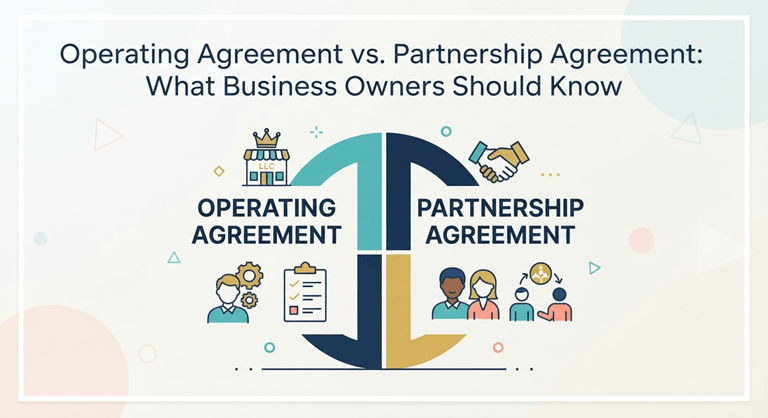
What Is an Operating Agreement?
Limited liability companies, or LLCs, are the type of company that typically uses an operating agreement. It provides an explanation of the way the company will conduct itself and a summary of the rights and responsibilities of its members.
Key Terms Usually Included
An operating agreement may address:
- Ownership percentages.
- Profit and loss distribution.
- Voting rights.
- Management responsibilities.
- Procedures for adding or removing members.
- Rules for transferring ownership.
- Steps for dissolving the business.
Having an LLC operating agreement, even in states where it isn’t legally required, can still help set expectations for the members.
What Is a Partnership Agreement?
When two or more persons run a business together, they are considered partners and usually enter into an agreement. It outlines the operation of the partnership and the management and financial responsibilities of the partners.
Common Partnership Provisions
A partnership agreement may include:
- Each partner’s financial contribution.
- Division of profits and losses.
- Authority to make business decisions.
- Duties of individual partners.
- Procedures for resolving disputes.
- Rules for a partner leaving the business.
- Buyout and succession terms.
Without a written agreement, state partnership laws may determine how certain disputes or ownership issues are handled.
Operating Agreement vs. Partnership Agreement
The primary difference between these documents is the sort of business they serve.
Operating Agreements are meant to be used with an LLC; however, a Partnership Agreement is generally used with a general or limited partnership. Both documents can be used to set up internal rules, though there may be some differences in the language and legal requirements depending on the type of business and state laws.
Liability Considerations
Typically, LLCs offer their members limited liability — which means that the personal assets of the members are disassociated from many of the obligations of the business.
However, in a general partnership, the partners could be held personally liable for some of the business debts and legal claims. This is why it is crucial to grasp the nature of the business before signing a contract.
Why Written Agreements Matter
Business connections can alter. Owners can have conflicting agendas regarding expenditures, growth, ownership stake, accountability, and/or company direction.
When there are questions, there’s a written agreement as a reference point. It can also set up processes to resolve disputes instead of relying on informal discussions or assumptions.
When Should an Agreement Be Updated?
The operating and partnership agreements do not necessarily need to stay the same throughout the business.
Owners may need to update an agreement when:
- A new owner or partner joins.
- Ownership percentages change.
- The company takes on significant debt.
- Management responsibilities change.
- The business expands into new markets.
- An owner plans to leave or retire.
Regular review makes sure that the document continues to accurately represent the manner in which the business operates.
Getting the Right Legal Guidance
The right agreement depends on your business structure, ownership, and state laws. Business owners who need help reviewing or preparing important legal documents can use FindTheLawyers to find attorneys with experience in business formation, contracts, partnerships, and other commercial legal matters.
Choosing the Right Business Agreement
While operating agreements and partnership agreements are both useful to business owners in establishing expectations and eliminating uncertainty, they should not be used interchangeably. To develop a more stable foundation for long-term operation, it is important to know which document applies to your business, clearly outline the rights and responsibilities of each owner, and update the agreement regularly.
Popular on OTW Right Now!




About The Author

Gagan Bhangu
Founder of otechworld.com and managing editor. He is a tech geek, web-developer, and blogger. He holds a master's degree in computer applications and making money online since 2015.