
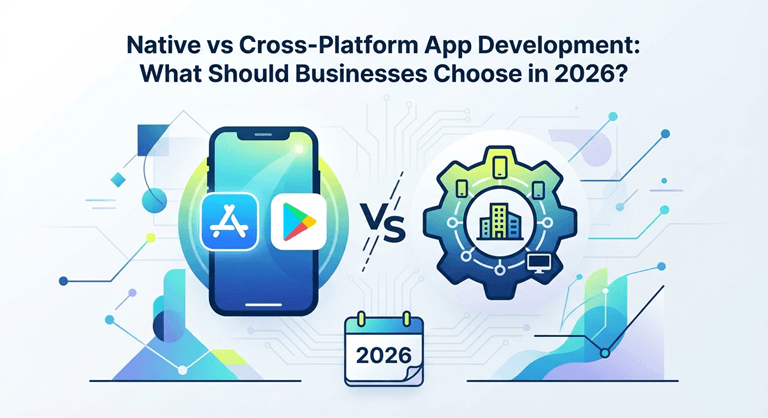
Native vs Cross-Platform App Development: What Should Businesses Choose in 2026?
Choosing between native and cross-platform app development remains one of the most important decisions businesses face when planning a mobile product. The choice affects development cost, release speed, application performance, user experience, platform compatibility, and long-term maintenance.
In 2026, the decision is more complex than simply choosing between “better performance” and “lower cost.” Native development tools have become more productive, while frameworks such as Flutter, React Native, and Kotlin Multiplatform have significantly improved their performance and access to platform capabilities.
The right approach depends on the product’s requirements, target users, available budget, technical complexity, and expected growth.
Businesses investing in wearable app development services may benefit from a native or hybrid approach when the product requires deep integration with health sensors, workout sessions, notifications, Bluetooth accessories, complications, or background monitoring.
What Is Native App Development?
Native app development means building an application specifically for one operating system using its preferred languages, frameworks, and development tools.
For Android, native applications are commonly developed with Kotlin and Jetpack Compose in Android Studio. Google continues to follow a Kotlin-first approach for Android development and officially recommends Kotlin for building modern Android applications.
For Apple platforms, developers generally use Swift, SwiftUI, UIKit, and Xcode. SwiftUI allows teams to build interfaces across iPhone, iPad, Mac, Apple Watch, Apple TV, and Apple Vision Pro using Apple’s native development ecosystem.
If a business wants both Android and iOS applications, a fully native approach usually requires two separate applications. Although they may share branding, APIs, and backend services, their user interfaces and platform-specific code are developed independently.
A professional development partner such as Next App INC can evaluate the product’s features, performance requirements, target devices, security needs, expected user growth, and maintenance plan before recommending an architecture.
What Is Cross-Platform App Development?
Cross-platform development allows teams to create Android and iOS applications while sharing a substantial portion of the codebase.
Popular approaches in 2026 include:
- Flutter, which uses Dart and renders applications through its own framework.
- React Native, which uses React and JavaScript or TypeScript to create native mobile interfaces.
- Kotlin Multiplatform, which enables developers to share Kotlin-based business logic between Android and iOS.
- Compose Multiplatform, which can extend Kotlin code sharing to interface development.
Google officially supports Kotlin Multiplatform for sharing business logic across Android and iOS and describes it as stable and production-ready. Developers can also use Compose Multiplatform when sharing user-interface code is appropriate.
React Native remains actively developed, with React Native 0.86 released in June 2026. The release expanded Android edge-to-edge support and continued efforts to make framework upgrades more predictable.
Flutter also remains a major cross-platform option. Flutter 3.44 and Dart 3.12 were highlighted at Google I/O 2026, continuing the framework’s focus on multi-platform development and faster developer workflows.
Advantages of Native App Development
Stronger Platform Integration
Native development provides direct access to the latest operating-system APIs and device capabilities.
When Apple or Google introduces a new feature, native developers can often integrate it without waiting for a cross-platform framework or third-party package to support it. This can be important for applications using advanced cameras, Bluetooth devices, background services, health data, augmented reality, secure authentication, or operating-system-level AI.
Consistent Platform Experience
Android and iOS users have different expectations regarding navigation, controls, permissions, gestures, typography, and accessibility.
Native development makes it easier to follow each platform’s conventions. An iOS application can feel fully integrated with Apple’s interface patterns, while the Android version can follow Material Design and Android-specific navigation behavior.
Better Control Over Performance
Native development gives teams direct control over memory usage, background execution, animation, battery consumption, and hardware acceleration.
This can be particularly important for:
- Real-time communication applications.
- Video and audio editing tools.
- Advanced mobile games.
- Financial applications.
- Health-monitoring platforms.
- Bluetooth-connected products.
- Augmented-reality experiences.
Cross-platform applications can also perform well, but highly demanding features may still require native modules and platform-specific optimization.
Faster Access to New Platform Features
Businesses that want to adopt the newest Android or Apple capabilities immediately may benefit from native development.
Native teams can work directly with official SDKs and documentation instead of depending on the update schedule of a plugin or framework integration.
Disadvantages of Native Development
The primary disadvantage is cost.
Building separate Android and iOS applications usually requires more engineering effort. Features must be implemented, tested, and maintained in both codebases.
Other challenges include:
- Longer development timelines.
- Separate platform expertise.
- Duplicated interface work.
- More complex release coordination.
- Increased testing requirements.
- Potential differences between Android and iOS features.
For businesses with limited budgets, building two complete native applications may delay the initial launch.
Advantages of Cross-Platform Development
Faster Initial Development
A shared codebase can allow teams to build Android and iOS versions at the same time.
Core features, validation rules, networking logic, state management, and interface components may be created once and reused across platforms. This can shorten the time required to launch a minimum viable product.
Lower Development and Maintenance Costs
Cross-platform development can reduce duplicated work. A feature update may be implemented once instead of being developed separately by Android and iOS teams.
This does not mean the codebase is completely identical. Platform-specific adjustments are still necessary, but shared architecture can reduce overall effort.
More Consistent Product Experience
Sharing interface components and business logic can help maintain consistency across platforms.
Brand colors, forms, account workflows, checkout processes, and content presentation can be implemented through a common design system. This may be valuable for companies that want their product to look and behave similarly on Android and iOS.
Easier Prototyping and Market Validation
Startups often need to test an idea before investing in a large engineering team.
A cross-platform framework can help launch an initial product on both major mobile platforms, gather user feedback, and validate demand. The business can then improve the architecture or introduce native components as the product grows.
Disadvantages of Cross-Platform Development
Cross-platform development still has limitations.
A framework may not immediately support a newly released operating-system feature. Developers may need to write Swift, Objective-C, Kotlin, or Java code to create a native bridge.
Other potential challenges include:
- Dependence on framework updates.
- Third-party plugin quality.
- Larger application sizes.
- Platform-specific bugs.
- Complicated upgrades.
- Differences in Android and iOS behavior.
- Reduced control over advanced hardware features.
A cross-platform application also requires careful design. Using the same interface without considering platform conventions can make the product feel unfamiliar to both Android and iOS users.
What About Kotlin Multiplatform?
Kotlin Multiplatform provides a middle ground between fully native and fully shared development.
A team can share networking, data models, database code, validation, and business logic while building the Android and iOS interfaces with native technologies.
This allows Android developers to use Jetpack Compose and iOS developers to use SwiftUI while avoiding duplication in the application’s core logic.
For many businesses, this hybrid model offers a strong balance:
- Native platform experiences.
- Shared business logic.
- Direct access to device features.
- Reduced duplication.
- Greater architectural flexibility.
However, Kotlin Multiplatform still requires developers who understand both Android and iOS environments.
Which Approach Is Better for Wearable Apps?
Wearable devices create additional development considerations.
Apple Watch and Wear OS have smaller screens, different interaction patterns, strict battery limitations, background-execution rules, health integrations, and sensor-based features. These applications should not simply be reduced versions of a smartphone interface.
Some business logic can still be shared across platforms, but the wearable experience often requires dedicated platform-specific design and testing.
When Should a Business Choose Native Development?
Native development is usually the better option when:
- Performance is critical.
- The application uses advanced hardware features.
- The product requires extensive background processing.
- Platform-specific design is a priority.
- Security and device integration are highly complex.
- The application will support Apple Watch or Wear OS deeply.
- The company has sufficient budget and separate platform expertise.
- New operating-system features must be adopted immediately.
Banking, healthcare, video production, advanced fitness, augmented reality, and hardware-connected applications may benefit from this approach.
When Should a Business Choose Cross-Platform Development?
Cross-platform development may be the stronger choice when:
- The business needs to launch quickly.
- Android and iOS must be released together.
- The budget is limited.
- The product primarily uses forms, content, accounts, and APIs.
- The same experience is required across both platforms.
- The company is developing an MVP.
- Advanced device integration is limited.
- The development team already has Flutter, React, or Kotlin expertise.
E-commerce applications, booking platforms, educational products, internal business tools, and content-based apps are often suitable candidates.
Making the Final Decision
Businesses should not choose a development approach solely because it is popular or appears less expensive initially.
The evaluation should include:
- Target platforms and devices.
- Required native integrations.
- Application complexity.
- Launch deadline.
- Available budget.
- Team expertise.
- Offline requirements.
- Performance expectations.
- Accessibility needs.
- Long-term update strategy.
A short prototype can also help determine whether a cross-platform framework delivers the required performance before full production begins.
Conclusion
There is no universal winner in the native versus cross-platform debate.
Native development offers the strongest platform integration, performance control, and access to new operating-system features. It is often the better choice for complex, hardware-intensive, security-sensitive, or highly polished applications.
Cross-platform development provides faster delivery, greater code reuse, and potentially lower costs. It is particularly effective for MVPs, business applications, e-commerce platforms, and products with similar functionality across Android and iOS.
Kotlin Multiplatform provides another valuable option by sharing core logic while preserving native interfaces.
In 2026, businesses should choose based on product requirements rather than assumptions. The best solution may be fully native, fully cross-platform, or a hybrid architecture combining shared code with platform-specific experiences.
Popular on OTW Right Now!



About The Author

Gagan Bhangu
Founder of otechworld.com and managing editor. He is a tech geek, web-developer, and blogger. He holds a master's degree in computer applications and making money online since 2015.