
How Hydraulic Torque Wrenches Improve Precision in Industrial Bolting Applications
Hydraulic torque wrenches provide a more accurate bolting process for industrial operations by providing a consistent and repeatable torque output without the guesswork and the fatigue-related torque variations associated with manual tightening methods. Therefore, they are the preferred option for critical bolted connections, such as those in safety-critical applications, where high accuracy of torque is essential to the safety or reliability of the equipment.
Precision can’t be an option when a single under or over-torqued bolt could cause catastrophic failure in industries such as these. The following article explains the mechanics of hydraulic torque wrenches, their benefits over other bolting techniques and selecting the proper type for the job.
What Makes Bolting Precision Critical in Industrial Applications
Bolted joints are used in some of the most important assemblies in industry, includingPressure vessels, Turbines, Flanges, Structural steel connections .If any torque deviation, no matter how small, is out of the blue, it can affect the whole system.
The Risks of Inconsistent Torque in High-Pressure Assemblies
Errors of torque in either direction are very serious:
- Over-torquing: leads to risk of damage to the joint due to high torques that may lead to leaks or misalignment or separation under load conditions
- under-torquing: may strip threads, may cause gaskets to become crushed or unscrewed
- Within pressurized systems like pipelines and reactors, either error can cause system failure, downtime, or a safety incident.
Why Manual Wrenches Fall Short in Precision-Critical Environments
Manual torque wrenches depend upon both the operator’s strength and technique, which are different for each individual and even for each application. . Manual methods to apply torque accurately are difficult because of fatigue, awkward angles and large bolts, especially when thousands of foot-pounds of torque are needed.
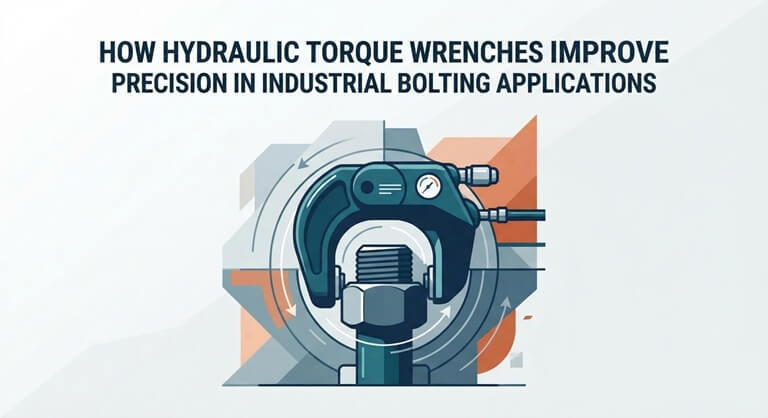
How Hydraulic Torque Wrenches Work
These hydraulic torque wrenches apply torque with the use of hydraulic pressure, which gives greater torque output with less physical effort applied yet still with accuracy.
The Role of the Hydraulic Pump and Cylinder in Torque Generation
Fluid is pumped by a hydraulic pump and then supplied to a hydraulic cylinder that is attached to the wrench. As this pressure acts on the cylinder it translates into a linear force, which is passed through a ratchet system to rotate a square drive. The precision control of the pressure of the pump makes the torque output much more controllable than manual torque application.
Understanding Torque Pressure and Square Drive Mechanics
Torque output is directly proportional to the hydraulic pressure, so that the operator can set a hydraulic pressure/torque value on the pump and obtain a specific and repeatable torque value. This torque is transferred to the socket and bolts through the square drive (which comes in different sizes) which is chosen depending on the torque requirements of the application.
Single-Acting vs. Double-Acting Hydraulic Torque Wrenches
Single-acting wrenches employ hydraulic power for the power stroke and a spring for the return stroke which results in lighter wrenches and are more suitable for use in confined areas. Double acting wrenches have hydraulic pressure on both strokes for quicker cycle time in high volume bolting applications.
How Hydraulic Torque Wrenches Achieve Superior Precision
Consistent Torque Output Across Repeated Applications
Due to the fact that torque is applied by regulated hydraulic pressure, not by hand, the hydraulic torque wrenches will produce virtually the same torque on each bolt in the sequence, which is essential for flanges and pressure critical joints that need to be tightened evenly.
Fine-Tuned Torque Control for Accurate Bolt Preload
The amount of torque applied directly affects the amount of preload on the bolt (tension that keeps the joints together). Hydraulic systems permit fine incremental pressure adjustments which enable technicians to set an exact preload target as specified by engineering standards instead of making the pressure adjustment by feel through manual operation.
Reducing Human Error Compared to Manual and Pneumatic Tools
The variability caused by operator fatigue, body position and technique are eliminated with hydraulic torque wrenches. Pneumatic tools are quick, but not as accurate in torque when compared to hydraulic systems, which are accurate even at high torque settings.
Key Applications of Hydraulic Torque Wrenches in Industrial Settings
Hydraulic torque wrenches are used in all types of heavy industries and when bolted assemblies are load-bearing or load safety:
- Oil, gas, and petrochemical plants:Flange connections, valves and pressure vessels require torquing to a specific torque to prevent leakage and leak testing is required for oil, gas and petrochemical plants.
- Turbine assembly and power generation: Parts of the turbine cases and generator must have correct torque to guarantee balance and eliminate vibration problems.
- Structural steel and heavy equipment manufacturing: Large size steel structures and heavy equipment assemblies require high torque and precision in bolting to achieve structural engineering tolerances.
- Applications with low clearance: When standard bolting tools can’t reach, compact hydraulic wrench heads can reach without compromising on torque accuracy.
Hydraulic Torque Wrenches vs. Other Torque Tools
| Feature | Hydraulic | Pneumatic | Manual |
| Torque Accuracy | High | Moderate | Low-Moderate |
| Max Torque Capacity | Very High | Moderate | Low |
| Operator Fatigue | Low | Low | High |
| Best For | High-precision, high-torque jobs | Speed-focused, lower-torque jobs | Light-duty, occasional use |
Hydraulic vs. Pneumatic Torque Wrenches
Pneumatic wrenches are fast and suitable for low torque high volume work, but are not as precise as a wrench with pressure control when bolting is a precision operation.
Hydraulic vs. Manual Torque Wrenches
In situations where a high torque accuracy is desired, manual methods are not as effective as hydraulic tools for infrequent use or light duty applications.
When to Choose Hydraulic Over Electric Torque Tools
Electric torque tools are accurate for medium torque applications, while hydraulic wrenches are still used for the highest torque demands in heavy industrial bolting applications.
Choosing the Right Hydraulic Torque Wrench for Precision Bolting
Matching Torque Capacity to Bolt Size and Application
Choose a wrench that has a torque range compatible with the torque torque range that is required for your application, but be sure to allow some operating range beyond the upper torque of the wrench to ensure accurate torque at working pressure, not the upper end of the wrench’s range.
Considerations for Square Drive Size and Low-Clearance Access
Check drive sizes for compatibility with your socket, and consider head clearance size if using in spaces close to flanges or machinery housings.
Calibration and Maintenance for Sustained Accuracy
Calibration against certified standards routinely will keep torque pressure readings accurate with service life — an essential component of precision.
Best Practices for Maximizing Accuracy with Hydraulic Torque Wrenches
Compliance with standards and proper calibration intervals
Use of wrenches should be calibrated to certified accuracy according to applicable industry standards (e.g. ISO 6789) and manufacturer’s recommendations, at the recommended times or following heavy use.
Proper Pump Pressure Settings for Target Torque Values
The output given may vary from make to make and drive to drive, always refer to the pressure to torque chart provided by the manufacturer of your specific hydraulic torque wrench to check output.
Common Mistakes That Compromise Torque Accuracy
Even a perfectly working wrench can produce non-correct torques when these errors are not corrected:
- Installing damaged or worn sockets.Installing in damaged or worn sockets.
- Neglecting hose connections or fittings
- Using pressure estimates rather than pressure charts to determine pressure settings
- Failure to recalibrate after heavy use and/or long periods of time operating the unit
Frequently Asked Questions
What is a hydraulic torque wrench used for?
Typical application where the torque is known and repeatable such as large industrial bolts in heavy manufacturing, power generation and oil and gas industry applications.
How accurate are hydraulic torque wrenches?
When properly calibrated, a hydraulic torque wrench is usually within ±3-5% of the set torque, and is much more accurate than a torque tool.
e generally within ±3-5% of the set torque, much more accurate than manual torque tools.
What is the difference between hydraulic and pneumatic torque wrenches?
In general, hydraulic wrenches can be more accurate and can drive more torque, while pneumatic wrenches are faster, and can be used in applications where a large quantity is required but not much torque is needed.
How often should a hydraulic torque wrench be calibrated?
Industrial uses should be calibrated more frequently, as per most manufacturers’ recommendations; otherwise, calibration is recommended after every 12 months or after extensive use.
Can hydraulic torque wrenches be used in low-clearance spaces?
Yes, “small and low profile” hydraulic wrench heads are made to fit into situations where standard size tools can’t fit.
Conclusion:
Hydraulic torque wrenches remain the tool of choice for precision bolting due to their high torque and high degree of repeatability, so they can reduce the risk of human error and joint failure, especially in critical sectors like aerospace, automotive, and pharmaceutical. Choosing the proper wrench, using correct pressure levels and calibration are all very important to the accuracy that can be maintained over time.
Popular on OTW Right Now!
-
 The Strategic Role of Bulk Diesel Exhaust Fluid Supply in Enhancing Efficiency, Compliance, and Sustainability
-
 How Residential Proxies Turn You Into A Digital Ninja
-
 Are Massage Chairs Worth It? A Practical Buyer’s Guide
-
 Universal Testing Machine for UK Laboratories: Improving Testing Accuracy, Efficiency, and Reporting



About The Author

Gagan Bhangu
Founder of otechworld.com and managing editor. He is a tech geek, web-developer, and blogger. He holds a master's degree in computer applications and making money online since 2015.