
How to Maximise Social Media Reach Without Increasing Your Budget
Everyone assumes bigger reach means bigger spend. Throw more dollars at boosted posts, watch the numbers climb, simple maths. Except it isn’t, not really. Plenty of accounts with modest budgets out-reach competitors spending five times as much, purely because they’ve figured out the parts of the algorithm that don’t cost a cent to exploit. So what’s actually going on there?
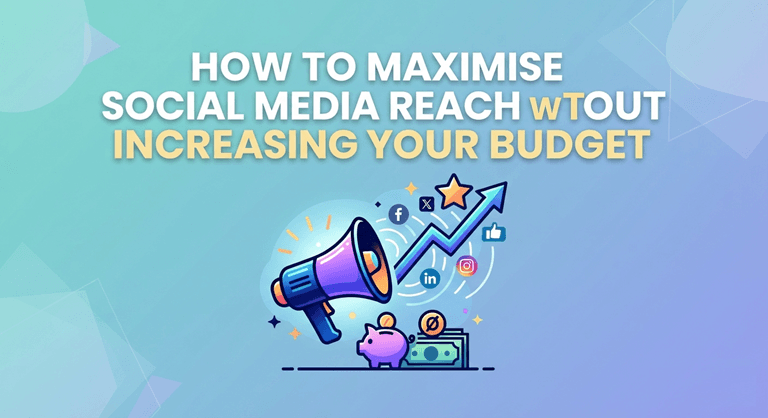
Reach Isn’t Bought, It’s Triggered
Every platform’s algorithm is hunting for one thing above all else: content people actually engage with, quickly, in ways that keep them on the app longer. Spend doesn’t directly cause reach; it just buys initial exposure. What happens after that initial exposure- the comments, shares, watch-through time, dwell time- that’s the stuff that decides whether a post snowballs or dies quietly with forty views. None of that costs money. All of it requires understanding what actually makes people stop scrolling.
Hooks Matter More Than Budget Ever Will
The first half-second of a video determines a lot, or the first line of a caption. If they miss that window, it’s too late to spend money on ads, and the algorithm is perfectly fine with them continuing to scroll past. If you nail it, then it gets compounded, and you don’t need any dollars to do that. This is truly the highest-leverage, lowest-cost lever that most businesses don’t even think about, while topping up their ad budgets.
- Open with a question, a contradiction, or a visual surprise, not a slow warm-up.
- Front-load the value; don’t save the good part for the end.
- Native formats beat polished ones; platforms favor content that looks like it belongs there.
- Consistency in posting rhythm builds algorithmic trust over time.
Comments Are Basically Free Reach Fuel
If anyone has tried this, it’s a tactic that seems to be underutilized: if your content can start a genuine discussion (or a discussion that asks a question people want answered), you’ll be rewarded for doing it — almost any major platform will pay attention. A post with 50 comments can often reach more people than a post with 10x the ad spend simply because of the engagement shown in the comments. It’s more effective to end a statement with a real question than with a “thoughts?” at the end, since that isn’t a question people actually want to answer.
Repurposing Content Is Reach Multiplication, Not Duplication
Six separate mediocre posts can’t reach the reach of one rock-star piece of content chopped up and reshaped into Reels, Stories, carousel posts, and a pinned comment thread. Most businesses consider each platform as a new demand for content and use up ideas and energy quickly. Smarter approach: Create one strong piece of main content, then make 6 variations. When it comes to reach ceiling, it’s quite the difference.
Timing Costs Nothing and Changes Everything
One of the trickiest things to fall behind on is posting at the wrong time, as you may not catch it unless you’re monitoring your posts regularly. Even a brilliant post can struggle if it’s published when your audience is asleep, working, or commuting, as it may miss the early engagement that helps it reach more people. The breakdown of the best times to post on social media in 2026 looks at when audiences are most active across different platforms, based on tens of millions of engagements. Many businesses aren’t leveraging this opportunity – timing.
Collaboration Reach: The Underrated Free Multiplier
You can target a new audience without paying a dime by collaborating with other accounts, even those in other small niches. All of these are effective because the algorithm sees these as new engagement by new people, not reengagement with the same brand by the same people. It is not that one account that has more followers can out-reach the other two, but rather that two accounts, and with not that many followers, can out-reach the other account.
Platforms Are Quietly Becoming Search Engines
This paradigm shift should make businesses rethink their concept of reach, and many still haven’t internalized it. So TikTok and Instagram are now being used as search engines in the same way as Google, and people are using the platforms to search for information straight out of the box, rather than opening a browser. Optimizing content for specific, searchable questions can mean that it will maintain its reach even after the posting window is closed, through search discovery. The piece on why social media is now a search engine is now a search engine explores how this shift works and what it means for the way you caption and title your content.
Community Beats Broadcasting
Firms that use social media as a broadcast medium – post and forget – do not perform as well as those that consider it to be a real conversation. In response to comments, interact with followers’ posts, appear in comments on other accounts, create that algorithmic trust that leads to greater organic reach. It is not as fast as ponying up cash for increased posts. It’s also significantly less expensive and additionally compounds in a manner that paid reach cannot.
Consistency Is Reach Insurance
This is a recipe for the algorithm to get confused, and for any momentum you may have created to be lost, as it’s posting sporadically, 3 times one week, nothing for the next 2 weeks. Whether it’s a small or large platform, a consistent and reliable pulse is telling, and it’s an account that is constantly returning. It costs nothing, and – and this is the reason why it’s the most underrated reach lever in the entire toolkit – it is boring and not a clever growth hack.
Small Accounts Can Genuinely Outperform Big Ones
But, as we say explicitly, followers and reach are not equal, and many with just a few thousand followers out-reach many with ten times that number. The algorithm doesn’t care about your audience in numbers; it matters whether or not your audience in real life is bothered by your content. Every time, small beats big, every time, small beats big, every time small beats big.
Analytics You Already Have, Just Ignored
There’s already a goldmine of free insight in most businesses, and it’s their own history. Which of them did get shared? Which of those went home to be with the Lord without a struggle? You can’t go wrong in searching your own history for patterns – it’s free of charge and will be more useful than any typical best practice, because it will reflect the behavior of your audience and not some industry average.
So What’s the Real Takeaway Here?
Budget buys visibility. It does not sell engagement – engagement sells. The ones who are winning this reach game without spending a fortune on advertising focus on hooks, timing, community, and search-friendly content – the free levers in plain view that most of the competition are too preoccupied with increasing their posts to notice.
If your organic reach has stalled and you’re unsure which lever to pull, look for a social media marketing team that takes the time to analyze this kind of problem and tells you to spend $1 more on ads.
Popular on OTW Right Now!


About The Author

Gagan Bhangu
Founder of otechworld.com and managing editor. He is a tech geek, web-developer, and blogger. He holds a master's degree in computer applications and making money online since 2015.