
How Thin-Film Solar Panels Are Recycled
Thin-film solar panels are different from the traditional crystalline silicon panels many people picture on rooftops. They are usually lighter, thinner, and made by applying very thin layers of photovoltaic material onto a backing material such as glass, metal, or plastic. Because of that design, they also require a different recycling approach.
The thin-film panels are frequently employed in commercial solar installations, solar farms, special applications, and in situations where weight, flexibility,y or extensive area is a critical factor. All solar panels have a lifespan and eventually reach the end. Panels can be replaced for a variety of reasons such as decommissioning of the site, upgrade to the system, damage to the panel, or age.
When that happens, thin-film panels should not be treated like ordinary trash. Recycling thin-film solar panels helps recover useful materials and keeps old panels out of the landfill whenever possible.
What Makes Thin-Film Panels Different?
The primary difference is in the type of material used for the solar cell. The thin-film panels can be made with materials called cadmium telluride or copper indium gallium selenide. Such materials can be applied in thin layers, and therefore the panel can produce electricity without the use of the thick silicon wafers used by most other solar panels.
The thin-film panel can include familiar components like glass, wiring, frames, plastics, and electrical components. The internal semiconductor layer is one of the most critical components in the recycling process, though, due to the fact that there are materials in it that should be separated and dealt with in an appropriate manner.
The Process Starts With Sorting
Thin-film solar panel recycling usually begins with identification and sorting. Panels are inspected to determine their type, condition, and construction. This step matters because thin-film panels should not always be processed the same way as monocrystalline or polycrystalline panels.
Disconnected panels can be removed from connected panels,s and panels that are broken or have exposed wiring, cracked glass, or damaged backing should be handled with care. It is safer and more efficient to keep panels organized prior to processing for recycling.
Removing Larger Components
The next step is frequently the removal of the materials that are easier to separate. First, exterior parts can be removed, such as frames, wiring, junction boxes, and the like. These components may include aluminum, copper, plastics,s and more recoverable components.
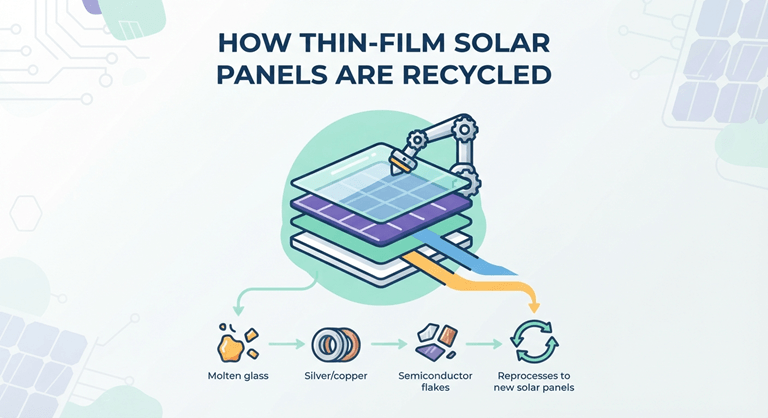
These components are taken off, which helps to reduce the panel to its fundamental layers. The recycling can then be directed towards the separation of the glass, the backing material, and the thin semiconductor layers.
Separating the Thin-Film Layers
Thin-film recycling gets more specialized at this point. The PV material is bonded in thin layers into the panel, and the PV material must be well separated from the glass/backing material.
The panel can be crushed, milled, heated, washed,d or chemically separated, depending on the panel type and recycling process. The ultimate aim is to de-glass and to recover valuable and sensitive materials in the semiconductor layer.
Recycling in the case of cadmium telluride panels could involve glass collection and the collection ofcadmium-m and tellurium-containing material. For CIGS panels, it can concentrate on the separation of glass and recovery of metals like copper, indium, gallium, and selenium that can be achieved.
Why Recycling Thin-Film Panels Matters
The importance of recycling thin-film solar panels is that materials within the panels should not just be discarded as waste. There may be a recovery value for some materials, and others may need to be handled with care due to chemistry.
Recycling also plays its role in the greater purpose of solar energy. Solar panels are fitted to generate ‘cleaner’ energy, but the full picture of environmental responsibility is also about managing them at the end-of-life. When panels are not recycled, they lose out on valuable materials and future waste issues become more difficult to handle.
Final Thoughts
Though thin film solar panels are important, efficient, and useful for many solar projects, they must undergo proper end-of-life management. Unlike traditional solar panel recycling, they are layered and use special semiconductor materials.
The right strategy is to figure out what type of panel it is, care for broken panels, organize materials, and recycle the panels via a process for recycling thin-film solar panels. If managed properly, old, thin-film panels could transition from retired solar panels to a cleaner recovery stream, rather than being wasted.
Popular on OTW Right Now!




About The Author

Gagan Bhangu
Founder of otechworld.com and managing editor. He is a tech geek, web-developer, and blogger. He holds a master's degree in computer applications and making money online since 2015.