
How Smart Packaging Tech Is Reducing Food Waste
Most people don’t think about packaging until it fails.
It is the chicken pack that is stinking a day before. The softening fruit that falls before the weekend. The prepared food that spills in the grocery bag. When food goes bad, we fault the store or the brand. When does the benchmarking time start to ask ourselves what has happened to it long before it goes to the shelf.
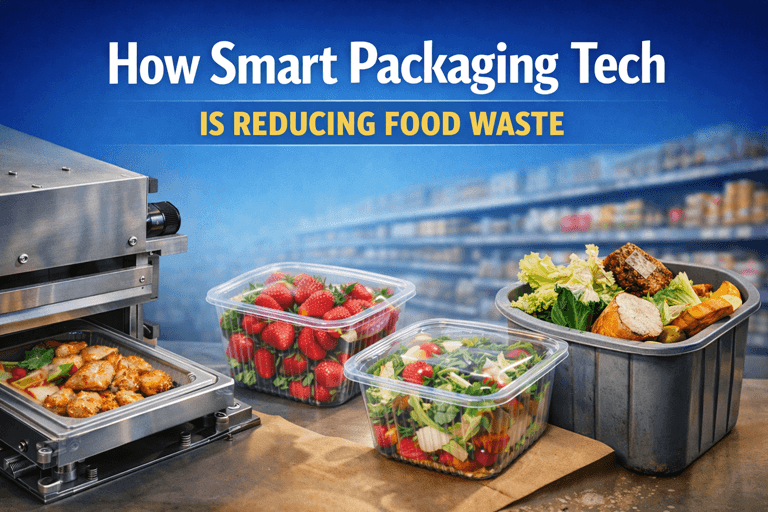
However, packaging is even greater than we all think.
Behind the scenes, food producers are increasingly investing in tray sealing technology to protect products from air exposure and contamination. Although consumers may not actually observe these systems at work, the effects of these systems are reflected in the fresher products, reduced leaks, and increased shelf life.
And in today’s economy, that matters.
Why Food Waste Often Starts Before We Shop
Much of the food waste occurs before even the products make it to our kitchen. Even non-significant sealing irregularities during transport and storage could allow oxygen in packaging. It is exposure that causes bacterial growth and reduces freshness.
In the case of grocery stores and restaurants, it would be the unsold inventory. On the one hand, it can translate to rising prices for families, since waste was reflected in the costs of operation by businesses.
The current systems of packaging are developed to minimize that danger.
Rather than using hand packing or loosely-tape wrapped trays, automated sealing systems exercise a tight grip on heat, pressure, and timing, forming uniform, airtight wrappings. This minimizes the chances of contamination and works towards quality maintenance along the supply chain.
What Makes Packaging “Smart”?
Whenever individuals mention smart technology, they tend to imagine artificial intelligence or apps. In food production, smart merely entails accuracy and predictability.
State-of-the-art systems keep track of temperature and pressure to make sure that all packages are created to the same standard. Others also endorse the concept of modified atmosphere packaging, where the oxygen contained in the tray is replaced with some protective gases to reduce spoilage.
The result isn’t flashy. It’s practical.
Food retains its freshness without having to rely much on preservatives. Goods move much longer distances and do not lose their safety. And businesses get greater leverage over quality.
Extra human-handling is also minimized, and this minimizes the risks of contamination as well, due to automation. Each of the sealed trays is put through the controlled procedure – there is no shortcutting, no guesswork.
A Quiet Shift in Local Food Businesses
Although big manufacturers were the first to implement automation, the mid-sized manufacturers and regional suppliers are also adopting it.
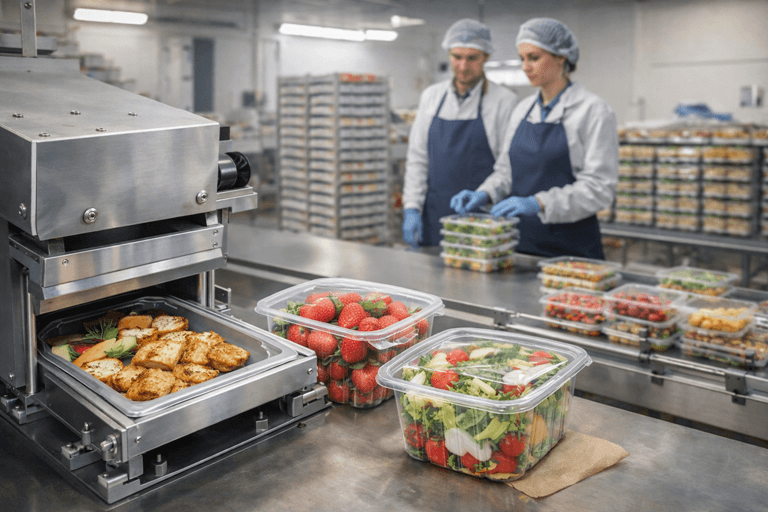
That transformation gives power to local economies.
The restaurants that place the ingredients prepared in advance enjoy more and more reliable storage. The supermarkets are in a position to keep ready-to-eat meals in their stocks. Smaller manufacturers are able to make distribution bigger than their local location without considering early spoilage.
Certain equipment salespeople are targeting accessibility of these emerging businesses. One such example is the firms such as Utien that create automated systems where efficiency and cost-effectiveness are synergetically shaped so that more food producers can implement high-end sealing solutions without necessarily having to upgrade their infrastructure.
It is not with the aim of industrializing local food. It’s to protect it better.
Sustainability Starts With Less Waste
The waste of food is not only a cost issue but also an ecological problem.
When food is disposed of, all the water used, the energy, manufacturing, and transportation costs used in processing the food are also wasted. The ability to increase the shelf life by a few days will make a huge difference in that effect.
This is directly involved in better sealing.
Better airtight packaging would result in less spoiled product. There are also systems whereby businesses can make use of lighter materials since enhanced sealing strength counters diminished plastic thickness.
And for sectors like fresh produce, reliable produce packaging solutions are becoming increasingly important. Fruits and vegetables are particularly sensitive to air and moisture exposure. Improved packaging helps preserve texture and quality while reducing shrinkage for retailers.
The consumer might not actually see the machines that are involved in these advances, but he does see the strawberries in the fridge when they stay longer.
The Growing Role of Data
The other reason why the technology in packaging keeps developing is the aspect of integration of data.
Current systems are able to monitor performance parameters throughout operation, as they are perceived, and exceptions are detected immediately. A seal that is not applied correctly allows the equipment to either flag or delete a package from the production line.
Such a built-in control of quality prevents the risk of recalls and brand protection.
In the long run, the production data can also assist businesses in identifying trends, such as the most challenging spoilage times or workflows that are not efficient. Changes can be made in time, and tiny problems will not turn out to be huge financial burdens.
Here, packaging is silently converging with the larger trends of automation and operational intelligence.
Why Everyday Shoppers Benefit
There is no chance that you will be in a supermarket and consider wrapping equipment. But its effects are visible.
Fewer leaking trays. More consistent freshness. Better defined packaging integrity. Even a longer storage time once you get home with their products.
And, possibly, most interesting, better price stability. The less business is wasted, the fewer losses are absorbed by it, a fact that can be used to mellow down cost increases meant to be transferred to the consumer.
Improved packaging does not help to prevent the wastage of food completely. But it minimizes preventable waste – the type of waste that arises due to the avoidance of air and poor seals.
What’s Ahead for Packaging Innovation
In the future, it would be expected that packaging technology will not change drastically but will probably keep on advancing quietly.
There will be increased automation of regional facilities. Hopefully, it will be more compatible with recyclable and biodegradable materials. Assure further unification of packaging equipment and supply chain software.
The finest technology usually just works in the background.
When food remains fresh as long as it ought to. When packaging holds firm. When shelves are well-filled without wastage. When there is less food in dumpsters.
Such in crements count.
Packaging can never be a trend on social media. However, with smarter and more open sealing systems, they are transforming the flow of food out of production lines and onto people’s dining tables in a safer, more effective, and efficient way with less wastage en route.
Popular on OTW Right Now!
-
 Using Specialized D&O Policies to Safeguard Against M&A Risks
-
How to Launch a Print-on-Demand Wall Art Store on Shopify in 2026 (Automations, Apps, and a Clean Workflow)
-
 Smart Moves: How Better Data Collection Leads to Better Decisions
-
 Top Programmatic AdTech Companies: 5 Reputable Providers to Know




About The Author

Gagan Bhangu
Founder of otechworld.com and managing editor. He is a tech geek, web-developer, and blogger. He holds a master's degree in computer applications and making money online since 2015.