
How NYC Professionals Are Rethinking Where They Work
Something fascinating is happening across New York City’s work culture. Walk into any coffee shop in SoHo or Williamsburg on a Tuesday morning and you’ll immediately notice laptops everywhere, unprepared meetings happening over cold coffee, and professionals who clearly aren’t just wasting time before heading to their office. The coworking space concept has evolved far beyond what anyone expected, and NYC professionals are leading this transformation.
The data make for a strong case. Coworking locations in NYC grew by over 6% between 2024 and 2025, with even faster growth, about 8%, in the outer boroughs. Manhattan office attendance remains roughly 20-24% below pre-pandemic levels, as per the Partnership for New York City.
What the numbers don’t show, though, is the fundamental shift in what professionals actually want from their workday. It’s no longer just a desk and Wi-Fi. People started looking for ways to connect with others, get things done, and find places that motivate them.
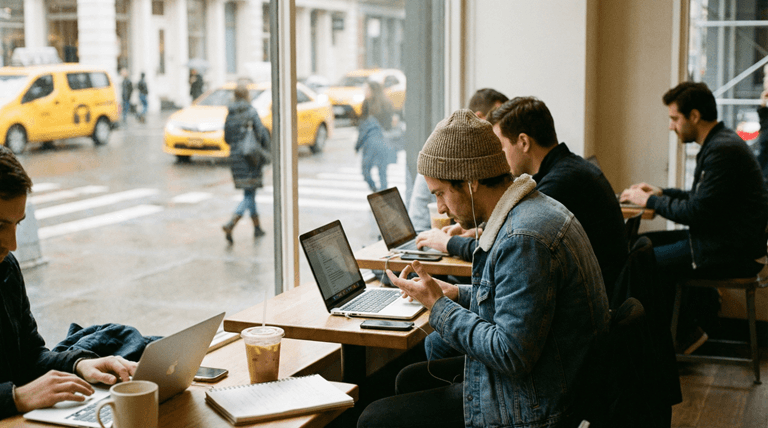
Why NYC Professionals Are Leaving Traditional Offices
For years, the conversation around flexible workspaces in NYC revolved around cost savings and lease flexibility. Companies wanted to avoid the crushing overhead of traditional office space. Freelancers wanted somewhere to escape their apartments. Even though these reasons are still there, something deeper has taken their place.
Remote workers consistently report loneliness as a top challenge – Buffer’s annual survey places it among the top three struggles. Meanwhile, research published in Harvard Business Review found that 83% of coworking space members feel less lonely since joining a shared workspace.
Traditional coworking environments addressed the loneliness problem by putting people in the same room. But many professionals discovered that sitting next to strangers who happen to be working doesn’t create a meaningful connection. You’re essentially alone, just surrounded by other alone people.
Why Modern Workspaces in NYC Are Evolving Beyond the Desk
The most interesting development in modern workspaces in NYC isn’t about amenities; it’s about intentional community design. Some platforms recognize that productivity and true professional relationships are not mutually exclusive goals. They are tightly linked.
84% of people who work in coworking environments report feeling more motivated. But dig deeper, and you find that motivation spikes dramatically when people feel a genuine connection to others around them.
This explains why some professionals report productivity gains of 1.5 to 2 times their normal output in community-focused settings. The energy of working alongside motivated peers, even when you’re not directly collaborating, creates accountability that home offices and sterile coworking floors simply can’t replicate.
Think of it like this: there’s a difference between coworking and working as if you have coworkers. One is a real estate arrangement, while the other is an experience that changes how you show up.
The Venue Revolution: From Office Parks to Rooftops
NYC professionals are discovering that where you work affects how you work. A growing movement is emerging around working from distinctive locations like rooftop bars that accommodate laptop use during daytime hours, private studios that feel more like creative retreats, and restaurants offering places to work during off-peak hours while remaining hospitality-first.
This isn’t about Instagram-worthy backdrops (though that’s a perk). Research shows that environmental variety actually boosts cognitive performance. Working in different settings throughout the week can reduce the mental fatigue that comes from staring at the same four walls every day.
Neighborhoods like the Lower East Side, Hudson Square, and parts of Brooklyn are seeing this play out in real time. Venues that sit empty during weekday mornings are finding new revenue streams by welcoming remote workers, while professionals gain access to refreshing places to work that they’d never find through traditional coworking searches.
Booking platforms like Wayo are facilitating this shift, connecting professionals to Community Workdays at independently owned and operated host venues. The model creates a win-win: host venues generate revenue during slow periods, and professionals gain access to new ways of working in NYC that feel completely different from traditional coworking.
Reality of Hybrid Work in NYC
According to a CNN survey, only about 4% of CEOs are still insisting on five-day office returns. Meanwhile, 53% of companies now require at least three days in the office, up from 37% the previous year.
This creates an interesting challenge for professionals. You need a place to work, but not every day. You want flexibility but also consistency. And you increasingly want your work environment to add value to your day rather than just serve as a functional backdrop.
The “hub-and-spoke” model is gaining traction across the city. Companies maintain a central office in Midtown or the Financial District for key collaboration days while giving employees access to satellite options closer to where they live. For individuals, this translates to a need for on-demand access that doesn’t require long-term commitments or exorbitant day pass fees.
As of 2025, the Class A vacancy rate in Manhattan is around 15%, and in Brooklyn, it has jumped to nearly 26%, well above pre-pandemic rates below 8%. These numbers signal that traditional leases are struggling to attract tenants who increasingly value flexibility, scalability, and simplicity.
What Actually Drives Productivity in Flexible Work Settings
When professionals talk about what makes a work environment effective, amenities rarely top the list. Yes, reliable WiFi matters. But the factors that actually move the needle on productivity are more subtle:
Energy and atmosphere. The feeling of being surrounded by focused, motivated people creates natural accountability. It’s harder to scroll Instagram when everyone around you is clearly getting things done.
Spontaneous connections. The ability to strike up genuine conversations, not forced networking. The best professional relationships often start with a random comment at the coffee station.
Environmental variety. Access to different types of settings for different types of work – quiet areas for deep focus, collaborative zones for brainstorming, and comfortable spaces for calls.
Inspiration. Venues that feel special make you want to show up. A rooftop with a Manhattan skyline view hits differently than a fluorescent-lit cubicle farm.
This is where newer approaches diverge from the WeWork model that dominated the 2010s. The focus is shifting from polished aesthetics and premium pricing to genuine experience design. How does the setting make you feel? Does it help you do better work? Would you recommend it to a friend?
Community Workdays: A New Flexible Workspace Model
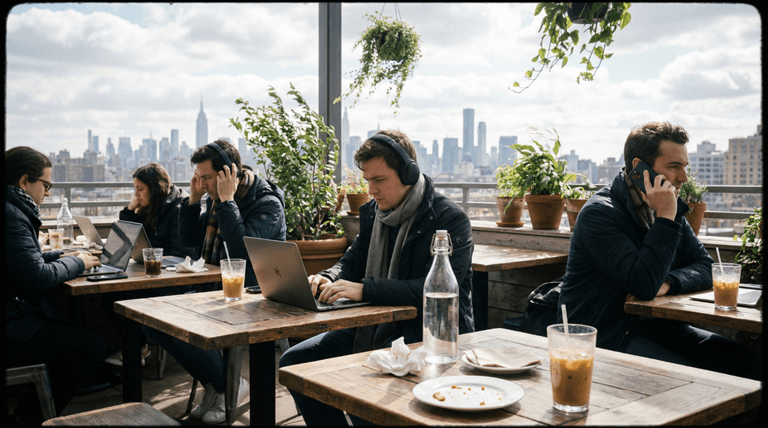
Perhaps the most interesting innovation is the concept of structured Community Workdays. Rather than simply providing access to space in which to work, some platforms are facilitating scheduled gatherings where like-minded professionals come together intentionally. The model differs from typical coworking in crucial ways. Instead of anonymous drop-in access, participants know they’re joining a curated community.
Wayo facilitates this approach through its booking platform, connecting people to Community Workdays at host venues across NYC. Early participants consistently describe these experiences as “the best workday they’ve ever had.” The feedback centers on three things: they were more productive, they made 2-3 meaningful connections on average, and the venue itself inspired them.
Even participants who didn’t directly interact with others reported that the curated community significantly enhanced their productivity.
What This Means for NYC Professionals
The evolution of workspace culture in New York reflects a broader shift in how we think about work itself. The pandemic didn’t just make remote work viable; it forced a reckoning with what office environments actually contribute to our professional lives.
For many NYC professionals, the answer isn’t returning to traditional offices or committing to permanent coworking memberships. It’s finding flexible solutions that adapt to different work needs on different days. Deep focus work may take place at home, collaborative sessions at a central location, and for the days in between. That’s where creative platforms and community-centered experiences come in.
In 2026, the most successful professionals are approaching their workday strategically. They’re asking: What environment helps me do my best work today? Where can I make meaningful connections? How can I avoid the isolation of home office days without sacrificing flexibility?
Finding Your Ideal Work Environment
The workspace landscape will continue evolving. Traditional office models aren’t returning to pre-pandemic norms anytime soon. Meanwhile, flexible options continue their steady expansion, particularly in neighborhoods outside Manhattan’s traditional business districts – Queens, Brooklyn, and even parts of the Bronx are seeing new approaches emerge.
What’s developing is a more thoughtful, personalized approach to where we work. The question isn’t anymore just “desk or no desk”; it’s about finding environments that contribute positively to both productivity and well-being.
For NYC professionals navigating this landscape, the key is experimentation. Try different settings; notice what affects your energy and output, and pay attention to whether you’re just occupying space or actually feeling part of something.
The best option for you might not be a traditional workspace at all – it might be a rooftop that accommodates laptop use while remaining hospitality-first, a restaurant private room, or a Community Workday alongside like-minded professionals.
The city that never sleeps has always been about reinvention. Now that extends to how we work, not just where.
Popular on OTW Right Now!


About The Author

Gagan Bhangu
Founder of otechworld.com and managing editor. He is a tech geek, web-developer, and blogger. He holds a master's degree in computer applications and making money online since 2015.