
How Flat-Rate Managed IT Ends Unpredictable Business Costs
Managing a business budget is challenging enough without the sudden shock of a massive technology repair bill. Many operations managers and CFOs in Vancouver struggle with disjointed cloud environments, outdated hardware, and the constant stress of potential IT emergencies. You likely know the feeling of opening an invoice only to discover thousands of dollars in unexpected charges just to get your network running again.
Welcome to the world of “break-fix”. With this archaic model, you’re charged expensive hourly rates for emergencies after the fact. Your company must wait for operations to be disrupted and employees to be unhappy while the fire is put out.
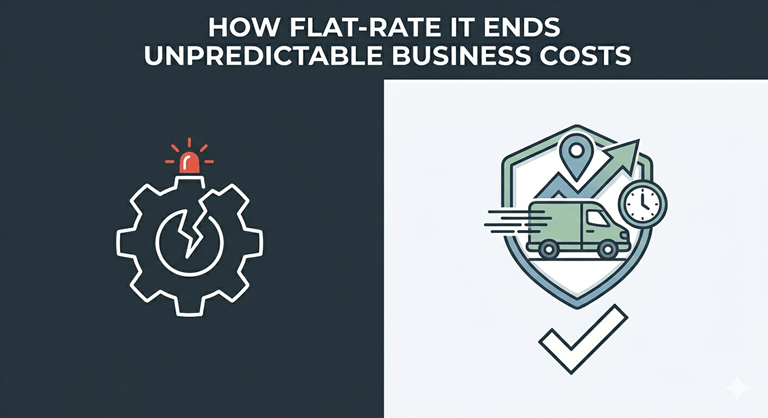
Rather than a server going down and paying emergency hourly rates, leading companies are working with proactive partners. By embracing a fully managed regional IT infrastructure, companies can negotiate fixed prices and no nasty surprises.
Going proactive with IT support means more than just repair work. It provides Budget certainty, removes commonplace outages, and turns your technology from a liability to an enabler of growth.
Key Takeaways
- Reactive “break-fix” IT services present huge budget risks and disguise enormous costs.
- Managed IT services, with flat-rate pricing, help you avoid budget shocks.
- 24/7 monitoring, disaster recovery, and advanced open-source software drive down your infrastructure costs.
- Allying with an effective local IT partner transforms your technology from expense to investment.
The Hidden Financial Dangers of the Reactive “Break-Fix” IT Model
Conventional business IT management is commonly referred to as the “break-fix” model. At first glance, only paying for IT services when they break down is an excellent way to minimise costs. But this approach completely exposes your business to today’s cyber threats and hardware malfunctions.
With a reactive model, there is a huge conflict of interest between you and the IT provider. Your IT vendor profits when your business is in the midst of a disaster. They have no incentive to make sure your network runs smoothly, to keep your data safe, or to help prevent the next major outage.
This quickly spirals into problems of “tech debt”. By avoiding timely system upgrades and maintenance, system errors begin to snowball. This ultimately leads to high unplanned costs in rebuilding after a disaster.
Calculating the True Cost of Network Downtime
The cost of a server crash goes well beyond the cost for your IT guy on an hourly rate. Loss of productivity, revenue, and reputation are just some of the consequences of network downtime.
Gartner recently quantified this massive risk for modern businesses. Their research shows the average cost of network downtime is $5,600 per minute across all industries. This number scales aggressively as the minutes tick by.
“The cost of an hour of downtime for the majority of midsize and large enterprises today is more than $300,000.”
The ITIC 2024 survey backs up the size of these incidents. In fact, their survey shows that 90% or more of midsize and large enterprises report that the loss of a single hour of service costs them over $300,000. These crippling outages are the direct result of the cost-cutting mentality of trying to save a few bucks on maintaining IT.
| Outage Duration | Estimated Cost (Based on Averages) | Business Impact |
| 5 Minutes | $28,000 | Minor disruption, delayed emails, employee frustration. |
| 1 Hour | $336,000 | Significant productivity loss, missed sales, and customer complaints. |
| 4 Hours | $1,344,000 | Severe financial damage, potential data loss, reputational harm. |
How Flat-Rate Managed IT Services Provide Budget Predictability
Managing IT costs through a predictable fee-based approach is the answer to the unpredictable IT budget. With a flat-rate model, you pay a fixed monthly fee for ongoing technical support and monitoring. The transparent pricing model eliminates unpredictable bills and the shock of high repair costs.
The model impacts how your finance team thinks about technology. It takes your technology costs from variable capital expenses (CapEx) to fixed operating expenses (OpEx). CFOs can develop their budgets with unprecedented ease with a fixed price for technology services 12 months ahead of time. With a flat-rate agreement, this dynamic is inverted; the company takes on the risk of network outages and has an interest in preventing them.
Achieving a Worry-Free Technology Experience
When evaluating options, you should look for a provider that includes proactive day-to-day management as part of its core offering. By leveraging specialized IT solutions in Vancouver, your business gains access to proactive care that actively prevents disruptions from ever reaching your employees.
This all-inclusive pricing model guarantees your upgraded infrastructure is always running at peak performance, offering you a stress-free IT experience so you can concentrate on expanding. Rather than worrying about technical intricacies or variable expenses, have a partner who’s in the business of removing obstacles and making sure your IT infrastructure remains a solid foundation for your business.
Core Pillars of Proactive IT Management
Predictable IT isn’t just about changing your method of payment. It’s about shifting your operations to proactive threats and planning.
Your IT environment must become more stable, rather than patched. Managed IT companies use certain technical solutions to proactively avoid crises, thereby reducing your expenses.
Proactive Network Assessments and Cybersecurity
Relying on a reactive security strategy is no longer a viable option for modern organizations. Cybercriminals are actively seeking out vulnerable, under-protected networks. In fact, 43% of all cyberattacks now target small businesses because hackers know these companies lack proactive defenses.
To prevent this, managed service providers conduct thorough proactive network audits. These tests uncover security loopholes and old protocols, as well as performance issues that could cripple the network. Discovering an open port or an unpatched server early in the day allows a small mistake to become a whole business catastrophe.
Never before has the cost of cybersecurity been greater. This risk is outlined in IBM’s 2024 Cost of a Data Breach report. It states that the average cost of a data breach is $4.88 million. These enormous losses can only be avoided through proactive security.
Disaster Recovery and Business Continuity
Loss of information is a huge risk, but this is not enough to sustain your business. Backups and disaster recovery are not the same.
Business continuity plans keep your business afloat during an emergency. In the event of a fire consuming your business premises or a server crashing, your continuity plan outlines how your business will continue to operate. It includes remote virtual machines, enabling your employees to have access to their work in just minutes.
Your disaster recovery plan is the best insurance against network outages. It eliminates large downtime costs, as mentioned earlier. You can safely sail through a hardware crisis without any concerns about your operations and data.
Leveraging Open-Source Virtualization (Proxmox)
Physical servers are costly to acquire and maintain. Virtualization tools can help consolidate these servers, but enterprise licensing for legacy software is typically very costly. This can be prohibitively expensive for small and medium-sized companies.
Proxmox is an open-source alternative that offers flexibility and affordability. It enables you to host multiple virtual servers on a single physical machine with none of the hefty cost of proprietary software. This significantly reduces the monthly cost of your infrastructure without compromising performance or reliability.
Partnering with an IT services company with the expertise to provide end-to-end Proxmox solutions is a huge win. They can manage the consultation, secure relocation, and hosting of this open-source KVM hypervisor. Reach enterprise-grade speeds and efficiencies at a fraction of the time and cost.
What to Look for in a Vancouver IT Partner
When selecting a strategic IT vendor, look for a strategic partner, not someone to help you set up your helpdesk. Look for an IT team familiar with the Metro Vancouver business environment. They need to provide full-service, enterprise-level IT support, focused on your business.
Look for partners who speak in relationship terms at first meetings. Look for a vendor who promises strategic technology planning rather than short-term solutions. An excellent partner will meet with your leadership team to talk about your 12-month priorities as well as financial restrictions.
As well, encourage your team to assess the vendor’s readiness to do critical assessments first. A good managed IT service provider will audit your network to demonstrate its expertise to you before signing an agreement. This allows you to know what’s wrong and how the provider intends to fix it.
| Feature | Reactive “Break-Fix” IT | Strategic Managed IT Partner |
| Pricing Structure | Unpredictable hourly rates. | Flat-rate, predictable monthly fee. |
| Vendor Incentive | Profits from your network failures. | Profits when your network is stable. |
| Security Posture | Responds after a breach occurs. | Proactively hunts for network vulnerabilities. |
| Technology Strategy | Replaces parts as they permanently fail. | Plans hardware lifecycles and modern upgrades. |
Conclusion: Take Control of Your IT Budget
It’s time to stop putting up with unexpected IT expenses and fragmented technology support. The cost of network downtime and data security incidents is too great for businesses to overlook. Your company needs an IT structure that helps you grow, not one that costs money.
Adopting a fixed-rate, proactive managed IT approach solves these vexing operational problems. It stops the accrual of technology debt, protects your confidential data from cyber attacks, and enables accurate budgeting. Predictable costs eliminate the fear of receiving your monthly technology bills.
By embracing predictable technology, your whole leadership team can focus on growing the business instead of fighting fires. You should not have to worry about network issues and cybersecurity. Schedule a free network assessment to discover your vulnerabilities and transition to a flat-rate, predictable IT model.
Popular on OTW Right Now!



About The Author

Gagan Bhangu
Founder of otechworld.com and managing editor. He is a tech geek, web-developer, and blogger. He holds a master's degree in computer applications and making money online since 2015.