
How Digital Tools Can Help You Take Control of Your Credit
Credit used to feel like something that happened in the background. You applied for an account, received a decision, and were given little insight into the information behind it. Digital tools have made the process more visible. You can now check accounts from your phone, view a credit report online, receive payment reminders, and organize household costs without waiting for a paper statement.
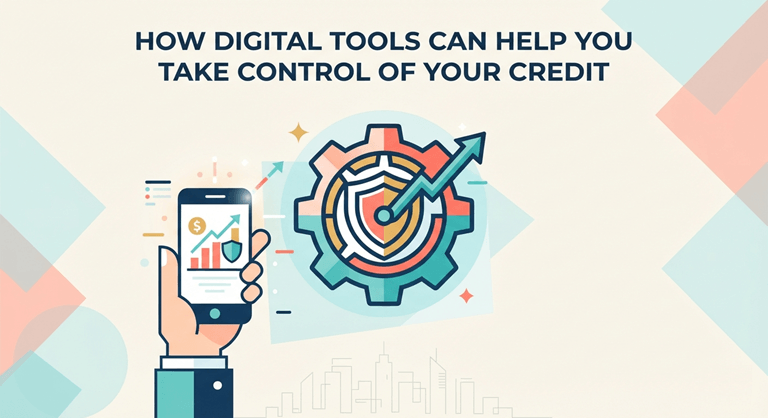
Increased information does not necessarily lead to improved decisions, however. If every finance app has a different score, or is constantly notifying you of new products, or gets you to apply for unnecessary finance products, you can still get confused even with a phone full of finance apps. It is not the number of features that make financial technology useful, but rather the ones that are. This is how those features will allow you to detect issues earlier, comprehend patterns, and act without being pressured.
Use technology to see the whole picture
The most obvious place to start is with a banking app, since it demonstrates what is going on presently. You might see an unexpected payment and receive the transaction notification within a couple of seconds, and you could be warned when a direct debit is due thanks to a balance alert. These are great when multiple small payments or a subscription are made over the course of a month. This will save you the trouble of having to remember the pattern and determine what’s still worth putting in your budget.
Credit report services offer the other perspective. They can display accounts that you have, your payment history, any searches made about you, and information on your addresses. While the app’s score may be helpful as a general guideline, it is not always the same number and applies differently to all lenders. Affordability is more than the score, and each lender sets their own. A report is most useful if it is used to see if the facts it lists are true and a report of accounts that you no longer recognize is examined.
Avoidable mistakes can be avoided with calendar and reminder apps! Sometimes, people may miss paying back their debts due to other reasons. This can be due to a missed annual bill, a change in a payment due date, or the presence of funds in the wrong account. Putting reminders in advance of significant payments allows you time to take the necessary action. Please ensure the dates when you receive income and the dates when you spend income coincide so the system is easier to manage.
Some budgeting apps can consolidate multiple accounts, classify expenses, and display them in trends over time. They often don’t get the categories right, so it may take some time in the first few weeks to get used to them. It could be a transfer to a savings account is classified as an expenditure or a trip to the supermarket contains items that do not fit in the food bucket. The value is giving attention to the overall direction and not to the perfection of every transaction.
Security applications need to be on par. Create strong and unique passwords for financial accounts and emails and use multi-factor authentication. Your email address is one of the ways you will receive your password reset, so it’s important to keep it secure. It’s also important to note that device updates are significant as well since they contain bug fixes that can be used by the bad guys for malicious software.
Do not let an app rush the decision
There are financial applications that are really intending to minimize the friction, which can be fine with regard to checking your balance, but not so fine if you’re entering into a commitment. When they are already filled out,t and you are notified instantaneously of eligibility to borrow, it can feel like another easy online transaction. The application doesn’t speed up the repayment term nor decrease the quantity of total payments. Stop before you go any further, take the app away, and take a look at the decision within your total monthly budget.
This is particularly important when your credit history has been affected by missed payments or other difficulties. Products described as bad credit loans may be relevant to some circumstances, but the label does not explain whether a particular agreement is affordable or suitable. Read the interest rate, the total amount that will be paid back, the term, and the fees. Imagine that, if you had another normal bill or expense for repair or maintenance, in the same month, how would that affect the payment?
Be cautious with services that promise to repair a credit score instantly. If you download an app or pay a subscription, you don’t often get rid of accurate negative information. Useful services can help you understand reports, detect mistakes, and cultivate better habits, but can’t rewrite legitimate payment history in an instant. Typically, improvement occurs with consistent behavior over time, for example, making agreed commitments when they are expected and maintaining control over balances over time.
There must also be limits placed on notifications. Increased alerts can lead to anxiety, but not increased awareness. Select the messages that have a useful purpose, such as an out-of-balance warning message or a confirmation when a card payment is made, and turn off promotional messages that don’t have a useful purpose and which might encourage unnecessary spending. Any technology should make you aware of important events and not your finances all of the time.
It’s good to have some data not in one app. Save important agreements and keep track of when they will expire, and be able to reach providers without using a saved link. Apps update, companies merge, and phones go missing. A basic backup system makes for a convenient but not dependent system.
Modesty is the ideal size for digital. A safe banking application, access to your credit report, a calendar, and a budgeting system you can understand might be sufficient. It should be a clear problem to solve when adding a service and not just yet another score or dashboard to be reviewed. Technological solutions that help eliminate forgotten payments, illuminate unhelpful spending, and free up time to think promote good credit habits. Often, when it instills urgency or confusion, it’s better to step back and use the tool.
Popular on OTW Right Now!


About The Author

Gagan Bhangu
Founder of otechworld.com and managing editor. He is a tech geek, web-developer, and blogger. He holds a master's degree in computer applications and making money online since 2015.