
How Can Restaurants Get Smart with Online Orders and Reservations?
Online orders and table bookings either make your service run like clockwork—or silently kill it. The most intelligent solution is to consider them as a single system: a single menu, a set of rules, a source of truth, and a workflow that your staff can effectively follow on a busy night.
The real problem
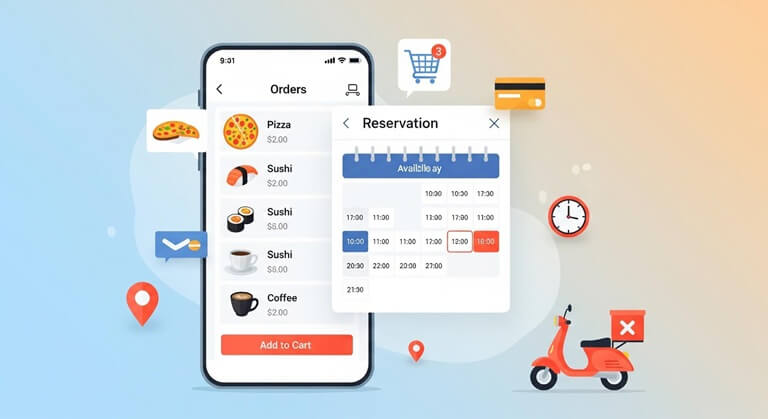
The majority of restaurants do not have problems with the necessity to simply have more apps. They find it difficult due to the fact that orders and bookings come from too many places, at too many speeds, and do not share any common logic. One of the tables is booked at 7:00, a delivery order arrives at 6:55, the kitchen is already busy, the dining room is waiting, and the drivers are hovering around the pass.
This is important as the guests don’t care why it happened, but they experience the waiting. The worst combination when no one has organized online ordering and reservations is a stressed staff, imbalanced timing on food, and a customer who will choose to make future bookings elsewhere instead.
There’s also a money angle. Restaurants are often required to pay commission fees to third-party delivery platforms, which range in the neighborhood of 15-30 percent per order. This can make what otherwise would be considered a busy day a barely profitable one unless managed well.
Build a simple stack
A smart setup doesn’t necessarily mean an all-in-one solution. It consists of choosing a small collection of tools that communicate with one another—and then defining your operations in terms of those tools.
The practical objective here is simple: all orders and all reservations need to fall into a single location your team feels comfortable with, either linked up (preferably) to your POS or at least synchronized in a manner that does not create duplicate entries.
An excellent stack is typically composed of:
- One ordering channel that is under your control (website ordering or a direct ordering link).
- A dedicated reservations system (handling timed reservations, table combinations, and walk-ins).
- A single kitchen workflow: either KDS or printers, but not an all-in-one confusing system where employees have to check the iPad, then check the email, then check the POS.
And here is the unglamorous side that makes it all work: reliable connectivity. When the Wi-Fi goes dead in the middle of service, the tablets cease taking orders, credit cards take a while to process, and the front-of-house is left to make apology rounds. The idea of investing in reliable internet solutions for business isn’t exciting, yet it can be the difference between a seamless transition and anarchy with delicious food.
Another reality test: online food delivery is not shrinking; it is growing at an alarming rate, so operational discipline becomes increasingly important with every passing year. As an example, the size of the global online food delivery market is estimated at USD 288.84 billion in 2024 and is predicted to grow significantly by 2030.
Even service during the busy nights
Smart restaurants do not simply take phone orders online. They control the flow.
Take the example of a Friday evening when every decision is weighty. In case online orders come in unlimited numbers, they will interfere with your dine-in wave. So instead of desiring the kitchen to be a long hallway, have some crude guardrails installed, which would protect the service.
Strategies effective in the real world:
- Capacity to throttle when peak times come. Various ordering systems will give you a chance to limit each order to 10-15 minutes or to automatically extend the amount of time needed to prepare an order when the kitchen is crowded.
- Apply different prep times for pickup and delivery. Buffer time is frequently required in delivery orders since the arrival of the driver is unpredictable.
- Switch off the sources that interrupt your line. If one dish ties up your fryer for six minutes and destroys ticket times, take it off the menu (86 it) when you are in a rush.
- Create a “handover zone.” Special counter space, a shelf, simple labelling etc–whatever will ensure that drivers and pickup guests do not litter your pass.
Case in point: Consider a busy local Warrawong restaurant during a rainy weekend evening.
The restaurant is full to the brim, the phone continues to ring, and pick-up orders are already mounting. Whether this is a good or a bad night depends on a single decision: whether the team has one screen (or print stream) that it is following, with clear cutoffs and time policies, or is juggling four streams with one foot in the dark and deciding which of the orders to fill first.
Also worth mentioning: a customer will pardon a longer quoted time more than they will pardon being quoted 20 minutes and waiting 45. Intelligent management is sincere management.
Revenue protection policies
Most restaurants lack regulations on this ground since they are afraid of their customers being interrogated. Nevertheless, the right policies are not harmful-they bring light.
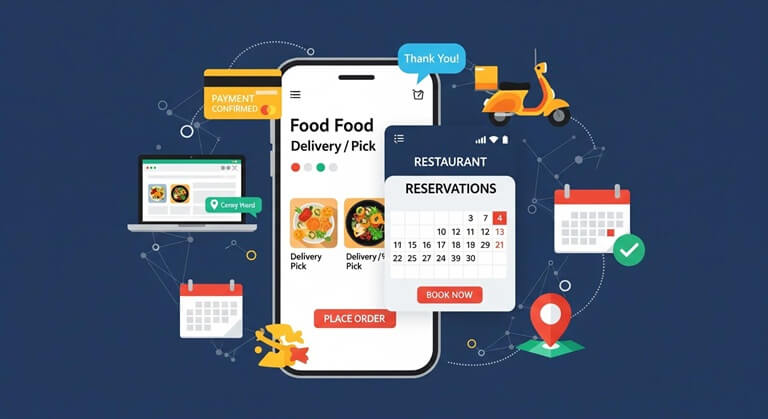
In the example of the reservation, the highest cost that is covered up is the no-show or the last-minute cancellation, which is like occupying a table that you would have sold twice. You must have been a party to this when you happened to have a complete booking sheet and then observed half a section of empty seats.
Reasonable solutions that work well:
- Remembering of the reservations (SMS/email) with a convenient link to Modify/Cancel.
- Deposits for high-season periods or big parties.
- Peak seating times with straight cut terms are contained in credit cards.
Such tactics prove to be effective. Such platforms as OpenTable argue that the deposit decreases no-show rates by approximately 57%.
Things are slightly different policy-wise in the case of online ordering: the concept is the same, though: get rid of uncertainties.
- Understandably, mark pick-up directions (where to park, where to enter, what name to use).
- Fix a final order time where closing procedures (clean-down of the kitchen is real) are observed.
- Make clear responsibility of refund/late delivery in case third-party drivers are used so that the staff does not need to make up at stress-out situations.
Finally, track your channel mix. The third-party marketplaces can be very good in discovery, but when you have a large percentage of your volume under big commissions, you are literally renting your own customer. Since platforms usually attract 15-30 percent commission, it is only prudent to treat third-party as a channel and switch regulars to direct ordering where possible over time.
Conclusion
The wisest option for dealing with online orders and bookings is to cease treating them as different worlds. Get everything into one trusted workflow, manage the demand during peak seasons, and have clear policies that will save not only your staff but your guests too.
With less complicated systems and consistent rules, keeping service standards is easy, food timing is better, and customers feel well taken care of, be it at table 12 or a bag at the counter. And that is the actual victory: fewer surprises, nicer nights, and a restaurant that functions the way it was built to take care of the dining experience.
Popular on OTW Right Now!


About The Author

Gagan Bhangu
Founder of otechworld.com and managing editor. He is a tech geek, web-developer, and blogger. He holds a master's degree in computer applications and making money online since 2015.