
How AI Is Turning Traditional CCTV Cameras Into Intelligent Security Systems
For decades, CCTV cameras have been good at one thing: recording what happened. The problem is that recording an incident and understanding it are very different jobs.
Consider the volume of footage alone. A business with 100 cameras operating 24 hours a day produces 2,400 camera-hours of video every day. No security team can realistically watch it all. When something goes wrong, finding a few useful seconds can mean searching through hours of recordings.
Security risks have not disappeared either. The FBI estimated 5.99 million property crime offenses in the United States in 2024, including 779,542 burglaries. Although property crime declined 8.1% from 2023, businesses and property owners still need practical ways to identify incidents and investigate them efficiently.
Artificial intelligence is changing that process. Instead of simply storing footage, AI-enabled systems can identify people, vehicles, objects, and certain activities, generate useful alerts, and make large video archives searchable.
In this article, we will look at how AI is giving traditional CCTV systems new capabilities and why the software behind security cameras is becoming just as important as the cameras themselves.
1. CCTV Is Moving Beyond Passive Recording
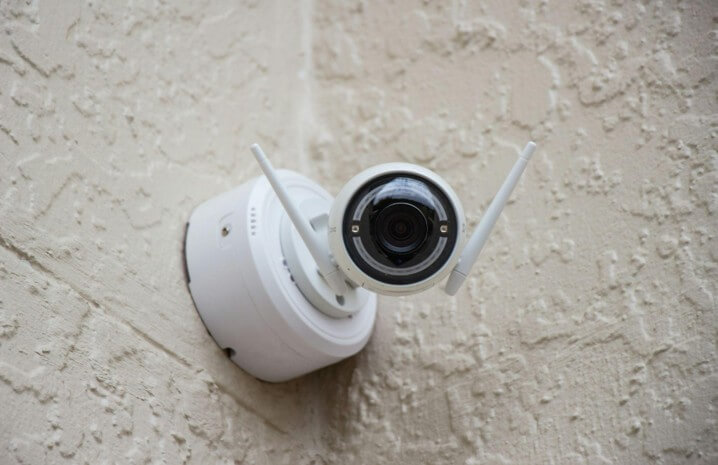
Traditional CCTV is largely reactive. Cameras capture video, a recorder stores it, and someone reviews the footage when an incident occurs.
Early video analytics added motion detection, but these systems had an obvious weakness. They often reacted to changes in pixels rather than understanding what caused those changes. A shadow, tree branch, animal, or passing vehicle could generate an alert.
AI adds context.
Computer vision can distinguish between different objects and activities. Instead of simply reporting movement, an intelligent system may determine whether that movement involves a person, vehicle, or another object that matters to the security team.
This broader change from passive surveillance to active analysis is also explored here in How AI Is Changing Physical Security, which looks at how AI can analyze surveillance feeds, classify objects, and help security teams identify relevant activity faster.
The difference can be summarized simply:
- Traditional CCTV asks, “What was recorded?”
- AI-enabled CCTV asks, “What is happening?”
- Searchable video analytics asks, “Where can I find the event I need?”
In many cases, the camera itself may not look different. The intelligence comes from the software interpreting its video.
2. Existing CCTV Cameras Can Become More Useful
Moving to AI does not always mean removing every existing camera.
Many organizations already have significant investments in IP surveillance infrastructure. If those cameras provide suitable video and use compatible standards, an analytics platform may be able to add intelligence without requiring a complete hardware replacement.
This is where CCTV analytics software becomes particularly useful. Coram, for example, describes a hardware-agnostic approach that can connect with existing ONVIF-compliant IP cameras. Its platform includes plain-language AI video search, Journey Views for following a person or vehicle across cameras, and real-time alerts for events such as unauthorised entry, forced doors, firearms, smoke, and slips and falls. Coram also says sites with more than 100 cameras can typically be connected in about 10 minutes, excluding any new camera installation that may be required.
The larger point is not about one platform. It is about how CCTV modernisation is changing.
Businesses can increasingly evaluate the cameras they already have before assuming that an intelligent security upgrade requires replacing the entire surveillance network. In suitable environments, the software layer may provide much of the improvement.
3. AI Makes Thousands of Hours of Video Searchable
Finding an incident in conventional CCTV footage can be frustrating.
Imagine that a warehouse manager discovers missing equipment at 8 a.m. Nobody knows whether it disappeared at midnight, 3 a.m., or shortly before the morning shift arrived.
If five cameras cover the relevant area, manually reviewing even eight hours means dealing with 40 camera-hours of potential footage.
AI-powered search can narrow that workload.
Modern analytics can index visual information such as people, vehicles, clothing, objects, and movement. Some platforms also allow natural-language searches, meaning an investigator can describe what they are trying to find instead of relying only on timestamps.
For example, searches might include:
- “White van near the loading dock after 8 p.m.”
- “Person wearing a red jacket at the rear entrance”
- “Vehicle entering the parking lot after midnight”
- “Person walking through this hallway after closing”
The system can then surface potentially relevant clips for human review.
This does not eliminate investigators. It helps them spend less time watching irrelevant footage and more time examining events that may actually matter.
4. Cameras Can Alert Teams While Something Is Happening
Traditional surveillance is often most valuable after an incident. Someone discovers a broken door, missing property, or damaged vehicle and then checks the cameras.
AI can shorten the time between an event occurring and someone becoming aware of it.
Depending on the system, video analytics can be configured to recognize particular events or conditions, including:
- People entering restricted areas
- Vehicles appearing in controlled zones
- Activity outside normal operating hours
- Possible smoke or fire conditions
- Falls and other safety incidents
- Potential weapons
- Unusual activity around sensitive locations
Context matters here.
A person walking through a warehouse loading area at 2 p.m. may be completely normal. The same activity at 2 a.m., when the facility is closed, may deserve attention.
An intelligent system can use rules, schedules, zones, and object recognition to make alerts more relevant. A security employee can then review the video and decide what response, if any, is appropriate.
AI is therefore better viewed as an early-warning tool than an automatic decision-maker.
5. Better Analytics Can Help Reduce Alert Fatigue
An alert is useful only if people pay attention to it.
Traditional motion detection can create large numbers of unnecessary notifications because it may react to anything that changes the image. Rain, shadows, insects, headlights, and vegetation can all create movement.
When employees repeatedly receive alerts that mean nothing, they may begin ignoring them. This is commonly known as alert fatigue.
AI analytics can improve the situation by distinguishing between different types of activity.
Suppose a company is concerned about people entering a fenced storage area between 10 p.m. and 6 a.m. The important event is not simply “movement”. It is a person entering a specific area during a specific period.
That additional context can help security teams build more targeted alerts.
For organisations managing dozens or hundreds of cameras, reducing irrelevant notifications can be just as valuable as generating new ones. The objective is not to create the maximum possible number of alerts. It is to surface events that deserve human attention.
6. CCTV Data Can Help Beyond Security
Once software can recognise and categorise what appears on camera, video can become useful for more than investigating theft or trespassing.
Retail stores, warehouses, offices, and other facilities can potentially use analytics to understand how physical spaces operate.
A retailer, for example, may notice that checkout lines regularly become crowded between 5 p.m. and 7 p.m. A warehouse could identify an intersection where forklifts and pedestrians frequently cross paths. A large office might examine how frequently certain common spaces are actually used.
Depending on the analytics available, organisations can study:
- Foot traffic patterns
- Queue formation
- Occupancy trends
- Vehicle movement
- Congested areas
- Recurring safety events
This changes the value of surveillance footage. Video no longer needs to become useful only after something goes wrong.
The same cameras installed for security may also provide information that helps businesses improve layouts, staffing, workflows, and safety procedures.
7. AI Still Needs Human Judgment
Intelligent CCTV is more capable than traditional surveillance, but it is not infallible.
Analytics can generate false positives or miss events. Performance can be affected by lighting, camera angle, image quality, weather, obstructions, crowded scenes, and the type of activity being analysed.
That is why human oversight remains important.
Organisations adopting AI video analytics should pay particular attention to:
- Camera placement: Analytics cannot reliably interpret an area the camera cannot clearly see.
- Human verification: High-impact alerts should be reviewed when appropriate before decisions are made.
- Privacy: Organizations need clear policies governing where cameras operate and how analytics are used.
- Video access: Recorded footage should be available only to authorized users.
- Retention: Businesses should determine how long footage needs to be stored.
- Regular testing: Alert rules should be reviewed to determine whether they are producing useful results.
AI should support security teams rather than remove judgment from the process. The technology is most useful when it helps people find information faster and make decisions with better context.
Traditional CCTV vs. AI-Enabled CCTV
| Capability | Traditional CCTV | AI-Enabled CCTV |
| Video recording | Yes | Yes |
| Basic motion detection | Common | Yes |
| Person and vehicle recognition | Limited | Available |
| Intelligent real-time alerts | Limited | Available |
| Natural-language search | No | Available on some systems |
| Cross-camera tracking | Mostly manual | Available on some systems |
| Operational analytics | Limited | Possible |
| Human review | Required | Still important |
The important distinction is not necessarily video resolution. It is how much useful information can be extracted from the footage and how quickly people can find it.
Key Takeaways
- AI is turning CCTV from a passive recording tool into a more active security system that can analyze what cameras capture.
- Existing IP cameras may still have value, since some analytics platforms can work with compatible third-party infrastructure.
- AI-powered search can reduce manual video review by helping teams find people, vehicles, objects, or events more quickly.
- Real-time analytics can improve awareness by alerting teams to defined events while they are occurring.
- More intelligent detection can reduce unnecessary notifications compared with basic motion-based alerts.
- Video analytics can support operations as well as security, including traffic, occupancy, queue, and safety analysis.
- Human oversight remains essential because AI results still depend on camera quality, environment, system configuration, and context.
FAQs
What is CCTV analytics software?
CCTV analytics software uses technologies such as artificial intelligence, machine learning, and computer vision to analyze surveillance footage. Depending on the system, it can identify people, vehicles, objects, movement, or particular events and make footage easier to search.
Can AI work with existing CCTV cameras?
Sometimes. Many modern analytics systems can work with compatible IP cameras, while older analog equipment may require additional hardware or replacement. Compatibility should be checked before upgrading.
How is AI video analytics different from motion detection?
Traditional motion detection primarily recognizes visual changes in an image. AI analytics attempts to understand what caused those changes, such as a person or vehicle, which can make alerts more contextual.
Does AI eliminate the need for security staff?
No. AI can help identify and prioritize events, but people are still important for verifying alerts, understanding context, investigating incidents, and deciding how to respond.
Can AI CCTV be used outside security?
Yes. Depending on the system, analytics can help organizations understand foot traffic, occupancy, queues, vehicle movement, and how certain spaces are being used.
Conclusion
The biggest change happening to CCTV is not necessarily inside the camera. It is happening in the software behind it.
A camera that once produced hours of passive recordings can now contribute to a system that identifies objects, searches video, highlights relevant activity, and helps investigators find useful footage faster.
That does not make the basics of physical security obsolete. Good lighting, sensible camera placement, access control, privacy safeguards, trained personnel, and clear response procedures still matter.
AI simply makes the huge amount of video organizations already collect easier to use.
As CCTV systems continue to grow, the more useful question may no longer be “How much footage can we record?” It may be “How quickly can we understand what our cameras are seeing?
Popular on OTW Right Now!
-
 I Handed MeltFlex AI My Ugliest Room on Purpose. It Nailed the Vibe and Fumbled the Fine Print
-
 The Real Cost of Maintaining an AI System: The 18 Months After Launch
-
 Future Trends: How AI and Image-to-3D Conversion Are Shaping Next-Gen Gaming
-
 How AI Is Reshaping Digital Marketing Strategies for Startups in 2026



About The Author

Gagan Bhangu
Founder of otechworld.com and managing editor. He is a tech geek, web-developer, and blogger. He holds a master's degree in computer applications and making money online since 2015.