
Choosing a European Dedicated Server Location: A Practical Checklist
Europe Is a Network of Markets, Not One Location
Selecting dedicated server hosting EU businesses can rely on requires more than choosing a country from a list. Europe contains many data-center markets, network exchanges, regulatory jurisdictions, and user clusters. A server that is ideal for customers in the Benelux may not be the best primary location for a service focused on the Nordics or Southern Europe. Unihost offers access to multiple European locations, which makes it possible to start with the audience and application rather than force every workload into the same region.
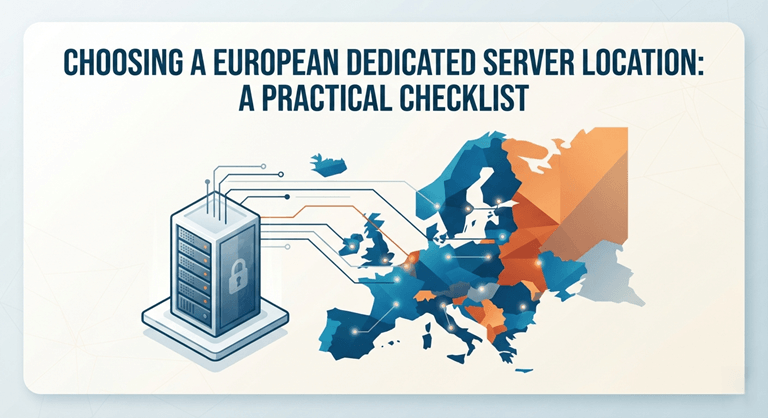
The goal is not to find a universally best city. It is to find the location that produces the right balance of latency, resilience, operational access, and cost for a particular business.
Map Users and Dependencies First
Start with data from analytics, logs, customer data, and sales projections. Find the location of active users, which markets will grow, and external systems your application calls. The distance between a user and a web server is not the only factor that can impact the end-to-end response time—payment processors, identity platforms, databases, and partner APIs can also impact the time.
Test round-trip latency from a set of networks, and compare routes over time. Although being close is helpful, peering quality and carrier paths may make a slightly more distant facility more beneficial.
Treat Compliance as a Design Requirement
The data is often sensitive, particularly when it relates to personal or commercial matters, and is often the subject of European projects. Compliance cannot be achieved simply by having an address for the data center in the EU; provider jurisdiction matters too, as this guide to GDPR-compliant hosting explains. Hosting in the EU can help facilitate a wider data-location strategy. Teams need to know where to find backups, logs, access to support, and third-party processors. They’ll also need to outline retention, deletion, encryption, and incident response protocols, along with others, with qualified legal and security counsel.
Have any questions about contracts, subprocessors, access controls, and primary and recovery system locations with providers. Assurances that are not documented are not as helpful as documented responsibilities.
Compare Connectivity and Failure Options
A strong deployment in Europe requires more than a quick port. Discuss traffic allowances, upstream diversity, DDoS protection, routing policies, and how to switch bandwidth. Don’t accept downtime if it’s expensive for the business; use a second server, off-site backups, database replication, or a warm recovery environment in another location.
The choice of resilience must match the application. Some brochure websites require reliable backups; others, a platform that processes payments and communications, might require redundant elements and a tested failover plan.
Look Beyond the Advertised Monthly Price
Look at the complete operating model – hardware, setup, bandwidth, extra addresses, licenses, management, backup capacity, migration efforts, and support. A low base price may add up to be costly when services are included. With fixed, clear pricing, it’s easier to budget, particularly when workload demands are predictable.
Financial value of quality support. Confirm response channels, escalation paths, replacement processes, and the scope of management, and clarify what remains the customer’s responsibility. Technical skill in a response may be more important than a small difference in the headline fee in an incident.
Choose for Today, Design for the Next Region
A proper EU strategy begins with a sensible selection of the primary location and a documented route for expansion. Ensure that the deployment, monitoring, security, and backup are standardized, so that the same service can be replicated at other locations. With Unihost’s multi-location, custom configuration options, that advancement can come to pass without overbuilding day one. Use total recovery cost, clear responsibility, realistic recovery requirements, and tested routes to make the final decision, rather than a country name.
Popular on OTW Right Now!
-
 How Cyble’s Executive Monitoring Solutions Help Organizations Stay Protected
-
 How Data-Driven Risk Assessments Lead to Smarter IT Investments
-
 A Buyer’s Guide to Sourcing Quality Used Dell Servers
-
 How to choose a managed IT provider in Dallas-Fort Worth: what small business owners should ask before they sign


About The Author

Gagan Bhangu
Founder of otechworld.com and managing editor. He is a tech geek, web-developer, and blogger. He holds a master's degree in computer applications and making money online since 2015.