
Blockchain vs Traditional Mobile Apps: Key Differences Businesses Should Know
Mobile applications have become an essential part of modern business strategies. From banking and healthcare to retail and entertainment, companies use apps to connect with customers, automate processes, and deliver digital services. However, businesses today have more technology options than simply building a conventional mobile application. Blockchain-powered applications are emerging as an alternative for use cases that require decentralization, transparency, digital ownership, or enhanced trust.
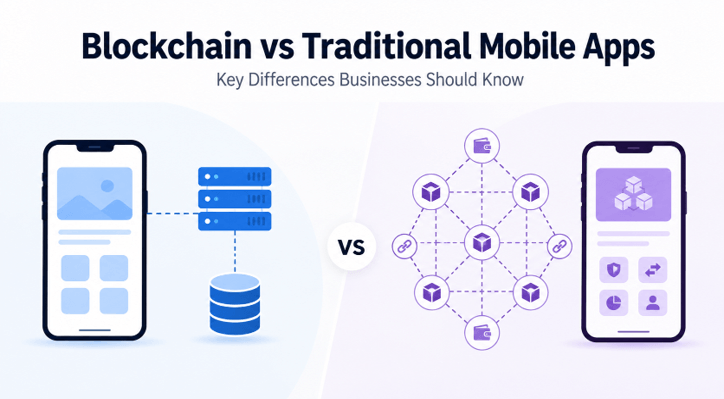
Blockchain and conventional mobile applications are two different technologies; knowing the distinctions can assist businesses in selecting the proper technology for their objectives. Both can deliver a great mobile experience, but they have considerably different architectures, security models, data management, and use cases.
What Are Traditional Mobile Apps?
Traditional mobile applications are usually built in a centralized fashion. The application interfaces with the backend server, database ,and APIs for transactions and data management. In the general case, the application’s infrastructure, user data, and business logic are controlled by the business.
For instance, an e-commerce application can keep the profiles of customers, information about products, orders, and money details in centralized databases. The app receives a customer’s order; the order is sent to the company’sbackendd system, which processes the order and stores it.
Traditional applications work for those businesses that require absolute visibility and control of their application and data infrastructure. They can also be created relatively quickly with the help of technologies like Swift, Kotlin, Flutter, or React Native.
What Are Blockchain Mobile Apps?
Blockchain mobile applications are mobile applications that integrate blockchain networks. These applications can function on a distributed ledger alongside a centralized database to record transactions and control digital assets or decentralized processes, as opposed to depending entirely on a centralized database.
Blockchain apps can communicate with smart contracts, cryptocurrency wallets, decentralized identity systems, and tokenized assets. Some transactions are being verified and added to the blockchain network, which decreases reliance on a central authority.
Businesses that want to build these solutions often work with a specialized blockchain application development company that understands blockchain networks, smart contracts, wallet integration, security, and mobile development.
Blockchain vs Traditional Mobile Apps: Key Differences
1. Centralized vs. Decentralized Architecture
The biggest difference is how data and operations are managed.
In a traditional mobile application, all the data is stored on a central server, which is managed by the business or by a third party. This means that companies have direct access to their infrastructure and databases.
Transaction records can be spread throughout a blockchain network with blockchain applications. For many applications, many participants can verify transactions without having to depend completely on a single authority.
2. Data Management
Most of the information for applications is stored in central databases in traditional applications. Businesses can modify, update, or delete information as they deem fit based on their policies and data architecture.
The genesis of Blockchain systems is the concept of distributed and tamper-proof records. Once recorded on a blockchain, information is hard to change, if possible, depending on the blockchain network and implementation.
Blockchain is useful in applications that require a record of the transactions made, ownership of an object, or the ability to be audited.
3. Security Model
Traditional apps have data protection solutions like authentication, authorization, encryption, secure APIs, firewalls, and server-side security controls. But a centralized database can be a big target for attackers.
Blockchain applications rely on cryptographic methods and distributed consensus to validate the transactions. Smart contracts can also be used to execute a set of business rules.
But blockchain doesn’t guarantee the security of an application by itself. Even if the smart contract is well-coded, the private keys are secure, the wallets are not vulnerable, and the APIs are adequately protected, these can still pose significant risks.
4. Transparency and Trust
Typically, traditional applications hold their bbackenddata in a private manner and assign access controls for the data based on the administrator’s decisions. This is suitable for the majority of business applications.
Blockchain can offer more transparency as selected transaction records can be independently verified on the network. This could prove to be valuable in supply chain, financial applications, digital assets, loyalty programs, and decentralized marketplaces.
5. Performance and Scalability
Traditional mobile apps can be very scalable, as businesses can add more servers, fine-tune databases, and rely on cloud-based technology for the growing traffic.
Blockchain applications can face constraints in network speed, transaction charges, and confirmation speed. Thus, a hybrid system is frequently employed by developers in which the blockchain is responsible for transactions that need decentralization and traditional servers are responsible for other application data.
6. Development Complexity
To build a traditional mobile application, you need to have experience in mobile UI/UX, backend development, APIs, databases, cloud infrastructure, and security.
Blockchain applications necessitate a further understanding of smart contracts, wallets, blockchain protocols, token standards, cryptography, and decentralized architecture. This means that blockchain development may be more complex and require specific testing.
For businesses looking for flexible and scalable solutions, custom mobile app development services can be adapted to either traditional or blockchain-based architectures depending on the project’s requirements.
When Should a Business Choose a Blockchain App?
Blockchain is not necessary for every mobile application. Businesses should consider blockchain when they need features such as:
- Decentralized transaction processing
- Transparent and verifiable records
- Digital asset ownership
- Smart contract automation
- Tokenization
- Cryptocurrency payments
- Decentralized identity
- Multi-party data verification
- Tamper-resistant transaction history
For instance, if you’re developing a food delivery app, you don’t necessarily need blockchain. Blockchain technology, however, could be valuable to a decentralized marketplace where user-to-user tokenized asset trading takes place.
When Is a Traditional Mobile App Better?
Old-fashioned mobile apps are still the more optimal solution in many business situations. They are ideally suited for an organization that needs centralized control, quick performance, predictable infrastructure costs, or full control over the data of its customers.
There may be many apps that do not need blockchain technology to accomplish their goals, whether they’re restaurant apps, fitness apps, internal business apps, content platforms, appointment booking apps, or even lots of eCommerce apps.
Blockchain and Traditional Apps Can Work Together
A business doesn’t have to choose one or the other. This can be achieved by a hybrid approach, which leverages the strengths of both technologies.
In other words, blockchain could be used for payment, digital ownership, or smart contract transactions while the rest of the transaction is handled by the traditional cloud infrastructure for user profiles, product catalogs, analytics, etc., via mobile applications.
Businesses can leverage this to add blockchain capabilities to their apps without deploying them all to the blockchain.
Final Thoughts
Different businesses, different applications, different levels of security, scalability, and user experience needs all make blockchain or conventional mobile applications a better choice. Traditional apps can deliver centralized control, a well-established development framework, and performance, whereas blockchain apps can offer decentralization, transparency, verifiable transactions, and digital ownership.
Rather than picking a solution for a problem, businesses should define what they want to solve and then select blockchain, since it is a newer technology. The expertise of the developers can assist in identifying the most suitable design for the project, either a traditional or a blockchain-based or hybrid approach.
In the end, the technology that provides business value, without jeopardizing security, performance, cost, scalability, and user experience, is the one that’s right.
Popular on OTW Right Now!



About The Author

Gagan Bhangu
Founder of otechworld.com and managing editor. He is a tech geek, web-developer, and blogger. He holds a master's degree in computer applications and making money online since 2015.