
Best Cloud Security Software and Tools for Businesses in 2026
Cloud computing has become an essential part of modern business operations. Companies of all sizes now rely on cloud platforms to store data, run applications, manage workloads, and support remote teams. While cloud technology offers flexibility and scalability, it also introduces security challenges that businesses cannot afford to overlook.
As cloud environments become more complex, organizations need reliable security software and practical strategies to protect sensitive information. The right combination of security tools, access controls, monitoring solutions, and security practices can help businesses reduce risks and respond to threats more effectively.
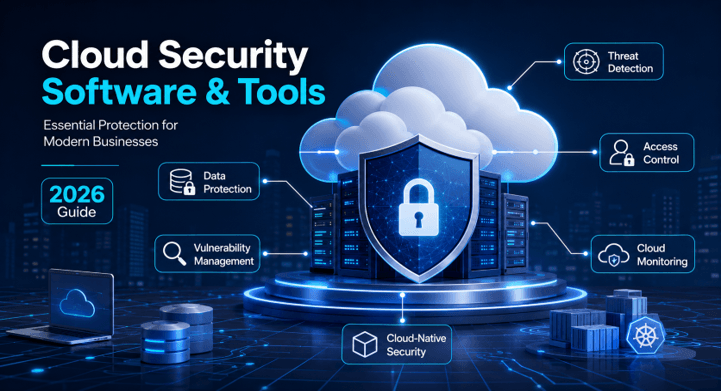
In this guide, we explore what businesses should look for in cloud security software and tools in 2026, along with the practices that can help create a stronger cloud security strategy.
Why Cloud Security Software Matters
Cloud security software aids enterprises in defending their infrastructure, applications, identities, and information from an extensive set of threats. These risks can range from unauthorized access, malware, misconfigured cloud resources, credential theft, data breaches, and vulnerabilities in applications or cloud workloads.
Cloud infrastructures can change quickly compared to traditional on-premises infrastructures. New user(s), application(s), service(s), and resource(s) can be added often. It is becoming more and more critical to have continuous monitoring and automated security controls.
A good cloud security solution should therefore offer a view into the environment and should help security teams uncover potential weaknesses before they turn into serious incidents.
Key Features to Look for in Cloud Security Tools
Security products offer different capabilities. Key factors to consider when choosing cloud security software include the nature of your workloads, security needs, and infrastructure.
Some of the most important features include:
- Cloud infrastructure monitoring: Companies can monitor the resources and find abnormal activity.
- Identity and access management: Security products should be able to provide organizations with control over who has access to certain cloud resources.
- Threat detection: Advanced solutions need to be able to detect suspicious activity and possible attacks in real time.
- Vulnerability management: Organizations require a view of vulnerable systems, applications, and configurations.
- Data protection: Sensitive data needs to be safeguarded with encryption, access management, and monitoring.
- Compliance support: Security platforms can assist enterprises in keeping the proper controls mandated by industry regulations and internal policies. Businesses can also evaluate Cloud Compliance Software of 2026 to help manage compliance requirements and maintain appropriate security controls.
- Automation: Automated alerts and remediation can reduce the workload on security teams.
Businesses evaluating different platforms can also explore resources such as Best Cloud Security Tools to understand better the types of solutions available and the capabilities they offer.
Choosing the Right Cloud Security Software
The top cloud security software is dependent on the organization’s environment. A small business with a fairly simple cloud environment might not require the same level of security features as a large enterprise that is using multiple cloud platforms.
When selecting a solution, businesses should question whether they use public, private, or hybrid/multi-cloud infrastructure. They should also review the compatibility with the current cloud services and security protocols.
Another factor to consider is ease of deployment. A robust security solution can be of little benefit if it is difficult to set up or manually manage.
Scalability is an important factor to consider for organizations as well. The number of resources in the cloud, applications, workloads, and users in a company can also increase substantially as the company grows. When choosing software, you can avoid significant changes later if it can grow with the business.
For businesses researching technology solutions, TheTweaks can also be a useful technology resource for discovering information about software, tools, and emerging technologies.
Cloud Security Best Practices for Businesses
Security software is just one component of an overall cloud security solution. It is also important for businesses to have policies and processes in place to minimize the risk of security incidents.
Setting up robust identity and access controls is one of the most critical measures. Users should not be granted any more or fewer permissions than necessary to perform their jobs. If possible, use multi-factor authentication.
It is also crucial to review cloud configurations regularly. Misconfigured storage, excessive permissions, exposed services, and outdated security settings can create unnecessary risks.
Businesses should also back up important information regularly and test recovery procedures. Organizations can find themselves in a situation where they are attacked by ransomware, accidentally deleted files, or other disruptive events where backups could prove invaluable.
Another component of the security plan should be continuous monitoring. Security teams should be able to see what users are doing, how systems are behaving, and what threats may be lurking, so they can investigate suspicious events promptly.
Cloud Security Best Practices offers an extensive outline of other security measures that can be implemented alongside organizations’ security software to enhance their security posture.
The Growing Importance of Cloud-Native Security
Organizations are transitioning from legacy cloud infrastructure to cloud-native technologies like containers and microservices, Kubernetes, and serverless applications.
While these technologies have a lot of advantages, they also come with new security implications. Applications can be made up of numerous interdependent services, and workloads can be dynamically added and removed.
Security must be considered as part of the development and deployment process and not as an afterthought.
Cloud-native security is about securing applications, workloads, cloud infrastructure, identities, APIs, and security across their entire lifecycle. Security teams need to monitor the underlying environment and the applications running on it.
Therefore, companies that are working with modern development architectures should learn about Cloud Native Security and how security can be implemented in cloud-based architecture.
How to Build a Strong Cloud Security Strategy
The key to a successful cloud security strategy is a mix of technology, processes, and employee awareness.
The first step is for businesses to find out what assets they value the most and what data and systems need to be best protected. Then, they can set up and secure the access, monitoring, vulnerability management, and incident response processes.
Also, cloud security teams need to audit their cloud environment periodically. What was secure a few months ago might not be suitable now, when new applications, users, or services have been added.
Another factor of paramount importance is employee awareness. No matter how robust the security software, weak passwords, phishing, accidental data exposure, or poor security practices can pose threats. Routine security training helps workers identify and prevent common risks.
Technology resources like TheTweaks can also help businesses keep up with software solutions, security technologies, and other advancements that can impact their IT environment.
Final Thoughts
As businesses continue their shift to the cloud, cloud security will be a top priority for 2026. Choosing the right security software package can improve visibility, threat detection, access control,, and protection against new threats.
But there’s more to it than technology, however. To implement cloud security, businesses need to use a combination of cloud security tools and robust access controls, routine configuration audits, ongoing monitoring, user education, and incident response protocols.
Cloud-native security should be part of the overall strategy for organizations adopting containers, microservices, and other modern architectures.
By leveraging the right software and implementing sound security measures, companies can create a more secure, more resilient cloud environment that still enjoys the flexibility and scalability of cloud computing.
Popular on OTW Right Now!

About The Author

Gagan Bhangu
Founder of otechworld.com and managing editor. He is a tech geek, web-developer, and blogger. He holds a master's degree in computer applications and making money online since 2015.