
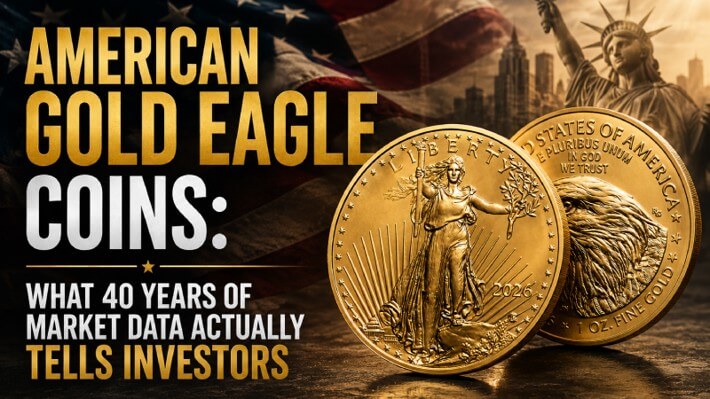
American Gold Eagle Coins: What 40 Years of Market Data Actually Tells Investors
The articles that people find about the American Gold Eagle typically touch on the essentials: It debuted in 1986, it is .9167 fine gold, it comes in four denominations, and it is eligible for Precious Metals IRAs. The facts are true, but they only paint part of the picture. Investors with experience tend to focus more on how the coin does in times of market stress, whether the 2021 design change is a factor for investors buying the coin, and why the fractional denominations continue to be ignored.
These considerations give a better idea of why the American Gold Eagle has been one of the most trusted bullion coins for almost 40 years.
Why the Legal Foundation Matters
The Gold Bullion Coin Act of 1985 was passed to create the American Gold Eagle. The South African Krugerrand was the most important bullion coin of the day, and the act created the first officially backed U.S. gold bullion coin.
That law also provides that every American Gold Eagle is backed by the government, which cannot be said of private mints.
It is not just a bullion ownership law. The American Gold Eagle is a 22-karat gold coin, not the .995 fineness that’s typically necessary for coins used in investment IRAs; however, it is nonetheless listed on the IRS’s Precious Metals IRAs list. That exception is indicative of faith in the coin through legislation by the federal government.
The 22-karat composition: A Feature, Not a Flaw
The .9167 fineness of the American Gold Eagle Coin is one of the most frequent questions asked about it, when contrasted with coins like the Canadian Maple Leaf or the American Gold Buffalo, which are .9999 pure. The Eagle’s composition, however, was deliberately made to be strong, not fine.
Traditionally, it has a Crown Gold alloy of 91.67% gold, 3% silver, and 5.33% copper. This mix results in a harder coin with greater resistance to scratching and normal wear and tear than the .9999 fine gold coins.
Moreover, there is no change in the gold content stated. The 1 oz American Gold Eagle is a 1 troy ounce piece of pure gold. Silver and copper are not included as part of that gold weight—they are added on top of a one-ounce gold coin—and that is why a one-ounce Eagle will weigh slightly more than a one-ounce .9999 fine gold coin.
Type 1 vs. Type 2: The Decision Most Articles Get Wrong
The U.S. Mint has released its first major redesign of the American Gold Eagle in over thirty-five years (2021). This change resulted in two different design variants, which can create confusion for buyers.
Type 1 (1986-2021) will have a reverse with a family of eagles designed by Miley Busiek. However, production ended in 2021, and no more Type 1 bullion coins will be minted. Some low-mintage dates have started to appreciate slightly for the MS-69 and MS-70 holders.
Type 2 (2021-present) added a new reverse with a close-up of a bald eagle, with a new design by Jennie Norris. The redesign also featured newer hub technology to correct the soft strike characteristics that were sometimes experienced on some Type 1 issues.
Both designs have the same amount of gold content. This is the key for most bullion investors. While it’s easy to see how a premium price will be justified for a documented low mintage date that the collector has shown interest in, it is advisable to pay a premium for a Type 1 coin only in that case. High production years, such as 2015 (801,500), do not have extra scarcity just because they are the earlier design.
What March 2020 Proved About Liquidity
When the markets were thrown out of kilter in March 2020, one major trait of the American Gold Eagle was brought to the fore.
The spread for Gold Eagles became smaller than most other competing bullion coins as financial markets were very volatile around the world. Demand was kept focused on a particular coin that is instantly identified and priced by U.S. dealers without extra validation, and which allows a more streamlined exchange.
That’s a testament to the coin’s widespread distribution system across the United States. That widespread acceptance may be more important to investors who see physical gold as a source of liquidity when markets are volatile than a slight premium on another gold bullion product or a small difference in gold’s purity.
The Fractional Sizes Most Buyers Dismiss
The 1 oz American Gold Eagle is the most popular offering; the 1/2 oz, 1/4 oz, and 1/10 oz offerings are generally considered smaller counterparts. In reality, they have benefits beyond economic considerations.
Fractional coins offer the added benefit of enabling investors to sell just a fraction of their holdings instead of an entire position worth more than $4,100.
Their past is as interesting as well. The U.S. Mint ceased proof coin production in 2008, after a sharp surge in demand for bullion during the 2008 financial crisis, so that 2008 would be the last proof issue until 2010. The 2008 1/10 oz Proof American Gold Eagle is also a very limited issue with only 8,480 coins to be minted.
On a percentage basis, low mintage fractional proof Gold Eagles issued in 1991-1993 and 2008 will have performed better than the one-ounce standard proof on longer holding periods. Yet, these problems have been less talked about in comparison to the bigger problems.
Buying Through BOLD
American Gold Eagles are not directly sold to the public by the U.S. Mint, but rather by authorized purchasers.
BOLD Precious Metals is an authorized and accredited U.S. Mint dealer with a BBB A+ rating. The company makes available a collection of American Gold Eagle coins in all four denominations (including the current year Type 2 bullion and proof editions) that are priced in sync with the current spot price of gold. All shipments are completely insured for extra security.
Conclusion
The American Gold Eagle has been in circulation for almost four decades, which is long enough to provide a sense of the times. It is a trusted choice for investors, having been backed by its government, its weight and its purity, its broad dealer acceptance, and its federal IRA eligibility; its Type 1 and some low-mintage fractional proofs are still appealing to collectors for additional numismatic interest.
Popular on OTW Right Now!



About The Author

Gagan Bhangu
Founder of otechworld.com and managing editor. He is a tech geek, web-developer, and blogger. He holds a master's degree in computer applications and making money online since 2015.