
AI Marketing Tools for Small Business: Platforms, Automation & Bots Compared
Small teams don’t have the luxury of a 20-person marketing department. That’s exactly why AI marketing tools have become less of a nice-to-have and more of a survival kit. The right stack of AI marketing tools can do the work of two or three hires, freeing up your time for the stuff that actually needs a human brain.
Here’s the thing: not every tool on the market deserves a spot in your budget. Some are genuinely useful. Others are just ChatGPT with a prettier interface and a bigger price tag.
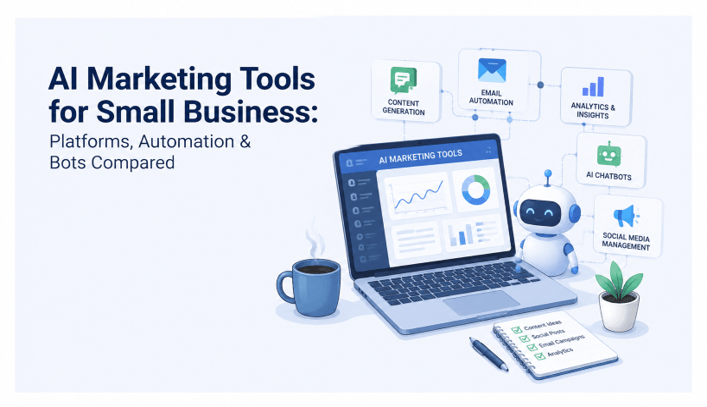
What Makes AI Marketing Tools Worth Your Budget?
An AI marketing platform earns its keep when it replaces hours of manual work, not when it just adds another dashboard to check.
Before you buy anything, ask what task you’re actually trying to solve. Content creation? Lead research? Customer support? Each of those points to a different category of AI marketing tools.
Small companies that do this well will typically start with an external professional to develop a strategy before adding in automation. Working with a team that offers Content marketing services can save you from buying five tools when you really needed one solid plan.
Once your strategy’s in place, tools become a lot easier to pick. You’ll know exactly what you need them to do.
AI Marketing Automation: Where Small Teams Get the Biggest Wins
Automation isn’t about replacing your team. It’s about eliminating repetitive tasks in their job so they can focus on strategy and creative work.
AI Marketing Tools for Content and SEO
The first place that most small businesses feel the pain is in content. You’re in need of blog posts, social captions, email copy, and product descriptions, and usually do not have enough time to write them all yourself.
Lots of tools can do the initial drafting quickly, such as Jasper and Brandwell. Surfer SEO and ContentShake AI integrate with keyword and competitor information, giving your content a better chance of ranking. None of these can, however, replace a human editor. Consider the output as a beginning and not an end.
Quick summary: AI content tools speed up first drafts and bake in SEO signals, but a human should still edit for accuracy, tone, and brand voice before anything gets published.
Research and Data Automation
Research platforms such as Paradigm and Browse AI do the work that’s too tedious for humans. Once you set up the workflow, the AI will pull new pricing from competitors at regular intervals, rather than having to manually check competitor pricing or make prospect lists by hand.
For a small team, that’s hours back every single week.
AI Marketing Bot Options for Small Business
An AI marketing bot can be the first line of defense for customer questions and doesn’t have to take breaks, go to sleep, or ask for a raise.
But Chatfuel allows you to create a bot without coding, which is significant if you don’t have a developer on your team. Userbot. But AI’s way is a little different: If it doesn’t know the answer to a question, it passes it on to a human, and it absorbs the human’s wisdom and gets wiser the more it does.
Neither tool is ideal right off the bat. This will take a few weeks for the bot to feel confident with your real customer questions.
Note: Bots work best for repetitive, predictable questions like shipping times or return policies. Save the nuanced conversations for your human team.
How to Use AI in Marketing Without Losing Your Voice
The biggest danger with AI tools is that they aren’t bad. It’s because their use makes everything sound the same when used excessively.
To use AI responsibly in marketing, keep a human engaged in all customer interactions. Rely on AI to write, find information, and arrange. Allow editing, approval, and adding in the face that helps develop your brand.
A few ground rules that tend to work well:
- Never publish AI-generated copy without a human read-through.
- Keep your brand voice guidelines written down somewhere the AI (and your team) can reference.
- Run anything long-form through a detector like Originality AI if you’re worried about it reading as robotic.
- Save AI for volume tasks, not your flagship campaigns.
Important: Skipping the human review step is the single most common reason AI-generated marketing content underperforms or damages brand trust.
Picking the Right AI Marketing Tools for Your Team
There is no one-size-fits-all best AI marketing software. The right choice depends on the size of the team, budget, and the task that’s consuming most of your time at the moment.
If content is your limiting factor, go for a writing and SEO tool first. For customer questions, start with a bot. If it’s manual research, start with a data automation platform. Trying to overcome all three simultaneously with a single set of AI marketing solutions typically leaves you frustrated.
If budgets are limited, it is smart to opt for free tiers of tools, so that you can test drive before you invest. Grammarly, Hemingway, and PhotoRoom offer solid free versions.
Don’t scale up until you have established that a tool does save time, and not add more work to the editing process. The ideal AI marketing tools will pay for themselves within a month or two.
FAQs
1. What’s the best free AI marketing tool for small business?
The solutions from Grammarly and Hemingway are both good for free when it comes to content editing, and Google Labs also has a number of no-cost design and automation tools to try out before paying anything.
2. Can AI marketing tools replace a marketing team?
No. While they can help boost repetitive tasks such as drafting and research, strategy, brand judgment, and customer relationships still require a human touch.
3. How much do AI marketing platforms typically cost?
Prices vary from free to $20 to $100+ per month. For most small businesses, the free or entry-level options are sufficient and can be graduated as your business grows.
4. Are AI-written blog posts bad for SEO?
Rather than being inherently bad, unedited AI-generated content tends to be shallow and lacks originality, which doesn’t align with the standards that search engines give preference to. It is advisable to have a human read and edit the draft before publishing it.
Popular on OTW Right Now!


About The Author

Gagan Bhangu
Founder of otechworld.com and managing editor. He is a tech geek, web-developer, and blogger. He holds a master's degree in computer applications and making money online since 2015.