
Ad Network vs. Ad Exchange vs. DSP: What’s the Difference?
Digital advertising has become increasingly automated, but the technology behind an online ad campaign can be difficult to understand.
Terms such as ad network, ad exchange, DSP, SSP and programmatic advertising are often used together, even though they describe different parts of the advertising ecosystem.
Understanding how these technologies work together can help advertisers make better decisions about where their campaigns run, how they reach audiences and how their budgets are spent.
What Is an Ad Network?
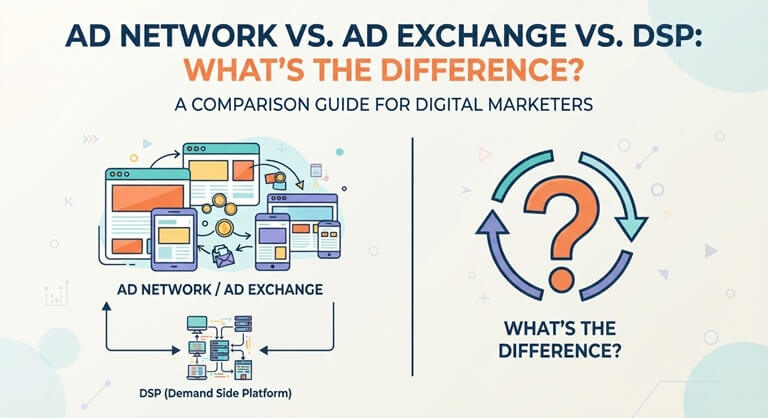
An ad network is a platform that connects advertisers with publishers that have advertising space available.
Instead of negotiating separately with hundreds or thousands of websites, an advertiser can work with an ad network to access a collection of publishers through one platform.
For example, an advertiser may want to reach people interested in finance, gaming or technology. Rather than approaching individual websites, the advertiser can use an advertising network that already has access to relevant inventory.
Ad networks can offer different advertising formats, including:
- Display banners
- Native advertising
- Video ads
- Mobile advertising
- Push-style formats
- Rich media
The main advantage is convenience. Advertisers gain access to multiple publishers through a single relationship, while publishers gain another source of demand for their available inventory.
However, not every ad network operates in the same way. Some focus on specific industries or audiences, while others offer broader inventory across many categories.
What Is an Ad Exchange?
An ad exchange works more like a digital marketplace.
Instead of simply matching advertisers with a collection of publishers, an ad exchange facilitates the buying and selling of advertising impressions between multiple parties.
When a visitor loads a page containing an available advertising slot, information about that impression can be sent into an auction. Multiple buyers may then compete for the opportunity to show an advertisement.
The winning bid determines which advertisement appears.
This process happens extremely quickly, often in the time it takes for a webpage to load.
The distinction between an ad network and an ad exchange can therefore be simplified like this:
Ad network: connects advertisers with publisher inventory.
Ad exchange: facilitates an automated marketplace where buyers and sellers can trade individual impressions.
The two can overlap, and some modern advertising platforms incorporate exchange-like functionality into their wider technology stack.
What Is a DSP?
A Demand-Side Platform, commonly called a DSP, is technology that advertisers use to buy digital advertising inventory programmatically.
Instead of manually selecting individual websites and placements, advertisers can use a DSP to define campaign parameters such as:
- Target audience
- Geographic location
- Device
- Advertising format
- Budget
- Bid strategy
- Campaign objective
- Frequency limits
The platform then evaluates available impressions and determines which ones are worth bidding on.
This makes DSPs particularly useful for advertisers that want to manage campaigns across multiple sources of inventory rather than handling each publisher separately.
How Ad Networks, Ad Exchanges and DSPs Work Together
These technologies are easier to understand when viewed as parts of the same ecosystem.
Imagine that a user visits a website.
The publisher has an advertising space available and wants to generate revenue from it. The available impression can enter an advertising marketplace through the publisher’s technology.
On the other side, an advertiser has a campaign running through a DSP. The DSP evaluates the available impression based on the advertiser’s targeting requirements.
If the impression matches the campaign, the DSP can submit a bid.
The marketplace evaluates competing bids, and the winning advertisement is delivered to the user.
The entire process can happen automatically without the advertiser or publisher manually negotiating every individual placement.
This is one of the main reasons programmatic advertising has become such an important part of digital media buying.
What Is an SSP?
There is another acronym worth knowing: SSP, or Supply-Side Platform.
If a DSP helps advertisers buy inventory, an SSP helps publishers sell it.
Publishers use SSP technology to manage their available advertising space and connect that inventory with potential buyers.
A simplified version of the ecosystem looks like this:
Advertiser » DSP » Ad Exchange » SSP » Publisher
In reality, the relationships can be more complicated. Multiple exchanges, supply partners and demand sources can participate in the same transaction.
Still, this basic model provides a useful starting point for understanding how digital advertising technology fits together.
Ad Network vs. DSP: Which One Should Advertisers Use?
An ad network may be easier for advertisers that want a relatively straightforward way to access a particular audience or collection of publishers.
A DSP can provide more control over campaign buying and optimization, particularly for advertisers running campaigns across multiple inventory sources.
The right choice depends on the campaign.
A small business running a straightforward awareness campaign may not need a highly sophisticated buying setup.
A performance marketer managing campaigns across multiple countries, devices and advertising formats may benefit from more advanced programmatic tools.
The important point is to look beyond the platform’s feature list and consider how much control you actually need.
What Should You Look for in an Advertising Platform?
Regardless of the technology behind the platform, advertisers should evaluate several practical factors before committing budget.
Audience Targeting
Look at the targeting options available. Geographic, contextual, behavioral and device-based targeting can all be useful depending on the campaign.
More targeting options are not automatically better. The useful question is whether the platform provides the signals that matter for your audience.
Inventory Quality
The size of a publisher network doesn’t tell you much about the quality of its inventory.
Ask where advertisements appear, what types of websites are included and how the platform handles questionable or low-quality traffic.
Reporting
Good reporting should make it easy to understand where your budget is going.
At a minimum, advertisers should be able to review impressions, clicks, conversions and spending. More advanced platforms may provide additional information about audiences, placements and campaign performance.
Fraud Protection
Invalid traffic can consume advertising budgets without generating meaningful results.
Look for platforms that have systems for identifying suspicious traffic and monitoring inventory quality.
Pricing and Bidding
Different platforms may use CPM, CPC, CPA or other pricing models.
Don’t focus solely on the lowest initial cost. A cheaper impression isn’t necessarily a better impression if it produces poor-quality traffic or few conversions.
Creative Formats
The available formats should match the campaign objective.
Display may work well for broad awareness, while native, video or mobile formats may be better suited to particular audiences and campaign stages.
Why Programmatic Advertising Is Different
Traditional media buying often involves negotiating individual placements and agreements with publishers.
Programmatic advertising changes the process by using software and automated bidding to evaluate impressions at scale.
That doesn’t mean advertisers no longer need strategy. In fact, automation makes campaign structure, targeting, measurement and creative testing even more important.
Programmatic advertising is no longer a niche part of digital media buying. According to the latest IAB/PwC Internet Advertising Revenue Report, programmatic advertising revenues reached $162.4 billion in 2025, an increase of 20.5% from the previous year.
The Bottom Line
Ad networks, ad exchanges, DSPs and SSPs perform different jobs, but they are all connected within the modern digital advertising ecosystem.
An ad network connects advertisers with publisher inventory.
An ad exchange provides a marketplace for buying and selling advertising impressions.
A DSP gives advertisers software for purchasing and managing digital inventory programmatically.
An SSP helps publishers manage and sell their available advertising space.
Understanding these differences makes it easier to evaluate advertising platforms and choose the technology that matches a campaign’s needs.
For advertisers moving beyond individual platforms such as search and social advertising, programmatic buying can provide access to a much broader range of digital inventory while giving them more control over targeting, bidding and campaign optimization.
Popular on OTW Right Now!




About The Author

Gagan Bhangu
Founder of otechworld.com and managing editor. He is a tech geek, web-developer, and blogger. He holds a master's degree in computer applications and making money online since 2015.