
A Homeowner’s Guide to Cleaning Ceiling Fans, Vents, and High Shelves
Surfaces above eye level are easy to forget because they rarely interfere with everyday movement. A ceiling fan can carry a layer of dust across the tops of its blades for months, a vent grille may slowly turn gray, and an upper shelf can hold debris that is almost invisible from the floor.
The challenge is not simply reaching these places. Dust disturbed overhead has somewhere else to go. A careless pass across a fan blade can drop particles onto bedding, furniture, rugs, and flooring that were already cleaned. Excess moisture is another concern because liquid used above shoulder height is harder to control and may reach electrical components, painted walls, or seams where it does not belong.
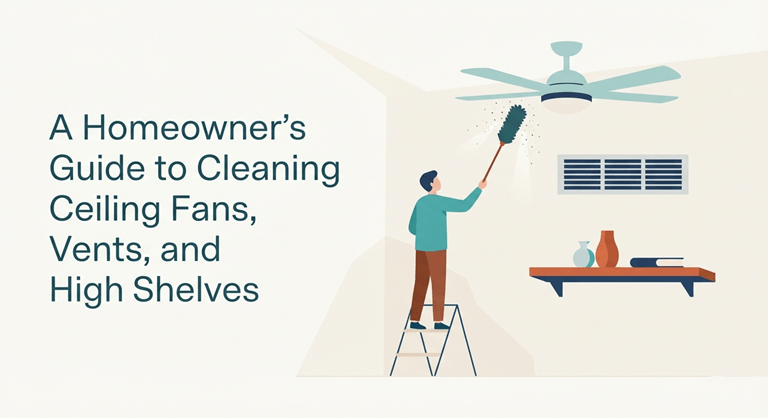
Fans, vent grilles, and upper shelves should therefore be treated as different cleaning jobs rather than one category called “high dusting.” Each surface collects debris differently, and each needs a method that keeps the work controlled.
Start by Looking Across the Surface
Dust on elevated surfaces can be easier to see from the side than from directly underneath.
Stand several feet away and look across the top of a shelf or fan blade where light catches it.
For vent grilles, inspect the slats and outer edges rather than judging only the center.
This quick check can show whether you are dealing with a light film or a thicker layer.
That difference matters.
Heavy dry dust should generally be captured before a damp cleaning method is considered. Introducing moisture too early can turn loose gray particles into streaks or paste that takes more work to remove.
The inspection also prevents unnecessary cleaning. If one high shelf is dusty while another nearby surface is still clean, there may be no reason to treat both the same way.
Prepare the Area Below Before Working Above It
Before touching anything overhead, look down.
A ceiling fan may be positioned above a bed, dining table, sofa, or rug. A high shelf can sit over electronics, framed photos, or decorative objects.
Move lightweight or delicate items out of the immediate area where practical.
You do not need to empty the whole room.
The purpose is simply to avoid turning one dusty fan into five additional cleaning jobs.
If furniture below cannot be moved easily, plan how you will collect falling dust afterward.
This preparation is especially useful with fans that have not been cleaned in a long time, because thick buildup may release in small clumps rather than fine particles.
Use Stable Access Instead of Reaching Too Far
Overhead work becomes less controlled when you are stretching at the limit of your balance.
Use a stable household step stool or ladder appropriate for the height and follow its safety instructions.
Do not stand on chairs, tables, countertops, beds, or other furniture.
If the surface cannot be reached comfortably with suitable equipment, leave it for someone who can access it safely.
Long-handled dusting tools can reduce climbing, but they still need to provide enough control to capture dust rather than knock it across the room.
Repositioning yourself or the ladder is safer than leaning sideways for the final few inches of a shelf.
The goal is not simply to reach the surface. It is to remain steady enough to clean it gently.
Switch Ceiling Fans Off Completely
A ceiling fan should be off and fully stationary before cleaning starts.
If it includes a light fixture, allow bulbs and surrounding components to cool before working near them.
Begin with the top of each blade, where dust often accumulates most heavily.
Use a soft microfiber material or another suitable tool that captures particles instead of brushing them outward.
Avoid pulling downward on the blade.
Fan blades are designed to move air, not support pressure or body weight.
If you need to steady a blade, do so gently and without bending it.
A fan that appears loose, warped, or unstable should be treated as a maintenance concern rather than something to correct during cleaning.
Check the Narrow Edges of Each Blade
The broad top surface is only part of the job.
Dust can form a narrow line along the leading and trailing edges of a fan blade.
After the first pass, look at each blade from the side.
If a line of buildup remains, clean the edge carefully using a method appropriate for the blade material and finish.
Avoid soaking wood, composite materials, or finished surfaces.
If a dry method removes the dust successfully, there may be no reason to introduce moisture at all.
Check the underside only if it actually needs attention.
Cleaning every face of every blade automatically can add work without improving the result.
Keep Liquid Away From the Motor Housing
Spraying an overhead fan directly is a poor way to control where the cleaner goes.
Mist can reach the motor housing, light sockets, controls, wiring openings, or nearby ceiling.
If a damp method is suitable for the blade, apply the product to the cloth rather than spraying upward.
Use only enough moisture to deal with the remaining residue.
Dry the blade afterward if its care instructions call for it.
The same caution applies around ceiling-mounted fixtures in general.
The cleaning solution should stay on the surface being cleaned rather than being allowed to run toward electrical or mechanical components.
Treat Vent Grilles as Exterior Surfaces
Not every grille on a wall or ceiling performs the same job.
Some are supply registers.
Others are return-air grilles.
Bathroom and kitchen exhaust systems have their own covers and airflow patterns.
For ordinary household cleaning, concentrate on accessible exterior dust unless the equipment instructions specifically describe homeowner maintenance beyond that point.
A vacuum with a soft brush attachment may be useful for dry surface dust.
Avoid pushing tools deep into ductwork.
If a cover is designed to be removed for routine maintenance, follow the system or manufacturer instructions rather than assuming every grille should come off.
Cleaning the visible cover and servicing the system behind it are different tasks.
Look at the Paint Around the Vent Too
Sometimes the grille is not the only part that looks dirty.
Dust can create a faint outline on the nearby wall or ceiling.
Remove loose particles gently before deciding whether the painted area needs further cleaning.
Avoid aggressive scrubbing.
A dark mark may be ordinary dust, but it can also reflect staining, wear, or airflow patterns that will not disappear through repeated wiping.
If discoloration returns unusually quickly after cleaning, pay attention to that pattern.
Visible moisture, damage, or another unusual condition around a vent should be investigated separately rather than treated as an endless surface-cleaning problem.
Keep Bathroom Exhaust Covers Free of Loose Buildup
Bathroom exhaust covers collect a mixture of dust and lint.
Moisture in the room can make that buildup more noticeable than dry dust elsewhere.
Turn the fan off before working on the accessible cover.
Use a suitable dry method to remove loose surface debris.
Avoid spraying water or cleaner upward into the opening.
If the exhaust fan seems unusually noisy, weak, or unable to manage normal bathroom moisture, wiping the cover may not solve the underlying problem.
Mechanical performance belongs in a different category from household cleaning.
Recognizing that distinction prevents repeated cleaning from being used as a substitute for needed maintenance.
Empty High Shelves in Manageable Sections
Upper shelving often becomes difficult to clean because it is used for long-term storage.
Decorative bowls, books, framed pieces, baskets, boxes, and seasonal objects can remain untouched for months.
Do not remove everything at once.
Work across the shelf in short sections.
Take down a few objects, clean the exposed area, inspect those items, and return them before moving farther along.
This keeps the room organized while you work.
It also reduces the chance of damaging delicate decorations or forgetting where stored items belong.
A crowded floor full of objects removed from a high shelf creates a second problem that was not there before the cleaning began.
Clean Stored Objects Before Returning Them
A freshly dusted shelf will not remain clean for long if every dusty object goes straight back onto it.
Check the bases, backs, rims, and upper edges of stored items.
Smooth decorative pieces may need only a gentle dry wipe or another material-appropriate method.
Books, paper storage boxes, woven baskets, artwork, and delicate objects need more cautious treatment.
The goal is not to wash every decorative item.
It is to remove enough loose dust that the object does not immediately redeposit the same buildup onto the shelf.
Pay special attention to pieces that have been sitting in the same position for a long time.
Their hidden sides may hold much more dust than the surfaces facing the room.
Let Gravity Decide the Cleaning Order
High surfaces change the sequence of a cleaning job. Even careful dusting can release some particles from fan blades, upper shelving, and exterior vent grilles onto furniture or flooring below. Cleaning the carpet first and the ceiling fan afterward simply creates a reason to vacuum the carpet again.
A top-down approach avoids that duplication. In a room where elevated dust has been neglected, the high areas should be addressed before the final furniture dusting, surface wiping, and floor vacuuming or mopping. If Yall Maid Austin Cleaning Services is being used for professional residential cleaning, pointing out overdue fans, upper ledges, or other reachable high-dust areas before the work begins allows the room to be approached in that same logical order rather than treating the overhead buildup as an isolated task at the end.
The important idea is sequence. Dust that falls once can be collected during the normal lower-room cleaning instead of forcing a second pass over surfaces that were already finished.
Check the Front Edge and Rear of High Shelving
Dust does not always settle evenly across a shelf.
The front lip may collect residue from occasional hand contact, while the rear edge can hold a thicker layer where air movement is limited.
If the shelving is open-backed or the wall behind it is safely accessible, inspect that area too.
Fixed shelving does not need to be dismantled just to remove ordinary dust.
Focus on what can be reached without forcing the job.
A narrow vacuum attachment or controlled dry dusting tool may help in corners where a full-size cloth does not fit.
Avoid pushing stored items tightly against a wall before the rear edge has been checked.
Use Very Little Moisture on Elevated Wood or Painted Surfaces
High shelves may be painted, stained, laminated, sealed, or made from composite materials.
Those finishes do not all respond to moisture in the same way.
Identify the material where possible and follow its care guidance.
If damp wiping is appropriate, use a cloth that is damp rather than dripping.
Watch seams, corners, and rear edges carefully.
Liquid running toward the back of an upper shelf can be difficult to see from below and may remain trapped after stored objects are replaced.
Controlled moisture is especially important overhead because gravity carries excess liquid exactly where you may have the least visibility.
Inspect the Floor After Each Elevated Area
Do not wait until every high surface in the room has been cleaned before checking where the dust went.
After finishing a fan, vent grille, or shelf, inspect the floor and furniture directly beneath it.
If only a small amount of dust escaped, the cleaning method is working well.
If a noticeable layer has fallen, adjust your technique before moving to the next area.
A tool that captures particles more effectively may reduce the amount of repeated cleanup required later.
This small check can also reveal unexpected debris.
For example, a high shelf may release tiny pieces of dried leaves from a decorative arrangement, while a fan might drop heavier clumps that should be collected before anyone walks through them.
Watch for Dust Around Crown Molding and Upper Trim
Once attention moves above eye level, other neglected surfaces often become visible.
Crown molding, upper door trim, tall cabinet tops, and the horizontal edges of built-ins can collect similar layers of dust.
That does not mean every elevated feature must be added to the same cleaning session.
Inspect them and decide whether the buildup is significant enough to address.
If they are cleaned, use the same top-down principle.
Handle the upper trim before the furniture and floors directly below it receive their final cleaning.
This keeps the work organized and prevents the room from being cleaned twice.
Rotate High Areas Instead of Doing Everything Every Week
Fans, vent covers, and upper shelving usually do not require the same attention as kitchen counters, sinks, or high-traffic floors.
How quickly they collect dust depends on airflow, room use, pets, open windows, surface texture, and how often the object moves.
A rotation can be more practical than adding every elevated surface to every cleaning day.
One session might include bedroom fans.
Another can cover upper living-room shelving.
A later session may focus on accessible vent grilles and tall furniture tops.
If Yall Maid Austin Cleaning Services is already part of a household’s scheduled cleaning routine, homeowners can also keep a short note of high areas that have been skipped for several cycles and identify one or two that deserve attention rather than allowing every hidden ledge to accumulate indefinitely.
Rotating the work also reduces the temptation to rush while using ladders or long-handled tools.
Know Which High Areas Should Be Left Alone
Not everything above eye level belongs in a DIY cleaning plan.
Very high ceilings, difficult stairwell fixtures, unstable shelving, inaccessible vents, and surfaces near electrical equipment may require different equipment or professional attention.
The same applies if the visible material is not ordinary household dust.
Unknown debris, suspected hazardous substances, heavy contamination, or signs of water damage should not be casually disturbed.
Safe access is part of deciding whether a surface should be cleaned at all.
Leaving one hard-to-reach area alone is better than creating a fall, electrical problem, or larger mess.
Elevated Cleaning Works Best When the Dust Stays Controlled
Ceiling fans, vents, and high shelves may all collect dust, but they should not be treated as identical surfaces.
Fan blades require gentle handling and careful control of moisture. Vent grilles call for exterior dust removal without unnecessarily reaching into mechanical systems. High shelving works best when it is emptied in small sections and the stored objects are checked before they go back.
The shared challenge is controlling what happens to the dust after it is disturbed.
Prepare the area below, work from higher surfaces toward lower ones, use stable access, capture particles rather than scattering them, and avoid forcing a job that cannot be reached safely.
Handled in the right order, elevated cleaning removes forgotten dust without turning the furniture and floors underneath into another complete cleaning project.
Popular on OTW Right Now!




About The Author

Gagan Bhangu
Founder of otechworld.com and managing editor. He is a tech geek, web-developer, and blogger. He holds a master's degree in computer applications and making money online since 2015.