
Integrating Digital Marketing and CRM for Business Growth
Introduction

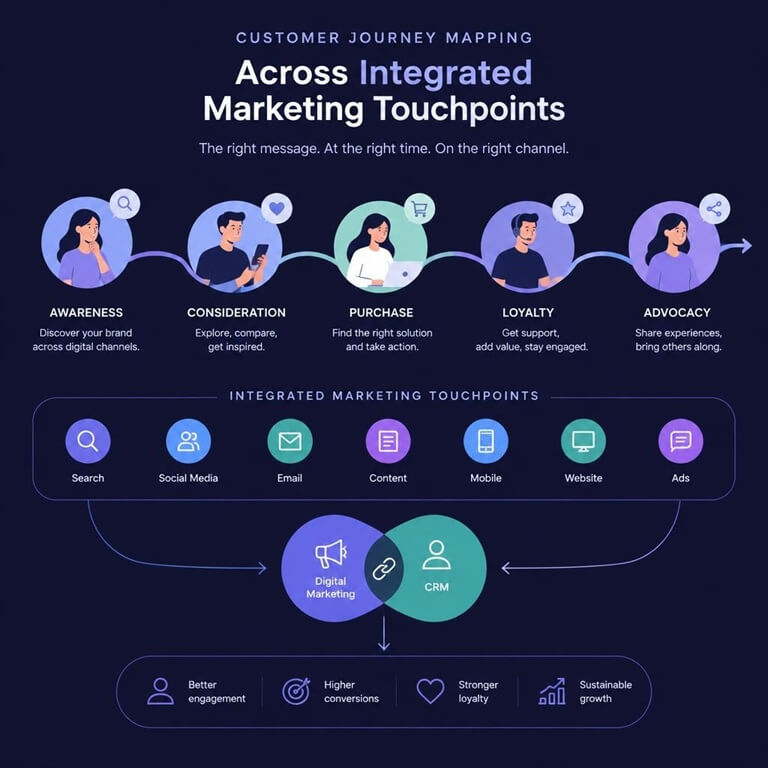
In the current digital landscape, the challenge for businesses is not simply about getting in front of the customer. It’s about actually understanding the customer and engaging with them. Digital campaigns in themselves are not the answer. We must forge lasting relationships that drive sustainable growth. This is where the powerful synergy between Digital Marketing and CRM (Customer Relationship Management) strategies comes into play.
Digital marketing creates so many new ways of engaging with customers and CRM provides the tools to build and maintain those relationships over time. Put them together, and you can drive business success. A lot of organizations will have the problem of their customer data being all over the place and the messages being inconsistent. Having digital marketing and a good CRM strategy in place together is the answer to that.
This guide is going to show you how to bring those key business functions together. We’ll define the core principles, explain what a good CRM marketing strategy is, show you how to link up your various digital channels with your CRM data to drive customer engagement, look at the key metrics you need to track to measure your campaigns, go into detail on advanced personalization and the various pitfalls you’re likely to encounter, along with some practical ways of overcoming them.
Furthermore, we will examine the significant roles of AI, data privacy, and the strategic alignment of sales and marketing teams for optimal growth. This comprehensive approach ensures efficient full-stack marketing funnel execution, transforming how we connect with our audience and build loyalty.
Understanding the Foundations: Digital Marketing vs. Traditional Approaches
To understand why it’s so important to combine digital marketing with CRM, we first need to understand what digital marketing is and how it’s different from the traditional approach.
Digital marketing is marketing via electronic devices and the internet. It’s the use of all digital channels (search engines, social media, email, websites etc) to reach current and potential customers. The key benefit is the ability to target your message, measure results in real time, and facilitate two-way communication. Search engine and social media marketing are of course the two big ones, but digital marketing is all-encompassing in that it covers every single digital point of contact with a customer.
Traditional marketing is all about the old school methods: print ads in the paper (newspapers and magazines), radio and TV, direct mail, billboards etc. They can still be very effective in certain circumstances and for certain audiences, but in general they don’t provide the level of targeting, the speed of feedback, or the cost-effectiveness that you get with digital marketing.
The fundamental differences between these two paradigms are significant:
Feature Traditional Marketing Digital Marketing Data Collection Limited, often aggregated Extensive, discrete data per user Audience Reach Broad, less targeted Highly segmented, global Analytics Delayed, often estimated Real-time, precise, actionable Communication One-way, broadcast Bi-directional, interactive Cost Efficiency Higher upfront investment Often lower, scalable, measurable Targeting Demographic, geographic (broad) Behavioral, psychographic (dynamic) Digital marketing’s inherent capabilities for discrete data collection, dynamic targeting, and real-time analytics provide a rich foundation for CRM strategies. It allows us to move beyond superficial interactions to build deep, data-driven customer relationships.
Core Pillars of Modern Digital Marketing and CRM Strategies
A good CRM marketing strategy has a number of key components, all of which are about the customer. A good contact and account database, intelligent segmentation and personalization, and seamless cross-channel coordination. That’s what enables you to have an informed, relevant and timely interaction with every customer.
The core components include:
- Reliable Database of Contacts and Accounts: This is the bedrock. It requires robust data hygiene practices, including deduplication, standardization, and regular updates to ensure accuracy and completeness. Without clean data, no CRM strategy can truly succeed.
- Lifecycle Stages:Defining clear customer lifecycle stages (prospect, new customer, active, at-risk, churned, etc.) enables you to communicate in a targeted way at each stage of their journey and to apply the right strategy at the right time.
- Contact Management: Beyond just storing names and emails, effective contact management involves tracking interactions, preferences, purchase history, and behavioral data.
- Customer Data Platforms (CDPs): While not always strictly necessary for initial CRM marketing, CDPs are increasingly vital for unifying disparate customer data, resolving identities across systems, and providing a single, comprehensive customer view.
- Predictive Modeling: Leveraging historical data to forecast future customer behavior, such as churn risk or likelihood to purchase, enables proactive and highly effective marketing efforts.
The key habit in CRM marketing is to have one main KPI for each customer journey and then treat all the other metrics as just supporting data. That keeps every single effort focused on one clear, measurable objective, which is going to drive business growth.
Multi-Channel Data Orchestration and Digital Marketing and CRM Strategies
Connecting your digital marketing channels to your CRM data is key to better customer engagement. It’s about managing the data so that the messages you send are consistent and relevant at every point of contact.
Key elements of multi-channel data orchestration include:
- Identity Resolution: Unifying customer identities across various digital channels (website, app, social media, email) and CRM records. This creates a single customer view, preventing fragmented experiences.
- Event Tracking: Tracking real-time behavior (e.g., website visits, email opens, product views, purchases, etc.) and feeding that data directly into the CRM to enrich the customer profile.
- Behavioral Triggers: Setting up automated actions in response to specific customer behaviors. So an abandoned cart will trigger a reminder email, or a high-value product viewed will trigger a targeted advert.
- Automated Workflows: Designing and implementing sequences of automated communications and actions across different channels (so an email nurture campaign, an SMS alert, a task being created for a sales rep etc).
Using CRM data enables you to move beyond the generic campaign and deliver a much more personalized experience. If you know what a customer has bought in the past you can use that to inform what you recommend in an email. You can use their service history to inform the message in a social ad. It’s all about ensuring that every digital interaction is rooted in a real understanding of the customer and that’s what builds the relationship and drives engagement. Businesses looking to optimize their customer relationship management systems for such sophisticated integrations might consider platforms that offer tailored Microsoft Dynamics 365 solutions, ensuring their CRM is perfectly aligned with their unique operational needs and digital marketing ambitions.
Audience Segmentation and Contextual Personalization
Good segmentation and personalization isn’t just about dropping a customer’s first name in. It’s about delivering the right experience to the right person based on their needs and interests. That in itself can have a massive impact on customer experience and conversion rates. CRM data is the key to that.
We can enhance personalization through:
- Three-Axis Segmentation: A powerful approach involves segmenting audiences not just by demographics, but also by:
- Lifecycle Stage: Are they a new lead, an active customer, or at risk of churning?
- Value: What is their potential or actual customer lifetime value (CLV)?
- Intent: What actions have they taken recently (e.g., visited a pricing page, downloaded an ebook, abandoned a cart)? This granular segmentation allows for highly targeted messaging.
- Intent Signals: Tracking specific actions and behaviors that indicate a customer’s current interests or needs. For instance, repeatedly viewing a particular product category signals a strong intent to purchase within that segment.
- Dynamic Content: Tailoring website content, email elements, or ad creatives in real-time based on the individual customer’s profile and behavior stored in the CRM. This ensures that the message is always relevant to them.
- Activation Rates: Personalization efforts directly impact activation rates—the percentage of users who complete a key action after signing up or purchasing. By guiding new users with personalized onboarding journeys, businesses can significantly improve these rates.
The aim is to avoid making personalization ‘creepy’ by ensuring it’s relevant and focused on value rather than being intrusive. CRM data enables you to anticipate what your customer needs and therefore be able to engage them in a way that is genuinely useful, which in turn builds loyalty and drives sales. Welcome emails, abandoned cart emails, and upsell and cross-sell emails are all examples of where personalization and segmentation are absolutely key to success.
Channel Integration, Automation, and Operational Alignment
Being truly customer-focused is more than just having the data. It also requires channel integration, intelligent automation and cross-functional collaboration. That’s how you deliver a seamless experience to the customer regardless of the channel they use.
Omnichannel consistency means that if a customer is interacting on social media, that should inform their next email. If they’re on the website, that should inform their next conversation with a sales rep. CRM powered automation brings all of these channels together to ensure that the messages are timely and relevant. Lead scoring is a prime example of this, using engagement and demographic data to help the sales team focus on the leads that are most likely to convert. That obviously accelerates the sales cycle and moves the prospect through the funnel quicker. Being able to rapidly roll out marketing campaigns and CRM updates is key to being able to respond to market shifts and customer feedback.
Aligning Sales and Marketing for Funnel Optimization
A major advantage of blending digital marketing with CRM is that it brings sales and marketing together as a single revenue-generating unit. In the past, they were very much two separate teams, and that created all sorts of inefficiencies and missed opportunities. CRM data is the glue that binds them.
Best practices for aligning sales and marketing include:
- Shared KPIs: Both teams should be aiming at the same KPIs, things like customer acquisition cost, conversion rates at each funnel stage and customer lifetime value. That way, everyone feels accountable for the entire customer journey.
- Service-Level Agreements (SLAs): Formal agreements between sales and marketing define expectations for lead quality, lead follow-up times, and feedback loops. Marketing commits to delivering a certain quantity and quality of leads, while sales commits to timely engagement.
- Lead Handoff: CRM’s make it easy to hand a lead from marketing to sales with all the relevant data attached. Once marketing has qualified the lead, sales can see exactly what the lead has done, what they’re interested in, and all their interactions, so the sales rep can go in and engage with them in a far more personal way.
- Closed-Loop Reporting: CRM enables marketing to track the revenue that their campaigns are generating and allows sales to provide feedback on the quality of the leads they receive. That ongoing feedback is then used by both sides to refine their approach and ensure that marketing is indeed generating leads that will convert.
This collaborative approach, powered by a unified CRM system, is essential for optimizing the entire sales and marketing funnel. It moves beyond just lead generation to holistic full-stack marketing funnel execution, ensuring that every stage, from initial awareness to post-purchase advocacy, is optimized for growth.
Executing Omnichannel Digital Marketing and CRM Strategies
When you’ve got your teams aligned and you’re using a single CRM, you can actually run some really sophisticated omnichannel digital marketing campaigns which will drive customer engagement. You’re using a range of digital channels, all of which are driven by the data in the CRM.
Common strategies include:
- Email Automation:CRM data is used to create highly targeted and personalized email campaigns (welcome emails, onboarding, product suggestions, re-engagement, etc.). The automation ensures that the right email is sent to the right person at the right time.
- SMS Triggers:For urgent or time-sensitive messages, you can have an SMS sent directly from the CRM when something occurs, e.g., an abandoned cart, a delivery update, an appointment reminder.
- Paid Retargeting: You can upload CRM segments to the ad platforms to create custom audiences for retargeting. You’re essentially able to show your ads to people who have already engaged with your brand, which increases the likelihood of conversion.
- Organic Search (SEO): CRM doesn’t do the SEO for you, but the customer insights it provides can be used to inform your SEO strategy. You can use the insights to determine which keywords and topics are relevant to your customers.
- Social Media Engagement: CRM data can inform a targeted social media content strategy by identifying customer demographics, interests, and preferred platforms. This ensures that social media efforts are not just about broadcasting, but about engaging specific segments with relevant content and offers.
Using a CRM to manage these channels is the way to provide the customer with a seamless experience. So a customer might see a social media ad, then get a targeted email, then have a chat with a website bot and each step in the journey is informed by the CRM and builds on the previous one.
Overcoming Implementation Challenges and Navigating Regulatory Frameworks
Digital marketing and CRM integration has its advantages but there are also challenges. You’re very likely to run into technology issues, and there will be resistance to change within the business.
Common challenges in implementing CRM marketing include:
- Legacy Silos: Existing departmental data silos can prevent a unified customer view. Overcoming this requires significant data migration and integration efforts.
- Change Management: Introducing new systems and processes often meets resistance from employees accustomed to old ways. Effective change management strategies, including clear communication and training, are crucial.
- User Adoption: If employees don’t see the value or find the CRM difficult to use, adoption rates will be low, undermining the entire investment. Intuitive interfaces and ongoing support are key.
- Data Quality Issues: Inaccurate, incomplete, or duplicate data can cripple CRM effectiveness. A continuous focus on data hygiene is essential.
- Lack of Clear Strategy: Without a well-defined CRM marketing strategy linked to business objectives, implementation can become directionless.
To deal with these issues, you can use agile approaches, run pilot programs, make the necessary changes as a result of feedback, and aim for quick wins to demonstrate value. It’s also important to have a dedicated team and executive sponsorship.
Data Privacy, GDPR Compliance, and Consent Governance
With data privacy now such a key issue, protecting customer data and obtaining consent aren’t just legalities anymore. They’re fundamental to building trust in CRM marketing. Regulations such as GDPR in Europe and similar legislation across the world have fundamentally changed the way that businesses handle customer data.
Key considerations include:
- GDPR Compliance: This regulation mandates strict rules for data processing, requiring clear consent for data collection, transparency about data usage, and robust data protection measures. For CRM marketing, this means ensuring all customer data is collected with explicit consent and used only for the purposes for which consent was granted.
- Consent Management: Implementing robust systems to record, manage, and retrieve customer consent preferences is vital. Customers must have easy ways to opt-in, opt-out, and manage their communication preferences across all channels.
- Privacy Impact Assessments (PIAs): Conducting PIAs helps identify and mitigate privacy risks associated with new data processing activities, ensuring that CRM implementations are privacy-by-design.
- Data Minimization: Only collecting and retaining data that is necessary for specified, explicit, and legitimate purposes. This reduces privacy risks and improves data quality.
- First-Party Data: Prioritizing the collection and use of first-party data (data collected directly from customer interactions) is becoming increasingly important as third-party cookie usage declines. CRM systems are central to managing this valuable asset responsibly.
Adhering to these principles not only ensures legal compliance but also builds customer trust, which is invaluable for long-term relationships. A transparent and ethical approach to data handling can become a significant competitive differentiator.
Scaling Technology Adoption with Public Innovation Initiatives
Beyond internal initiatives, businesses can also leverage external support to advance their digital transformation, particularly in the areas of CRM and marketing. The Digital Europe Program is a good example of public sector effort to drive digitalization across Europe.
The Digital Europe Program (part of the EU’s 2021-2027 budget) has €8.1bn to spend. Its objective is to bring digital technology to businesses, citizens and public services. It will fund projects in the areas of supercomputing, AI, cybersecurity, digital skills and the diffusion of digital technology across society. In September 2023 it added a focus on semiconductors under the Chips Act.
How can companies leverage this for CRM and marketing?
- Technology Funding: Businesses, especially SMEs, can apply for funding to adopt cutting-edge digital technologies. This could include grants for implementing AI-driven marketing automation tools, enhancing CRM systems with advanced analytics capabilities, or bolstering cybersecurity for customer data platforms.
- AI Adoption: The program’s focus on AI can help companies integrate AI into their CRM marketing for predictive analytics, personalized content generation, and optimized customer journeys.
- Cybersecurity Standards: Leveraging support for cybersecurity can help businesses ensure their CRM systems and customer data are protected against evolving threats, crucial for maintaining trust and compliance.
- Advanced Digital Skills: The program supports the development of advanced digital skills, which can help businesses train their marketing and CRM teams to effectively utilize new technologies and strategies.
If businesses are looking for calls for proposals and can align their digital marketing and CRM initiatives with the program’s priorities, they can access significant funding and expertise. That in turn will accelerate their digital transformation and keep them in the game for October 2026 and beyond.
Performance Measurement and Lifecycle Metrics
To keep on improving and to show ROI you need to measure the performance of your digital marketing and CRM campaigns. In the context of CRM marketing, you need to separate out your primary lifecycle KPIs from your diagnostic metrics. You need to have one primary KPI for each journey and all the others are just diagnostic.
Metric Category Primary Lifecycle KPIs (Focus on outcome) Diagnostic Metrics (Focus on process/health) Acquisition Customer Acquisition Cost (CAC) Lead-to-MQL conversion rate Marketing Qualified Leads (MQLs) Website traffic, engagement rates Activation/Onboarding Activation Rate (e.g., first purchase, feature adoption) Email open/click rates, time to first action Retention Customer Lifetime Value (CLV) Churn rate, engagement frequency Renewal Rate, Repeat Purchase Rate Support ticket volume, NPS scores Expansion Net Expansion Revenue (upsell/cross-sell) Product usage, feature adoption Overall Campaign Conversion Rate, ROI A/B test results, channel performance How can AI and automation be applied to CRM marketing to optimize customer journeys and increase ROI?
- AI for Predictive Analytics: AI can analyze vast amounts of CRM data to predict customer behavior, such as churn risk, likelihood to purchase specific products, or optimal times for communication. This enables proactive marketing interventions.
- Automated Personalization: AI-powered algorithms can dynamically personalize content, product recommendations, and offers in real-time across channels, optimizing the customer journey for individual preferences.
- Optimized Campaign Management: AI can help determine the best channel, message, and timing for each customer touchpoint, maximizing engagement and conversion rates. This includes automating A/B testing and multivariate testing to continuously refine campaigns.
- Chatbots and Virtual Assistants: AI-driven chatbots integrated with CRM can provide instant, personalized customer support, answer FAQs, and even guide customers through purchasing decisions, freeing up human agents for more complex issues.
- Lead Scoring and Routing: AI can refine lead scoring models, identifying high-potential leads with greater accuracy and automatically routing them to the most appropriate sales representative, increasing sales efficiency and ROI.
By focusing on these key metrics and leveraging AI and automation, businesses can transform their CRM marketing from a cost center into a powerful growth engine, continuously optimizing customer journeys and significantly increasing ROI.
Frequently Asked Questions About CRM and Digital Marketing
What is the primary difference between standalone digital marketing and CRM-driven marketing?
The fundamental difference is in the way each approach is constructed and what it’s really focused on. Standalone digital marketing is channel- or campaign-focused and is about attracting and converting. It uses data but doesn’t necessarily have a deep understanding of the customer. CRM driven marketing is customer record-centric and is all about knowing who the customer is, what they’ve done, what they need to do next, and how the brand can continue to add value. It’s about the ongoing relationship, the relationship over time rather than a one-off sale.
How do businesses resolve data silos between sales and marketing teams?
Resolving data silos is critical for unified customer engagement. Businesses can achieve this through several strategies:
- Unified Platforms: Implementing a single, integrated CRM platform that serves both sales and marketing functions is the most effective solution.
- Bidirectional Data Sync: Ensuring that data flows seamlessly and in real time between marketing automation platforms, sales CRMs, and other customer-facing systems.
- Shared Metrics and Goals: Aligning sales and marketing teams around common KPIs (e.g., customer lifetime value, pipeline velocity) encourages collaboration and a shared understanding of the customer journey.
- Regular Communication: Establishing formal and informal channels for sales and marketing teams to communicate, share insights, and provide feedback on lead quality and campaign effectiveness.
- Service-Level Agreements (SLAs): Defining clear expectations for lead handoff, follow-up, and feedback between the two departments.
What initial steps should organizations take when unifying digital channels with CRM data?
Organizations should begin with a structured approach:
- Data Audit and Clean-up: Assess the quality, completeness, and consistency of existing customer data across all systems. Prioritize cleaning and standardizing core CRM fields (e.g., 10-20 essential attributes) rather than trying to perfect everything at once.
- Define Customer Lifecycle Stages: Clearly map out the customer journey and define distinct lifecycle stages relevant to your business (e.g., lead, MQL, SQL, customer, advocate).
- Identify High-Impact Journeys: Start with one or two high-ROI CRM marketing programs, such as a welcome/onboarding sequence for new leads or an abandoned cart follow-up, to demonstrate early success.
- Implement Frequency Caps and Suppression Rules: Before launching, establish global frequency caps and suppression rules within your CRM and marketing automation platforms to avoid overwhelming customers with too many messages.
- Pilot Testing and Iteration: Launch pilot programs with a small segment of your audience, measure the outcomes against a primary KPI, and iterate based on performance and feedback. This agile approach minimizes risk and allows for continuous improvement.
Conclusion
Digital marketing and CRM are now absolutely essential if you’re going to grow in October 2026 and beyond. The moment you understand how digital marketing and CRM work in tandem and bring them into one strategy, you’ve got a whole new set of tools at your disposal to engage your customers and win.
We’ve looked at how a good CRM enables data-driven digital marketing (i.e. the ability to segment your customers, personalize your messaging and manage your channels effectively). We’ve also looked at how sharing of data and of goals between sales and marketing can improve the entire customer journey from first touch through to loyalty post-purchase. Solving the issues of data silos, data protection and the use of public innovation programs (e.g. the Digital Europe Program) are all key to success and growth.
Building a truly integrated digital marketing and CRM system requires a degree of flexibility, a focus on data driven growth and a commitment to continual testing. The use of KPIs and AI/automation enables you to go beyond just meeting the customer’s expectations and actually create stronger relationships and improve your ROI. With a fully integrated system in place, every customer interaction is more relevant, more personal and ultimately helps to retain the customer and grow the business.
.
Popular on OTW Right Now!


About The Author

Gagan Bhangu
Founder of otechworld.com and managing editor. He is a tech geek, web-developer, and blogger. He holds a master's degree in computer applications and making money online since 2015.