
How Biometric Mobile Payment Terminals Are Making Everyday Transactions Faster and Safer
A quick coffee, a top-up for the transit card, a government subsidy payment – all different types of payment – until fairly recently would have ended in the same way: the customer entering a PIN. That’s all rather passé now. People forget their PINs, cards get stolen and a four digit code is easy for someone to see. At the same time customers want the checkout to be fast and completely contactless.
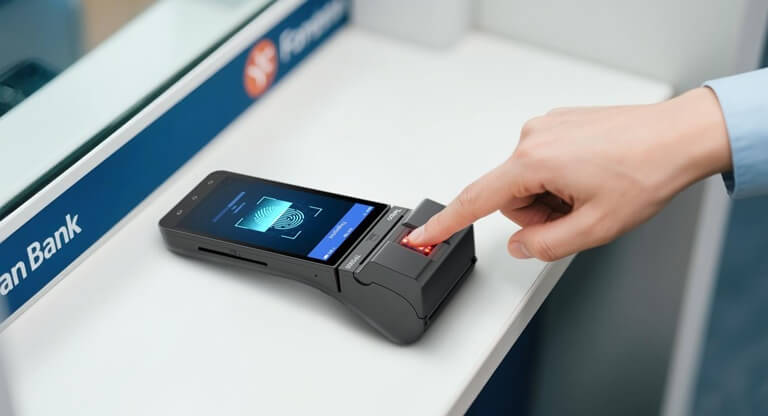
This is the gap that biometric mobile payment terminals are filling. By confirming a payment with a fingerprint or a face, they tie the transaction to a real person instead of a piece of plastic. Let’s look at why this shift is happening and what buyers should check before choosing a device.
Why PIN-Based Security Is Losing Ground
Chip cards reduced one type of fraud, but card-present threats such as skimming, stolen cards, and shoulder-surfing still cost merchants and banks every year. The weakness is structural: a PIN is a shared secret that can be copied, shared, or observed. Biometric authentication replaces that secret with something the customer always carries — their own fingerprint or face.”
This results in payments that are both harder to attack and easier to use which is precisely what the regulators and card networks want.
The Biometric Payment Market Growing at Full Speed
The numbers confirm the momentum. The global biometric payment cards market was valued at around US$289.6 million in 2024 and is projected to reach roughly US$5.7 billion by 2030 — a compound annual growth rate above 60%. Biometrics is moving from a premium option to a mainstream expectation, especially in markets rolling out financial-inclusion and identity-verification programs.
For merchants, banks, and payment service providers, the question is no longer whether to support biometric payments, but which hardware to deploy.
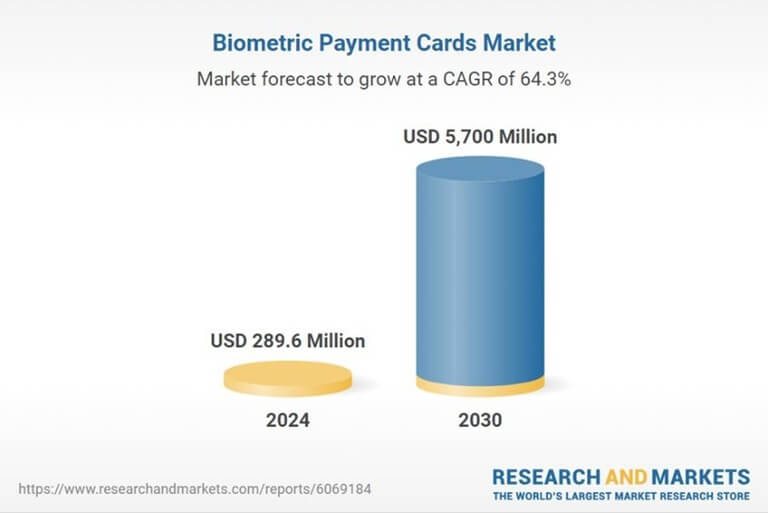
https://www.researchandmarkets.com/reports/6069184/biometric-payment-cards-global-strategic
What to Look for in a Biometric Mobile Payment Terminal
Not every terminal with a fingerprint reader is going to be suitable for use in a regulated financial environment. Before you even start to shortlist, look for these key features:
- Certified payment security. Look for PCI PTS (the current generation is V6.x) and EMV Level 1 & 2 certification plus approval from the major card schemes. Without all of that the device will not be able to go into a regulated payment environment.
- Multiple payment methods. The customer wants to pay with their chip card, their contactless card, their QR code and their mobile wallet (all on the same device ideally).
- Connectivity that works for you. 4G, Wi-Fi and Bluetooth are all important for mobile merchants, delivery people and pop-ups.
- Manageability at scale. Remote key injection, central device management and tamper protection are all key features when you’re deploying hundreds or thousands of devices.
A Closer Look at the Telpo P9 Payment Terminal
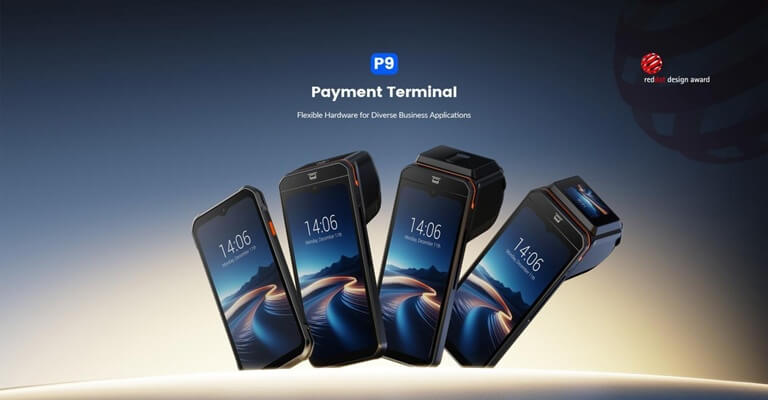
One device built around these requirements is the Telpo P9, a handheld smart payment terminal from Telpo, an AI-driven smart terminal manufacturer.
The Telpo P9 runs Android on an octa-core processor and supports an unusually wide range of payment methods: smart card, magnetic stripe, NFC contactless, QR codes, and mobile wallets — with an optional fingerprint module for biometric payment and KYC scenarios.
On certifications, the P9’s financial configuration is among the most complete in its class: PCI PTS 6.x, EMV Contact L1 & L2, EMV Contactless L1, Visa, Mastercard, RuPay, Amex, JCB, UnionPay, Pure, Discover, NSICCS, and TQM. Just as importantly, the device also carries the regional and export-oriented electronics certifications that global procurement teams routinely have to chase — CE, FCC, RoHS, WEEE, and PPWR. In practice, this means a single model can move through financial approval in one country and customs clearance in the next, which removes one of the biggest hidden costs of international POS terminal rollouts.
Battery life is another major consideration. The Telpo P9 has a removable 5000mAh battery which will get you through a full day, meaning field staff can just swap batteries rather than looking for a power outlet. It also has a 6.5″ screen, an optional barcode scanner and a very simple design which makes it very easy to repair. All of which makes it ideal for the realities of field use.
Master Manufacturer in Smart Terminals
Payment hardware isn’t a one-off purchase. It’s a long term commitment. A payment terminal is typically in use for five years or so. Getting a new model into a bank, a telecom or a government project involves very long project cycles, multiple rounds of tendering and a very rigorous certification process. That’s why the manufacturer is just as important as the device.
Telpo Technology Co., Ltd. was founded in 1999 in Foshan, China and is listed on the NEEQ (stock code 833839). It’s now a fairly well known name in the smart terminal space with approximately 600 people in the company (around 200 of whom are R&D engineers).
Telpo’s production is very strong with a factory of approximately 45,000 sqm capable of producing some 2 million units per year and between 150k and 180k smart terminals per month. Quality is controlled in a CNAS accredited lab of around 900 sqm which does EMC, climate and RF testing and 100% functional testing on every unit. The level of in-house testing is such that it actually accelerates the certification process and keeps defect rates very low over the course of a long project.
Telpo’s distribution is just as robust. They export into over 100 countries across Africa, the Middle East, Southeast Asia, Latin America and Europe. Their terminals are used in banking, telecom, government identity and subsidy schemes, retail chains and public transport (where device failure or missing certs would be absolutely unacceptable).
Biometrics as an Engineering Strength, Not a Checklist Item
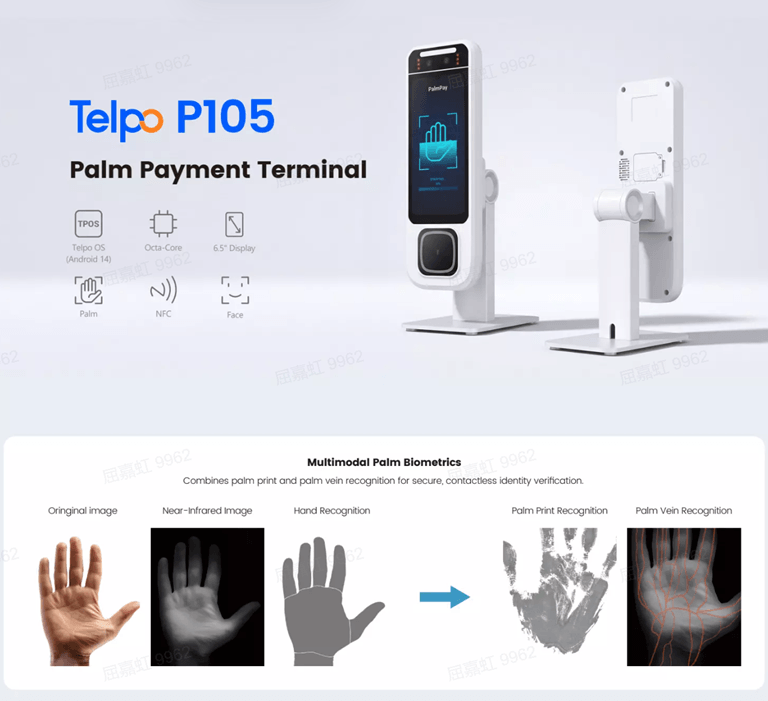
Beyond the P9, Telpo’s customization capability is worth highlighting. The company has combined multiple biometric technologies with payment hardware to build a family of biometric payment devices: face-recognition payment terminals already deployed in 7-Eleven convenience stores, iris-recognition payment devices, and palm-vein / palm-print recognition devices developed in cooperation with Qualcomm, among others.
This is not a gimmick. Strengthening payment terminals with fingerprint, iris, or palm-vein recognition reflects a broader industry trend — as transaction volumes grow and fraud tactics evolve, both regulators and consumers are raising the bar for transaction security and personal data protection. Biometric-ready hardware lets issuers and acquirers upgrade authentication without replacing the terminal fleet.
Telpo as an AI driven smart terminal provider actually offer a lot more than just payment terminals. They have AI powered self checkout, AI cash registers, AI smart kiosks, AI ticket validators and device management software so their partners can run multiple projects through a single certified supplier.
Real-World Scenarios Where Biometric Terminals Shine
- Retail and food service. Queue-busting checkout with tap-and-authenticate flows keeps lines moving during peak hours.
- Banking and KYC. Biometric verification supports customer onboarding, account access, and subsidy disbursement in branch-light regions.
- Mobile and field payments. Delivery drivers, market vendors, and event staff accept secure card payments anywhere with a cellular signal.
- Government and aid programs. Biometric identity confirmation ensures benefits reach the intended recipient, reducing leakage and fraud.
Final Thoughts
Biometric payment terminals are changing the way we think about secure checkout. The ideal device will have the right financial certs, be compliant with export rules, support all the payment methods that your customers use and come from a manufacturer that can deliver and support it over the long term.
If you’re evaluating mobile payment terminals for a retail rollout, a banking project, or a government program, the Telpo P9 is a practical starting point — and Telpo’s manufacturing depth and dual-layer certification coverage make it a supplier worth shortlisting.
About Telpo
Telpo Technology Co., Ltd. is an AI driven smart terminal manufacturer established in 1999 and based in Foshan, China. They are listed on the NEEQ (stock code 833839) and manufacture a range of smart payment terminals, Android POS terminals, biometric payment terminals, cash registers, self service kiosks and ticket validators. They have a production capacity of 2 million units per year from a 45,000m2 factory and have a CNAS accredited lab. Their terminals are PCI PTS 6.x, EMV Level 1 & 2 and have all the major card scheme certifications as well as the relevant regional export certifications (CE, FCC, RoHS, WEEE, PPWR). They are sold to over 100 countries and are used in banking, retail, government and transport projects.Appendix: Reference Article (Original)
Source: https://www.telpo.com.cn/blog/how-biometric-handheld-payment-terminals-convenient-payment
https://www.researchandmarkets.com/reports/6069184/biometric-payment-cards-global-strategic
Popular on OTW Right Now!



About The Author

Gagan Bhangu
Founder of otechworld.com and managing editor. He is a tech geek, web-developer, and blogger. He holds a master's degree in computer applications and making money online since 2015.