
How Solar-Powered Security Towers Stay Online Off the Grid
Solar-powered security towers operate without the need for mains power or wired internet. They use three key technologies: solar panels and batteries for power, a cellular modem for connectivity, and a low-power camera with on-board processing that only transmits the relevant footage. The solar panels charge the batteries, which in turn power the cameras, sensors, and lights through the night and in periods of cloudiness. 4G or 5G connectivity is used to transmit the alerts and live video to a monitoring center. It’s a fully self-contained system which can be deployed on a construction site, car park or remote location and is up and running in hours.
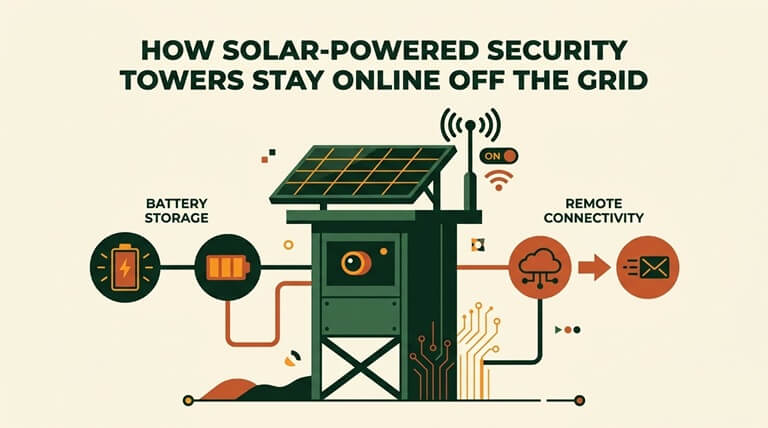
This is a good example of how energy, networking and video can all be combined into a single, compact system.
The Anatomy of a Security Tower
Most mobile surveillance towers share a similar set of components:
| Component | Role | Why it matters |
| Solar panels | Generate electricity during daylight | Removes the need for mains power or generators |
| Battery bank | Stores energy for night and cloudy days | Keeps the system running around the clock |
| Charge controller | Manages charging and protects batteries | Improves efficiency and battery life |
| Cameras | Capture video, often with zoom or night vision | Provide coverage of the site |
| Sensors and analytics | Detect motion, people and vehicles | Trigger alerts and reduce false alarms |
| Cellular modem | Connects the tower to the internet | Enables live viewing and remote monitoring |
| Mast and trailer | Raise cameras high and allow relocation | Improves field of view and flexibility |
Every component has to be designed for power efficiency as all the energy that is used has to be generated and stored on site.
Powering a Tower Without the Grid
Keeping the security equipment running 24/7 on solar power requires careful energy planning. The engineers will look at a number of key factors:
- Panel capacity: The panels have to produce sufficient energy on the short winter days, not just in summer.
- Battery storage: Batteries need sufficient capacity to run the system overnight and through several days of consecutive cloudiness.
- Efficient charging: Modern charge controllers help the panels to deliver more usable energy and protect the batteries from overcharging.
- Low power electronics: Cameras, modems, and processors are all selected to be low power.
- Smart power management: The system can turn down the lighting and other non-essential functions when the battery level gets low.
Where the tower is located is very important. A tower in Arizona, for instance, gets a lot more sun in winter than one in the PNW, so the setup is often altered to suit the local conditions.
Staying Connected in Remote Locations
Having a good connection is just as important as having sufficient power. If the connection is poor, then live monitoring won’t work. Some of the common solutions are:
- 4G LTE and 5G networks. Cellular modems are the most common option, offering good coverage and enough bandwidth for live video.
- Dual-SIM setups. Using two carriers provides backup if one network is weak or temporarily unavailable.
- External antennas. High-gain antennas mounted on the mast can improve signal strength in fringe areas.
- Satellite links. In very remote locations without cellular coverage, satellite connectivity can fill the gap.
- Local network bridges. Point-to-point wireless links can connect several towers to a single internet connection.
Bandwidth management is absolutely critical. Streaming HD video from a number of cameras all the time is a massive user of data so most systems will record locally and only stream when something occurs or when someone wants to view live.
Cameras and Sensors Built for the Job
Security towers typically use a mix of camera types to balance coverage and detail:
- Fixed cameras monitor entrances, perimeters and specific zones.
- Pan-tilt-zoom cameras can rotate and zoom to follow activity across a wide area.
- Low-light and infrared cameras provide visibility at night.
- Thermal cameras detect heat signatures, useful in darkness, fog or large open spaces.
Lights, loudspeakers and strobes are frequently used to keep people at a distance. If someone does enter a restricted area the lights and other features will indicate that the site is being monitored.
Edge AI: Smarter Alerts, Less Data
A significant improvement in security towers is on-board video analytics (also known as edge AI). Instead of sending every single video frame to the cloud, the video is analysed by the tower’s own processors and it’s capable of identifying things like people and vehicles.
This method has a number of advantages. It reduces the number of false alarms caused by animals, moving branches or changes in light. It saves bandwidth as only the relevant events are transmitted. It also uses less power than continuous video streaming, which is a major benefit for solar-powered systems.
Edge processing enables sites to be monitored continuously even in locations where there’s a lack of energy and/or internet connectivity.
Where Human Monitoring Fits In
Technology can detect the activity but people are still required to work out what’s actually going on. A lot of organizations will have a mixture of automated detection and live operators who will look at the alerts as they come in and then decide what to do.
Services that pair mobile camera towers with 24/7 remote monitoring, such as Wifieye, use this layered approach. When analytics flag an event, trained operators check the live feed, issue warnings through on-site speakers and contact police if necessary. This combination reduces false alarms while ensuring genuine threats receive a fast response.
Engineering Challenges
Designing reliable off-grid security systems isn’t simple. Engineers have to address:
- Extreme weather, including heat, cold, wind and heavy rain
- Battery performance in low temperatures
- Theft or vandalism of the tower itself
- Network congestion in busy areas
- Remote maintenance and software updates
- Balancing image quality with power and bandwidth limits
Durable enclosures, tamper-resistant designs and remote diagnostics help keep towers running with minimal on-site maintenance.
Security That Goes Wherever It’s Needed
Solar-powered security towers are a prime example of the advances that mobile technology has made. They can secure sites that would previously have been very difficult or expensive to secure by utilizing renewable energy, cellular connectivity and smart video analytics.
As the solar panels, the batteries, and the AI processors get better, these systems are going to get even more powerful. They provide a very flexible way of providing real time security on construction sites, parking lots, utilities and for any number of other temporary events where you don’t have the grid and you don’t have fibre.
Popular on OTW Right Now!


About The Author

Gagan Bhangu
Founder of otechworld.com and managing editor. He is a tech geek, web-developer, and blogger. He holds a master's degree in computer applications and making money online since 2015.