
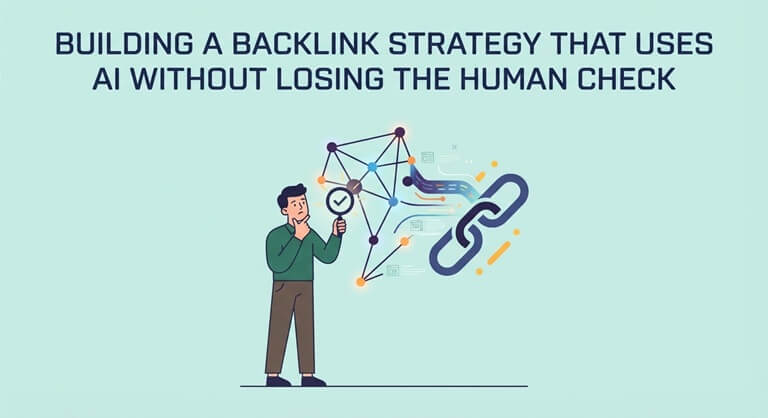
Building a Backlink Strategy That Uses AI Without Losing the Human Check
A good backlink strategy is one that’s focused on getting relevant mentions, which will help the reader and your business. It’s not about just getting as many links as you can. AI can certainly help with a number of things in the process (finding prospects, doing the research, drafting the outreach, etc.). It can also make it easier to scale out some of the lower-quality tactics. The point is to use automation to augment your own judgment rather than to replace it.
This is absolutely critical for small marketing teams. A smart process can save you hours a week, whereas blindly sending out automated messages to hundreds of unrelated sites is going to damage your reputation and waste your time. Here are a few ways you can use AI at each stage of the link building process.
Start With the Page You Want to Earn Links For
Before you go out looking for sites to contact, pick the asset that you’re going to be trying to get a link for. That could be an original piece of research, a useful technical guide, a useful tool or a clear explanation of a problem your customers have. If your page isn’t something unique and valuable in its own right, then no amount of prospecting tooling is going to help.
AI can be used to review your page and identify any gaps. You can ask it to summarise who the page is for, list the questions it answers and suggest other topics that could be added to improve the resource. You can then compare those suggestions against actual customer questions, search results, and your team’s knowledge. The objective is to improve your asset rather than just produce some generic content because the AI has told you that the topic is popular.
Find Prospects by Relevance, Not Just by Volume
AI tools can help you filter your list of potential sites by topic, audience and the type of resources they provide. They can also cluster sites that have covered similar topics or linked to similar material. That, in turn, makes it much easier to go from a long list to a much shorter, more focused list of good prospects.
You still need to check relevance yourself. Go to each site and ask whether the site’s audience would actually benefit from your resource. Make sure the site is live, the page is editorial (not just a list of paid links), and that your link would be a natural fit in the article. A high authority score or a tool’s confidence score in no way makes an irrelevant site a good site to link to.
Some AI tools will also be able to find potential contact details or summarise what a site has covered recently. Treat that as lead information to check, not as content to simply copy into your campaign. A small thing like a name getting it slightly wrong or a job title being out of date may not seem like a big deal, but if you’re doing it repeatedly, it looks very unprofessional.
Use AI to Improve Outreach, Not Multiply It
Once you have a qualified prospect, AI can help organize the context for a concise message: what the writer has covered, why your resource is relevant, and what specific addition it could make to their article. A practical overview of AI-assisted link building can help teams think through where automation fits into the workflow.
Writing a draft is just the first step. Your message has to get to the right person and the right article, accurately describe your content, and clearly set out the value to the recipient. Strip out any generalities, any fake friendliness or anything that could be sent to anyone. The recipient should instantly understand why you’re writing.
Keep it simple. You can point to a resource that may help their page, you can offer an expert opinion, or you can suggest something useful to add. Don’t go around saying they owe you a link for coverage. If there’s no clear benefit to their readers, then it’s better not to send it.
Make Stronger Assets With the Right Skills
Getting links often involves more than just good writing. A useful piece of content might need some clear charts, a product tutorial might benefit from a short, well-paced video and a technical guide may well need a developer to go through the examples and test them. All of these things make your piece of content more accessible and more likely to be shared.
If your team lacks a particular skill, outsourcing a defined task can be more efficient than stretching an in-house team across unfamiliar work. For a campaign that needs short-form video, this guide on hiring a freelance TikTok or Reels editor outlines what to consider when choosing someone for the job. Osdire is one marketplace where buyers can hire freelancers across areas including video, design, writing, and technology; as with any marketplace, clear briefs and review criteria matter more than simply choosing the fastest option.
Set Guardrails Before Automating
AI can accelerate a bad process so it’s vital to set boundaries upfront if you’re going to link AI to your email system or your publishing system. You need to have someone in the chain who is responsible for approving prospects and messages. Don’t use AI to generate text that creates fake author names, fake stats or the kind of article that’s just going to be used to drive links. Only upload sensitive customer or campaign data to a tool if your organization has approved the way it will handle that data.
It also helps to separate useful automation from risky shortcuts:
- Good use: Summarise the prospect’s relevant article, check the summary and then tailor your note.
- Good use: Tag the prospects by topic and remove the duplicates prior to a person having a look at the list.
- Risky use: Send the exact same AI-generated pitch to every contact without checking that it’s appropriate for that particular contact.
- Risky use: Assess the success of the campaign purely on the number of emails sent or number of links acquired.
Measure Outcomes That Matter
Don’t just track the number of placements you get, track the quality of those placements. Good metrics to use are the relevance of the referring sites, the number of referral visits, engagement with the page in question, and whether the new audience is taking the desired next step. Look at the pattern in the responses and rejections too. If people consistently say your resource is too broad, that might indicate you need to improve the content rather than the outreach.
Keep regularly reviewing your workflow. Strip out any AI tasks that don’t save you time and in fact end up causing more problems than they solve. The good backlink strategy is all about quality content, smart targeting and polite outreach. AI can be used at every stage of that process, but you still have to work to earn the trust that makes a link worthwhile.
Popular on OTW Right Now!



About The Author

Gagan Bhangu
Founder of otechworld.com and managing editor. He is a tech geek, web-developer, and blogger. He holds a master's degree in computer applications and making money online since 2015.