
How Route Planning Software Improves Business Efficiency
Delivery ops are far more than just moving things from A to B. You’ve got to manage the drivers, manage the delivery times, manage the fuel costs and deal with the ever changing road conditions. If you’re doing it all by hand, then a small error in one area can have a knock-on effect right through the schedule.
Route planning software helps the business to keep all of that in order. It takes the location data, applies the routing rules and uses the optimisation techniques to produce sensible routes for the drivers. The end result is a more efficient use of time, vehicles and people.
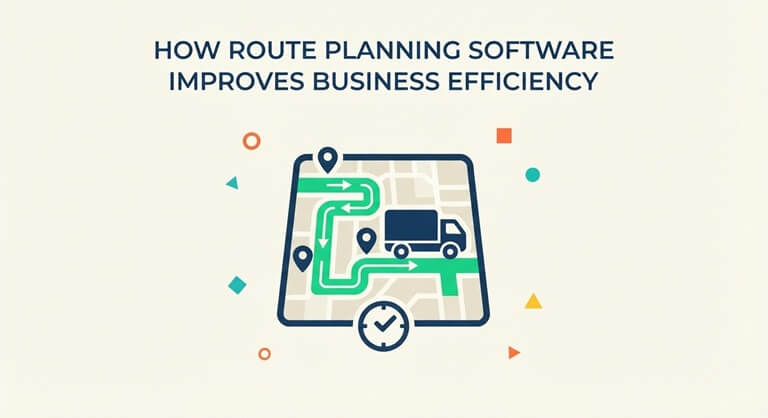
Reducing Travel Time and Fuel Costs
Planning out delivery routes by hand becomes a nightmare when you’ve got a lot of stops for your drivers. The sequence of the stops matters. A poor route will result in excessive backtracking, longer journeys and more fuel consumption.
Route planning software looks at the sequence of stops and will find more efficient ways of getting from one to the next. The software may take into account the road network, estimated times of travel and delivery priorities. This enables the dispatcher to assign routes based on actual requirements rather than on assumption.
Fuel savings are going to be down to things like traffic, the type of vehicle and how many deliveries you’re making in one area. That said, eliminating any extra distance will reduce fuel consumption and reduce vehicle wear. Shorter routes can also allow drivers to fit in more deliveries.
Businesses can start by testing a free route planner tool to organize stops and explore more efficient delivery sequences. This approach is useful for small businesses that need better route coordination without immediately investing in a complex logistics platform.
Improving Driver Productivity and Scheduling
Driver productivity is about more than just how fast they drive. You also have to allow time for parking, finding addresses, unloading the packages, collecting the signatures and assisting the customer. A good schedule will take all of that into account.
Route planning software will help the dispatcher work out when the drivers are likely to get to the various stops and will put the stops in a sensible order. Some of the systems will also take account of delivery time windows, driver shift limits, vehicle capacity and service times so that you don’t end up with a schedule that looks perfectly efficient on paper and utterly impractical in the real world.
For instance, if you’ve got a distributor who has to get to 25 customers in a day, you need to be thinking about opening hours, unloading times, and where the customers actually are. A route which is purely the shortest distance may well see you miss the time-sensitive delivery. A better route will be one which takes into account both the travel time and the service time.
Automated planning also saves the dispatcher a lot of time as they don’t have to rework the stops by hand. That in turn allows them to concentrate on the special cases, the customer calls and the resource management rather than spending the day re-scheduling.
Handling Multiple Vehicles and Delivery Constraints
As delivery operations scale up, planning becomes a resource allocation problem. It’s not simply about finding the shortest route; it’s about matching the right jobs to the right vehicles whilst staying within the confines of the business.
Effective route optimization can consider several variables:
- Vehicle capacity: Assign packages by weight, volume or space available.
- Delivery time windows: We schedule our stops around customer availability and the agreed delivery window.
- Driver working hours: Keep routes within shift limits and required break periods.
- Service duration: Allow time for loading, unloading, installation or customer handover.
- Vehicle availability: Match up delivery jobs with the appropriate vehicles and available drivers.
These limits are of course important as the shortest route isn’t necessarily the most cost-effective or the most sensible route. A route may be the shortest in terms of distance but could involve overtime, missed windows and overloaded vehicles.
For fleets with several vehicles, optimization software can distribute stops across drivers. This helps prevent one driver from carrying an excessive workload while another has unused capacity. The quality of the result depends on accurate input data and realistic business rules.
Responding to Delays and Operational Changes
Delivery plans are very much subject to change during the day. Traffic congestion, canceled orders, missed deliveries, and last-minute requests can all have an impact on the original plan.
Route planning software makes it far easier to go back and tweak routes when things change. Some of the more sophisticated systems can incorporate live traffic updates or interface with dispatch and tracking systems. This allows the manager to see the impact of a problem on the schedule prior to making any changes to driver assignments.
A good workflow is one that separates the things that must be done from the things that can be changed. A delivery deadline may be a must, the sequence of stops may be flexible. If something goes wrong you can then concentrate on the key tasks and rejig the rest of the route.
Not all tools provide real time route updates so you need to check what your software is capable of. You can still go ahead and create a new route quite quickly based on the current delivery information which will in itself help the manager to make a better decision.
Popular on OTW Right Now!

About The Author

Gagan Bhangu
Founder of otechworld.com and managing editor. He is a tech geek, web-developer, and blogger. He holds a master's degree in computer applications and making money online since 2015.