
Industrial Automation Systems for Manufacturing: Types, Architecture, and Examples
Industrial automation systems for manufacturing combine sensors, controllers, machines, networks, software, and operator interfaces to control production with less manual intervention. The right system depends on production volume, product variety, process requirements, safety needs, and how much information must move between the shop floor and business systems.
What are the types of industrial automation systems?
The main types of industrial automation systems are fixed, programmable, flexible, and integrated automation, although manufacturers may also classify systems by control technology, such as PLC, DCS, SCADA, or CNC-based systems.
Fixed automation
Fixed or hard automation performs a predetermined sequence using dedicated equipment. It is most suitable for high-volume production where the product and process remain stable.
Automotive transfer lines, high-speed bottling equipment, and dedicated assembly machines are common examples. The advantage is high throughput and consistent cycle times, while the main disadvantage is the cost and difficulty of changing the process.
Programmable automation
Programmable automation uses stored control programs that can be changed for different products or batches. PLC-controlled machinery, CNC equipment, and batch-processing systems commonly fit this model.
It is useful when production volumes are moderate and manufacturers need to produce different products without replacing the entire system.
Flexible automation
Flexible automation is designed to change between products with relatively little manual intervention. Robotic cells, flexible manufacturing systems, machine vision, and automated tool-changing CNC systems are typical examples.
This approach is valuable for high-mix manufacturing because software and automated equipment can handle product variation more efficiently.
Integrated automation
Integrated automation connects multiple production and information systems so that manufacturing data can move across the plant. This can include PLCs, SCADA, MES, ERP, industrial networks, databases, and analytics platforms.
Modern manufacturing increasingly combines these approaches rather than choosing one category exclusively.
What are the 4 types of automation?
The four commonly cited manufacturing automation types are fixed, programmable, flexible, and integrated automation.
Fixed automation prioritizes speed and repeatability, programmable automation supports batch production, flexible automation supports frequent product changes, and integrated automation connects production activities and information systems across a wider operation.
| Type | Best suited to | Flexibility | Typical example |
| Fixed | Very high-volume production | Low | Dedicated assembly line |
| Programmable | Batch production | Medium | CNC or PLC-controlled machine |
| Flexible | High-mix production | High | Robotic manufacturing cell |
| Integrated | Connected factory operations | High | PLC-SCADA-MES-ERP environment |
The important distinction is that these are production-system classifications, while PLC, DCS, SCADA, and HMI describe technologies or control-system functions. Mixing these two classification schemes can make automation architecture harder to understand.
What is the architecture of industrial automation systems?
The architecture of industrial automation systems describes how field devices, controllers, supervisory software, manufacturing operations, and enterprise systems interact, with the traditional ISA-95 model commonly represented as levels 0 through 4.
At the bottom, Level 0 contains physical processes and field devices such as sensors, motors, valves, and actuators. Level 1 contains control equipment such as PLCs and other controllers. Level 2 provides supervision through systems such as SCADA and HMI. Level 3 covers manufacturing operations and commonly includes MES, while Level 4 represents enterprise systems such as ERP.
A simplified data and control path looks like this:
Production process » Sensors and actuators » PLC/DCS » HMI/SCADA » MES » ERP and analytics
Modern factories can extend this architecture with industrial edge computing, IIoT connectivity, cloud platforms, and Unified Namespace approaches. Siemens, for example, describes architectures that connect shop-floor PLC data with MES through Industrial Edge and OPC UA.
What are industrial automation examples in real factories?
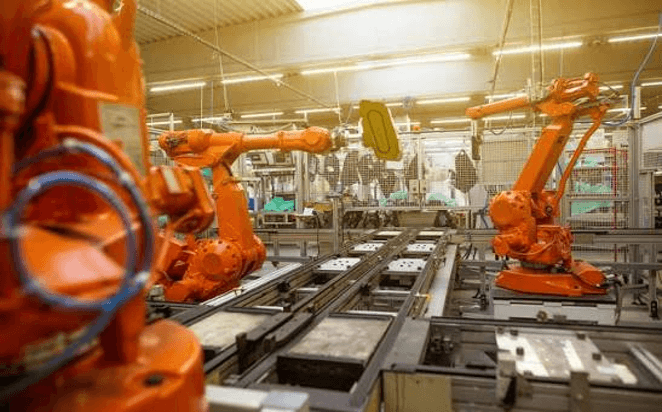
Industrial automation examples in real factories include robotic assembly, automated material handling, CNC machining, automated inspection, packaging, filling, welding, and conveyor-based production.
In an automotive factory, robots can weld or assemble components while PLCs coordinate machine sequences and safety systems. In food and beverage manufacturing, automated filling, capping, labeling, and inspection can operate at high speed. In machining, CNC equipment can be combined with robotic loading, automatic inspection, and production-data collection.
The automation system is therefore usually a collection of interconnected technologies rather than one machine. IBM identifies manufacturing applications such as automated conveyors and motor control for assembly-line robots as examples of industrial control systems in practice.
What are industrial automation systems for manufacturing examples?
Industrial automation systems for manufacturing examples include PLC-controlled production cells, robotic assembly lines, automated storage and retrieval systems, CNC machining cells, machine-vision inspection stations, and integrated production lines.
A practical machining cell might use a robot to load raw components into a CNC machine, a PLC to coordinate the cell, sensors to verify part position, vision equipment to inspect the finished component, and MES software to record production information.
A packaging line could similarly combine conveyors, sensors, servo drives, PLC control, HMI supervision, barcode scanners, and production monitoring.
This illustrates an important competitive gap in many basic automation guides: automation should be evaluated as a process and system architecture, not simply as a list of machines.
What do industrial automation systems for manufacturing notes cover?
Industrial automation systems for manufacturing notes typically cover automation fundamentals, control components, system types, architecture, PLCs, sensors, actuators, HMI, SCADA, industrial communication, robotics, safety, and manufacturing applications.
Good study notes should also distinguish between control and supervisory functions. A PLC may execute real-time machine logic, an HMI may provide the operator interface, SCADA may supervise multiple processes, and MES may manage manufacturing operations.
For engineering students or new automation professionals, notes are most useful when they include diagrams, terminology, examples, and comparisons rather than isolated definitions.
How do industrial automation systems and integration work together?
Industrial automation systems and integration work together by connecting machines and control systems with supervisory, manufacturing, and enterprise applications so that operational data can move between the appropriate layers.
Integration can involve industrial protocols such as OPC UA, Ethernet-based industrial networks, MQTT, or vendor-specific connectivity. The objective is not simply to connect everything, but to move reliable and contextualized information between systems.
For example, a PLC can provide machine-state data to an edge or SCADA layer, while MES can associate production results with a work order. ERP can then use higher-level production and business information for planning and resource management.
Modern architectures increasingly use edge computing and standardized data layers to connect heterogeneous equipment while preserving the requirements of real-time industrial control.
What do images of legacy industrial automation systems show about older plants?
Images of legacy industrial automation systems typically show hardwired control panels, relay logic, analog instruments, older PLCs, local operator panels, extensive cabling, and equipment with limited network connectivity.
Older plants were often designed around reliable local control rather than continuous enterprise-wide data access. A machine could perform its intended operation effectively while producing little structured data for modern analytics.
That does not mean legacy equipment must automatically be replaced. Many manufacturers instead use gateways, industrial edge devices, protocol converters, historians, or other integration technologies to connect older assets to newer systems. The appropriate approach depends on equipment condition, control requirements, cybersecurity risk, availability, and the value of the data.
Is there an industrial automation basics pdf worth downloading?
Yes, an industrial automation basics PDF can be useful when it comes from a reputable engineering, standards, education, or automation-equipment source and covers both concepts and practical architecture.
A useful PDF should explain automation types, sensors and actuators, PLCs, HMI, SCADA, industrial networks, control architecture, safety, and manufacturing examples. Vendor documentation can also be valuable when learning a specific automation platform.
For architecture and manufacturing integration, ISA’s material on RAMI 4.0 provides useful context for understanding reference architectures, while Siemens provides documentation and guides covering MES and industrial-edge integration.
Where can you find programming industrial automation systems pdf guides?
You can find programming industrial automation systems PDF guides through established automation vendors, standards organizations, engineering education resources, and reputable technical publishers.
When selecting a programming guide, look for material covering PLC programming languages, ladder logic, function blocks, structured text, I/O mapping, sequencing, troubleshooting, safety considerations, and commissioning.
The best guide depends on the controller and programming environment you are using. A generic PLC guide can explain programming principles, but platform-specific documentation is normally necessary for actual implementation.
Choose the architecture before choosing the automation technology
Manufacturers should define the production problem, required throughput, product variation, control requirements, data needs, safety constraints, and integration goals before selecting equipment or software. This prevents the common mistake of buying individual automation technologies without designing how they will operate together.
Build an automation roadmap around the factory process
Start by mapping the production process and identifying where manual work, quality problems, downtime, material movement, or missing production data create the greatest cost. Then select the appropriate automation type, define the control architecture, plan OT/IT integration, and introduce connectivity or analytics where they provide a measurable operational benefit.
Popular on OTW Right Now!




About The Author

Gagan Bhangu
Founder of otechworld.com and managing editor. He is a tech geek, web-developer, and blogger. He holds a master's degree in computer applications and making money online since 2015.