
How QA Teams Should Evaluate AI Testing Agents: A Scorecard
AI testing agents should be evaluated on more than the number of tests they generate: QA teams should measure test accuracy, coverage, execution reliability, defect detection, false positives, maintenance effort, and human intervention.
An AI testing agent can create hundreds of test cases and still be poor at finding meaningful defects. It may generate valid-looking automation that fails in CI, misunderstand requirements, or repeatedly test low-risk paths while missing critical workflows. A useful evaluation therefore needs to measure the agent’s complete testing behavior, not just its output volume.
What are the key ai testing agent evaluation metrics?
The key AI testing agent evaluation metrics are task success, test correctness, coverage, defect detection, false-positive rate, execution reliability, maintenance effort, efficiency, and human intervention.
QA teams should score these metrics separately because each exposes a different failure mode.
1. Test generation accuracy
Measure whether generated tests actually reflect the requirement, acceptance criteria, or expected behavior.
A useful score can classify tests as:
- Correct and executable
- Correct but requiring minor edits
- Partially relevant
- Incorrect or irrelevant
- Unsafe or misleading
For example, if an agent generates 100 tests and 82 accurately represent the intended behavior, its test-generation accuracy is 82%.
2. Requirement coverage
Coverage should measure more than code coverage. For AI testing agents, QA teams should also track requirements, user journeys, edge cases, integrations, permissions, and failure conditions covered by the generated suite.
A strong agent should expand meaningful coverage rather than simply generate more variations of the same happy-path test.
3. Defect detection rate
Defect detection is one of the most important production-oriented metrics.
Give the agent a test environment containing known defects and measure how many it identifies. A useful scorecard should distinguish between critical, major, and minor defects because missing a payment failure is more serious than missing a cosmetic issue.
4. False-positive rate
An agent that reports everything as a defect can create as much work as one that misses defects.
Track how many reported failures are confirmed defects versus false alarms. Lower false-positive rates generally mean less triage work for QA engineers.
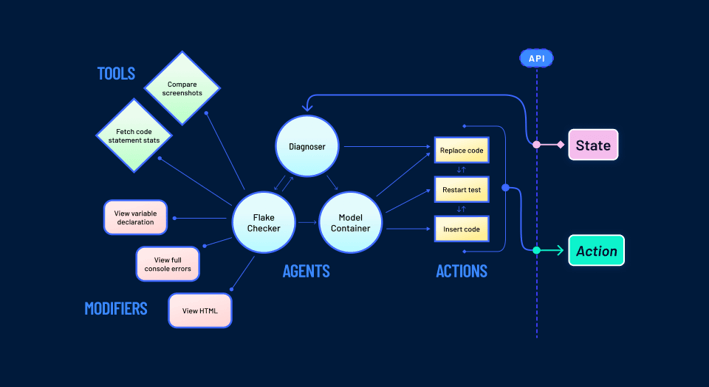
5. Tool and action correctness
For agents that interact with browsers, test runners, APIs, repositories, or CI systems, evaluate whether they choose the correct tool and provide correct arguments.
Modern agent-evaluation approaches explicitly separate tool selection from argument correctness because an agent can choose the right testing tool while passing the wrong URL, selector, environment, or test data.
6. Execution reliability
Measure whether tests actually run successfully in the intended environment.
Track:
- Test execution success rate
- Environment setup failures
- Timeout rate
- Flaky-test rate
- Recovery rate after tool failures
- Successful reruns
This prevents a team from overrating an agent simply because its generated test code looks correct.
7. Task completion rate
Task completion asks a simple question: did the agent accomplish the QA task it was given?
For example:
“Create regression coverage for the checkout flow, execute it, identify failures, and produce a defect report.”
The agent should not receive full credit merely for generating test cases. The complete workflow needs to be evaluated. Task-completion and step-efficiency metrics are commonly treated as separate measures in agent evaluation because an agent can succeed while taking an unnecessarily long path.
8. Efficiency and cost
Track how many model calls, tool calls, tokens, test executions, and minutes are required per successful QA task.
A useful business metric is cost per successful task rather than raw cost per test. An agent that costs more but finds substantially more real defects may be preferable to a cheaper agent with poor detection.
9. Human intervention rate
Measure how often a QA engineer has to correct, restart, approve, or manually complete the agent’s work.
A falling intervention rate is a useful signal that the agent is becoming more autonomous without sacrificing quality.
Where can I find an ai testing agent evaluation sample?
You can find useful AI testing agent evaluation samples by adapting agent-evaluation datasets, benchmark tasks, and evaluation-framework examples to your own QA workflows.
The most useful sample is not a generic collection of prompts. It is a fixed regression set containing realistic testing tasks with explicit acceptance criteria.
Start with 20–50 representative tasks covering different difficulty levels. Recent agent-evaluation guidance similarly recommends building evaluation sets from real work and production failures rather than relying exclusively on public benchmarks.
A practical sample could contain tasks such as:
- Generate API tests from an OpenAPI specification.
- Create regression tests for a new checkout feature.
- Find edge cases in a password-reset workflow.
- Test an application with invalid authentication credentials.
- Identify authorization problems between two user roles.
- Execute browser tests against a staging environment.
- Investigate a failed CI test and determine whether it is a product defect or test failure.
- Generate tests for a previously reported production bug.
- Update outdated selectors after a UI change.
- Produce a defect report from failed test executions.
For every task, define the expected outcome before running the agent.
A strong evaluation sample should record:
- Task input
- Expected behavior
- Required tools
- Allowed actions
- Critical failure conditions
- Expected test artifacts
- Known defects, where applicable
- Pass/fail criteria
- Actual agent trajectory
- Human reviewer score
This makes results reproducible when you change the model, prompt, testing framework, or agent architecture.
You can also use established agent-evaluation resources as starting points. DeepEval, for example, provides agent metrics for planning, tool correctness, argument correctness, task completion, and step efficiency, with tracing used to evaluate complete agent trajectories.
Public benchmarks such as SWE-bench, AgentBench, WebArena, OSWorld, and tau-bench can also provide useful ideas for evaluating tool-using agents, but they should supplement—not replace—your own application-specific regression suite.
What is the best ai testing agent evaluation framework?
The best AI testing agent evaluation framework is a layered scorecard that evaluates the agent’s reasoning, actions, test results, operational performance, and safety against the same repeatable test set.
A practical framework can use five layers.
1. Outcome score
Give the largest weight to whether the QA objective was achieved.
For example:
- 30% task completion
- 15% defect detection
- 10% requirement coverage
The exact weights should reflect business risk rather than arbitrary industry benchmarks.
2. Test-quality score
Evaluate whether generated tests are correct, relevant, maintainable, and capable of detecting meaningful failures.
Include test correctness, edge-case coverage, assertion quality, and false-positive rate.
3. Agent-behavior score
Inspect how the agent reached its result.
Measure tool selection, argument correctness, unnecessary actions, recovery behavior, and adherence to the intended workflow. Trajectory-level evaluation is important because a correct final result can conceal a risky or inefficient execution path.
4. Operational score
Measure whether the agent is practical to operate:
- Execution time
- Token consumption
- Tool-call volume
- Cost per successful task
- Failure and retry rate
- CI reliability
An agent should not pass a production gate simply because it has a high accuracy score if it takes too long or consumes excessive resources.
5. Safety and governance score
QA agents can potentially access source code, credentials, production-like data, test environments, and deployment systems.
Evaluate whether the agent:
- Uses only authorized tools
- Avoids restricted environments
- Protects sensitive test data
- Follows approval requirements
- Avoids destructive actions
- Escalates uncertain situations
- Respects role-based permissions
Safety should be a release gate, not merely another weighted metric.
Build the scorecard around release decisions
The most useful scorecard does not simply produce an overall percentage. It defines thresholds for deployment.
For example, a QA team might require:
- 90%+ task completion
- 85%+ test correctness
- 80%+ known-defect detection
- Less than 10% false positives
- 95%+ execution reliability
- Less than 10% human intervention
- Zero critical safety violations
The thresholds should be adjusted to the risk of the application.
Finally, rerun the same evaluation set whenever the team changes the model, system prompt, tools, test framework, or agent workflow. Agent behavior can change even when the visible feature appears unrelated, which is why repeatable regression evaluation is more valuable than a one-time benchmark.
Gate AI testing agents on quality, not test volume
A strong AI testing agent is not the one that generates the most test cases. It is the one that reliably finds important defects, produces executable and maintainable tests, uses tools correctly, operates efficiently, and knows when a human should take over.
Build a fixed evaluation set, score the agent across outcome, test quality, behavior, operations, and safety, then make those scores part of your release gate. That turns AI testing from a demo-driven experiment into an engineering capability you can measure and improve.
Popular on OTW Right Now!
-
 How to Turn Product Images into Marketing Videos with Runway Model on Pollo AI
-
 AI Receptionists for HVAC and Electrical Contractors: Costs, Call Volumes, and Setup
-
 How AI Video Is Making High-End Visual Advertising Accessible to Lean Teams
-
 How to Set Up an AI Voice Agent Platform for Patient Intake (No-Code Walkthrough)



About The Author

Gagan Bhangu
Founder of otechworld.com and managing editor. He is a tech geek, web-developer, and blogger. He holds a master's degree in computer applications and making money online since 2015.