
AI Receptionists for HVAC and Electrical Contractors: Costs, Call Volumes, and Setup
An AI receptionist for HVAC or electrical contractors can answer calls 24/7, qualify service requests, book appointments, capture lead information, and escalate urgent calls without requiring a person to answer every inbound call. The biggest difference between products is whether the AI is connected directly to the contractor’s scheduling and customer-management system or operates as a standalone phone service.
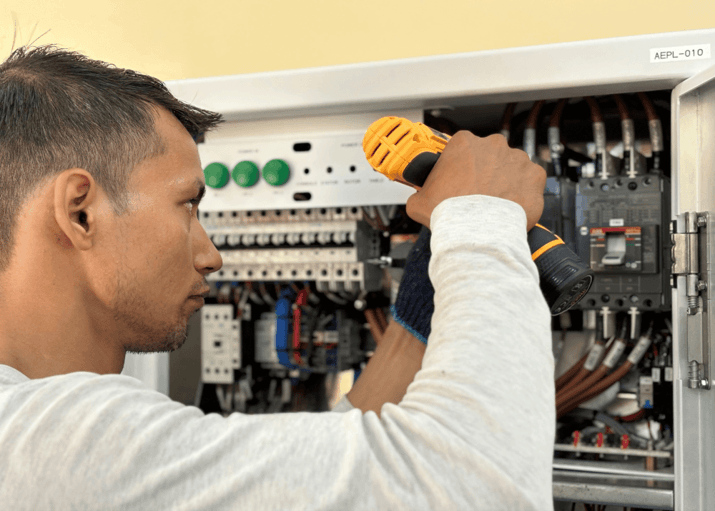
That distinction matters because a receptionist that only takes messages still leaves someone on your team to enter the customer, create the job, check availability and arrange the appointment. A system connected to your field-service software can potentially complete those steps during the call.
Ai receptionist for hvac
An AI receptionist for HVAC is a voice AI system that answers customer calls, understands the service request, gathers relevant information and can schedule or route the job according to the contractor’s rules.
HVAC is particularly well suited to this use case because many calls are repetitive but time-sensitive. A customer may need air-conditioning repair, heating service, maintenance, an estimate or emergency assistance. During a heat wave or cold snap, call volume can increase faster than a small CSR team can handle.
ServiceTitan’s 2026 guidance describes AI virtual agents as systems that can answer calls, have natural conversations, collect customer information, answer questions and book service appointments. Its HVAC implementation can use real-time dispatch availability to book directly to the dispatch board.
Housecall Pro’s CSR AI takes a similar integrated approach. It can use the company’s existing settings and service information to answer calls, collect information and, where configured, book jobs. Its setup includes rules for call handling and escalation.
For HVAC contractors, the most important features are therefore not simply a natural-sounding voice. Look for:
- 24/7 call answering
- Service-area qualification
- Emergency-call identification
- Appointment booking
- Existing-customer recognition
- Technician or dispatcher escalation
- Call summaries
- CRM or field-service integration
- Custom service and pricing rules
- After-hours and overflow handling
The best system should behave more like a basic dispatcher than a generic chatbot.
What is an ai receptionist?
An AI receptionist is an automated voice agent that answers business phone calls and uses conversational AI to understand what callers want and determine what action to take.
Instead of forcing callers through a traditional “press 1, press 2” menu, the system can ask questions in a normal conversation. Depending on its configuration, it can collect a name and address, identify the requested service, answer common questions, schedule an appointment, send information, transfer the call or create a follow-up task.
For contractors, the difference between an AI receptionist and a basic answering service is particularly important. A basic service may capture a message for someone to handle later. An integrated AI receptionist can potentially take the next operational step.
ServiceTitan describes its virtual agent as an AI system capable of taking actions such as booking appointments and accessing live dispatch availability.
Housecall Pro similarly positions CSR AI as part of its broader field-service platform rather than as an isolated phone tool. Its AI can use configured business information, services, availability and booking rules when handling customers.
That is why integration should be one of the first buying criteria for an HVAC or electrical company.
How does an ai receptionist hotel setup work?
An AI receptionist hotel setup typically works by connecting a business phone number to an AI voice agent, configuring the information it is allowed to provide, and defining what happens when a caller needs something outside its scope.
Although hotels have different workflows from HVAC and electrical contractors, the basic setup is similar.
First, calls are routed to the AI receptionist. This can involve call forwarding, a new number or an existing business-phone configuration depending on the provider.
Second, the business provides the information the AI needs. For a hotel, that could include room information, check-in times, amenities and booking rules. For an HVAC contractor, it would instead include service types, service areas, business hours, emergency procedures, pricing guidance and appointment rules.
Third, the company defines escalation. For example, a hotel might transfer a guest to a front-desk employee, while an HVAC company might route a no-heat emergency to the on-call dispatcher.
Housecall Pro’s current CSR AI setup illustrates this model: businesses configure call forwarding, customize CSR AI settings and specify whether calls should be booked or escalated to a human.
For contractors, setup should also include testing unusual calls before going live. Test emergency requests, existing customers, out-of-area callers, rescheduling, cancellations, pricing questions and requests for a human.
What is the best ai voice agent receptionist?
The best AI voice agent receptionist depends on whether you need a standalone phone system or one integrated with your field-service platform.
For a contractor already using ServiceTitan, its native AI Virtual Agent is one of the strongest options to evaluate because it operates within the platform and can use real-time dispatch availability. ServiceTitan says its AI Virtual Agent is available to its customers through Contact Center Pro.
Housecall Pro is similarly attractive for contractors already using its platform. CSR AI is built into Housecall Pro and can use existing business information, services, availability and customer-management data rather than requiring a separate system to be maintained.
For a contractor that does not need field-service integration, a standalone service can make more sense. Smith.ai’s current AI Receptionist pricing starts with a free tier for 25 calls per month, followed by a $150-per-month Pro tier with included calls and per-call pricing at higher volumes. Its Enterprise tier adds custom integrations and full-service setup.
The important comparison is therefore not simply “Which AI sounds the most human?” It is “Which AI can complete the next step in my workflow?”
What is the best ai receptionist for hvac companies?
The best AI receptionist for HVAC companies is usually the one that can connect the phone call to the actual service workflow.
For ServiceTitan users, the native AI Virtual Agent deserves priority because it can work with the live dispatch board instead of relying on a separate scheduling system. ServiceTitan also reports a case in which Riley Plumbing Heating & Air reached an 80% call-booking rate after deploying its AI Virtual Agent, with the company reporting a 20-minute setup. That is a vendor case study rather than independent industry research, so it should be treated as an example rather than a guaranteed result.
For Housecall Pro users, CSR AI is another strong fit. Housecall Pro says its AI can answer calls, summarize them and work from the company’s configured service and scheduling information. Its current setup also lets contractors specify where calls should escalate when a human is requested.
A standalone product such as Smith.ai is worth considering when you want AI phone answering without changing your field-service platform. Its AI can answer calls 24/7, qualify leads, route calls, schedule appointments and provide call recordings, transcripts and summaries. It also offers live-agent escalation on its AI service.
For an HVAC company, prioritize emergency triage above almost everything else. The system needs to know what constitutes a true emergency, what information to collect and exactly who should be contacted when that threshold is reached.
How much does an ai receptionist cost for a contractor?
AI receptionist pricing can range from relatively inexpensive standalone services to substantially higher costs for integrated or custom contractor deployments.
Smith.ai currently publishes a $0 starting tier for 25 calls per month, a $150-per-month Pro plan with 75, 150 or 300-call options, and a $500-per-month Enterprise plan starting at 300 calls with custom integrations and managed setup. Additional calls are charged according to the plan.
Other AI receptionists use flat monthly pricing, per-call pricing, per-minute pricing or custom quotes. This makes a simple “AI receptionist costs $X per month” figure misleading.
Call volume is particularly important for contractors. A company receiving 30 calls a month has a very different economics from a company receiving 300 calls a month, even if both use the same AI receptionist.
The better calculation is:
Monthly AI cost ÷ calls handled = effective cost per answered call.
Then compare that number with the value of a booked service call.
For example, if an AI receptionist costs $300 per month and helps capture only two additional $500 service calls, the gross booked revenue associated with those calls is $1,000. That does not mean the software automatically produced $700 in profit, because labor, parts and other costs still apply. It does show why the business case should be based on incremental booked work rather than the receptionist’s subscription price alone.
How many calls should an ai receptionist handle?
An AI receptionist should be sized around your actual call volume, with enough capacity for seasonal peaks rather than just your monthly average.
HVAC businesses need to think differently about volume because weather can create sudden demand spikes. A system that comfortably handles 20 calls on a normal Tuesday may be much more valuable if it can handle the surge when temperatures suddenly drop or rise.
ServiceTitan identifies after-hours, peak-season overflow, holidays, routine scheduling and staffing gaps as major use cases for AI virtual agents in HVAC.
Start by reviewing the last three to six months of phone records. Measure:
- Total inbound calls
- Calls outside business hours
- Missed calls
- Calls answered by a CSR
- Average call duration
- Calls that resulted in booked jobs
- Emergency calls
- Calls that required human escalation
Then size the AI around both normal and peak demand.
Do not optimize solely for the cheapest monthly plan. A contractor can save money on a low-volume plan and still lose revenue if the system becomes constrained during the busiest week of the year.
What should an HVAC or electrical AI receptionist be trained to do?
An HVAC or electrical AI receptionist should be trained around the decisions a CSR makes repeatedly, not given a generic script and left alone.
For HVAC, that can include determining whether the customer needs heating, cooling, maintenance, installation or emergency service. For electrical contractors, it might distinguish troubleshooting, panel work, outlets, lighting, generators, inspections or urgent electrical hazards.
The system should also know the company’s service area, business hours, appointment windows, accepted services, basic pricing rules and escalation procedures.
Emergency handling deserves its own workflow. An AI should not attempt to diagnose dangerous electrical conditions or make unsupported promises about repair costs. Instead, it should collect the information the contractor needs and follow the predefined escalation procedure.
Housecall Pro specifically recommends configuring service descriptions, pricing guidance, line items and booking settings so CSR AI can handle calls more accurately.
The quality of the underlying business data therefore matters almost as much as the AI model.
Start with after-hours and overflow calls
The safest way for an HVAC or electrical contractor to deploy an AI receptionist is usually to start with a narrow workflow: after-hours calls, overflow calls or routine appointment requests.
That gives the business a controlled environment in which to measure answer rates, booking rates, transfers, incorrect responses and customer reactions before giving the system broader authority.
Once the results are reliable, expand into scheduling, rescheduling, lead qualification, customer follow-up and other repetitive workflows.
The strongest AI receptionist is not necessarily the one that replaces the most human work. It is the one that answers every appropriate call, completes the tasks it can perform reliably, and knows exactly when to hand the conversation to a person.
For contractors, that means evaluating AI receptionists as part of the dispatch and booking workflow—not simply as an automated version of voicemail.
Popular on OTW Right Now!

About The Author

Gagan Bhangu
Founder of otechworld.com and managing editor. He is a tech geek, web-developer, and blogger. He holds a master's degree in computer applications and making money online since 2015.