
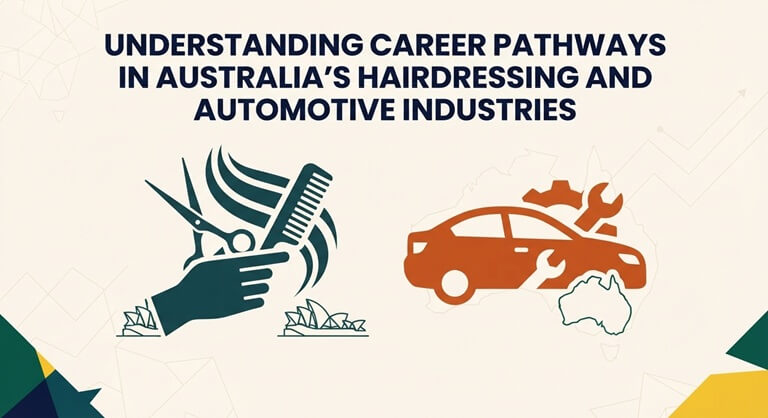
Understanding Career Pathways in Australia’s Hairdressing and Automotive Industries
Choosing a career is not always about finding one particular job and sticking with it for the rest of your working life. For many Australians, the more practical approach is to choose a field that suits their interests, develop useful skills and build experience over time.
The vocational sector offers plenty of options for people who prefer practical, hands-on work. Some careers are centred around working directly with people, while others involve machinery, technology and technical problem-solving. Hairdressing and automotive electrical work are good examples of how different a trade career can look depending on the industry.
Although the day-to-day work in these fields has little in common, both require practical ability, technical knowledge and a willingness to keep learning.
Why consider a vocational career?
University is not the only pathway into a long-term career. Vocational education and training can provide a more practical route for people who prefer learning through a combination of structured training and hands-on work.
Trades can also offer room for development. Someone might begin by learning the fundamentals of a particular occupation before gaining experience, developing specialised skills and eventually taking on greater responsibility.
The right pathway will depend on the individual. Interests, existing abilities, preferred working environment and long-term goals can all influence the type of trade that makes sense.
A career in hairdressing
Hairdressing is often thought of simply as cutting and styling hair, but professional salon work involves a much broader set of skills.
Hairdressers need to understand different hair types, communicate effectively with clients and develop the practical techniques required to deliver a range of services. Colouring, styling, treatments and other salon services all require attention to detail and an understanding of how products and techniques affect different types of hair.
There is also a strong customer service component. A technically capable hairdresser still needs to listen to clients, understand what they want and provide advice that suits their needs.
For people considering this career, cert iii hairdressing can provide a formal pathway into the industry while developing practical skills relevant to salon work.
Like many trades, hairdressing can also develop over time. Experience may lead to opportunities to specialise, work in different salon environments, move into management or eventually operate a business.
The changing role of automotive electrical work
The automotive industry has undergone significant changes as vehicles have become increasingly dependent on electrical and electronic systems.
Modern vehicles can contain sophisticated sensors, control units, electronic safety systems and computerised components. As a result, diagnosing a vehicle problem may involve considerably more than inspecting mechanical components.
This has increased the importance of workers who understand automotive electrical systems and can identify faults using appropriate diagnostic equipment.
For someone interested in this side of the automotive industry, certificate 3 in automotive electrical technology can provide a pathway into a field where mechanical knowledge increasingly overlaps with electronics and vehicle technology.
The work can involve diagnosing electrical faults, working with vehicle wiring and components, and understanding the systems that allow modern vehicles to operate correctly.
Different work, similar foundations
Hairdressing and automotive electrical work may appear to sit at opposite ends of the vocational spectrum. One involves personal services and client relationships, while the other involves vehicles, electrical systems and technical diagnostics.
Yet there are several similarities in what it takes to develop a career in either field.
Both require practical training. Both benefit from repeated hands-on experience. And both require workers to keep their knowledge current as products, equipment and industry practices change.
There is also a problem-solving element in both careers. A hairdresser may need to determine why a particular treatment has not produced the expected result, while an automotive electrical technician may need to trace the source of an intermittent electrical fault.
The nature of the problem is different, but the underlying ability to assess a situation and find an appropriate solution is valuable in both.
Choosing a pathway that suits you
Before committing to a particular trade, it is worth considering what type of working environment feels most suitable.
Someone who enjoys creative work, personal interaction and building relationships with clients may find the salon environment appealing. Another person might prefer working with tools, diagnostic equipment and technical systems.
It is also useful to think beyond the first job. What opportunities might exist after gaining experience? Is there scope to specialise? Could the skills eventually support self-employment or business ownership?
These questions can help put a qualification into perspective. Training is not necessarily the final destination; it can be the starting point for developing a broader career.
The value of practical experience
Formal training provides an important foundation, but practical experience has its own value.
Working alongside experienced professionals allows new workers to encounter situations that cannot always be replicated in a classroom. They can learn how to communicate with customers, manage unexpected problems, use equipment correctly and work efficiently within a real workplace.
Over time, experience can also help people discover which parts of their industry interest them most.
A person entering hairdressing might discover a particular interest in colouring or styling. Someone working in automotive electrical systems may become particularly interested in diagnostics or newer
Popular on OTW Right Now!
-
 Protect, Enhance, Personalize: The Real Value of High-Quality Cell Phone Accessories
-
 How Long Does an iPhone Actually Last? A Realistic Look at Lifespan
-
 Common Signs Your Home Needs Roof Repairs Before Minor Issues Become Major Problems
-
Best Two-Post Car Lifts in 2026: Ranked by Capacity, Ceiling Clearance, and Real-World Shop Fit


About The Author

Gagan Bhangu
Founder of otechworld.com and managing editor. He is a tech geek, web-developer, and blogger. He holds a master's degree in computer applications and making money online since 2015.