
The Netherlands and Belgium Living Room Goes Online: How Smart TVs and IPTV Are Rewriting Television in the Netherlands and Belgium
The most important device in the modern Dutch living room may no longer be the television.
It may be the router.
Television across the Netherlands is becoming increasingly dependent on broadband, Wi-Fi, applications and connected screens. That transformation helps explain why IPTV Nederland is becoming part of a much wider conversation about how households want to watch television in an internet-first world.
People comparing an IPTV abonnement are no longer simply asking how many television channels they receive. They want to know whether the service works on their Smart TV, whether football remains stable on Saturday evening, whether they can switch to a tablet in another room and whether the interface is simple enough for everyone in the house to use.
Across the border, IPTV België reflects many of the same trends, with one additional complication: Belgium’s television audience is split across Dutch-speaking, French-speaking and increasingly international households. Flexibility therefore matters just as much as raw catalogue size.
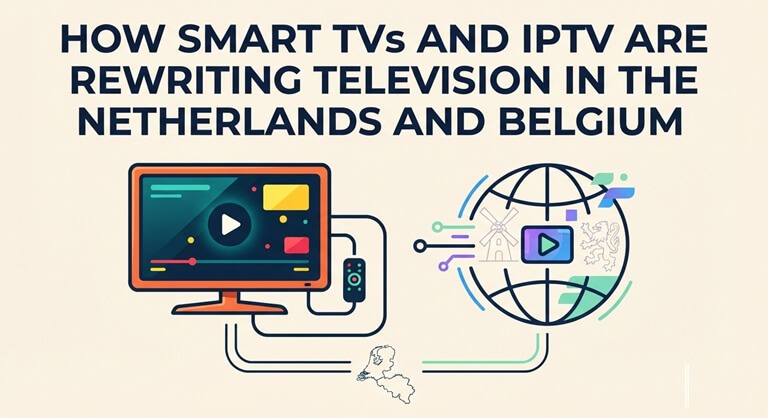
For the wider IPTV Nederland market, this represents a significant change. Television is no longer only a broadcast product delivered to one screen. It is becoming part of the connected-home ecosystem.
And once television becomes software, almost every rule begins to change.
The Smart TV Changed Television More Than 4K Did
Walk into an electronics store and televisions are usually marketed by size and picture quality.
55 inches.
65 inches.
OLED.
Mini-LED.
4K.
HDR.
Those technologies matter.
But one feature arguably changed television more than all of them:
Internet connectivity.
A Smart TV does something traditional televisions could not.
It communicates.
It downloads applications.
It receives software updates.
It searches content libraries.
It remembers preferences.
It connects to cloud services.
It switches between traditional television, YouTube, streaming platforms and internet television without requiring the viewer to understand what is happening technically.
The television stopped being just a display.
It became a computer with a very large screen.
Dutch Homes Are Already Built for Connected Entertainment
The Netherlands is particularly well suited to this transition.
Dutch households are highly connected, and broadband has become infrastructure for far more than browsing websites.
One internet connection may now support:
Remote work.
Video meetings.
Gaming.
Cloud backups.
Smartphones.
Security cameras.
Music streaming.
Smart-home systems.
And several simultaneous television streams.
This means television is increasingly competing for bandwidth with the rest of digital life.
Ten years ago, the internet going offline might mean somebody could not check Facebook.
Today it can interrupt half the house.
Belgium Makes the Story More Interesting
Crossing into Belgium adds another layer.
The technology may be similar.
The audience is more complex.
A household in Flanders may prioritise Dutch and Flemish television.
A family in Wallonia may primarily consume French-language programming.
Brussels can combine both, alongside international audiences.
That makes content discovery particularly important.
An enormous catalogue is not necessarily useful if the viewer has to scroll through hundreds of irrelevant options to reach the television they actually watch.
Good technology should reduce complexity.
Not add to it.
The Old Television Bundle Is Breaking Apart
For years, traditional television worked like a package.
One provider.
One receiver.
One bill.
A defined collection of channels.
Streaming changed that model.
Now a household might use one platform for movies, another for series, another for sport and several broadcaster applications for local programming.
Then there is YouTube.
Music.
Free streaming platforms.
Digital rentals.
Gaming subscriptions.
The modern entertainment setup offers more choice than any generation has had before.
It also has more passwords.
Subscription Fatigue Is Becoming Part of Movie Night
Imagine a typical household.
One entertainment subscription costs €10.
That seems reasonable.
Then another costs €12.
Another €15.
Sport gets added.
Music gets added.
Cloud storage gets added.
Gaming gets added.
Suddenly, individual affordable payments have turned into a substantial monthly total.
This is subscription fatigue.
And it is changing consumer behaviour.
People increasingly rotate services.
They subscribe when a particular series launches.
They cancel when they finish it.
They compare what they actually watch against what they are paying.
Television providers therefore have to compete for something more valuable than a signup.
They have to compete for permanence.
Multi-Device Viewing Is No Longer a Premium Feature
One television in one room no longer represents the modern household.
A family might have:
A Smart TV in the living room.
Another television upstairs.
A tablet.
Two laptops.
Several smartphones.
A Fire TV-type streaming device.
An Android TV box.
Perhaps an Apple TV.
Consumers increasingly expect their entertainment to move across these screens.
That expectation was largely created by streaming platforms.
Once people became accustomed to beginning a series on the television and continuing somewhere else, going back to a service tied to one box started feeling restrictive.
The device should follow the user.
Not the other way around.
Smart TV, Fire TV or Android TV?
One of the most confusing parts of modern television is that two televisions that look almost identical can run completely different software.
Samsung has its ecosystem.
LG has another.
Android TV and Google TV support their own application environments.
Amazon Fire TV adds another.
Apple TV operates differently again.
For consumers, these distinctions can become frustrating.
They do not necessarily care which operating system their television uses.
They simply want the app to work.
This is why checking compatibility before choosing a television service matters.
A good streaming experience begins before the subscription starts.
Your Router Is Part of the TV Setup Now
Consider this scenario.
Someone purchases a premium 65-inch 4K television.
They install it in the perfect location.
The image looks spectacular.
Then they begin streaming football.
Buffering.
The immediate reaction is often:
“The streaming service is bad.”
Maybe.
But perhaps the television is three rooms away from the router.
Perhaps the Wi-Fi signal passes through concrete walls.
Perhaps several people are simultaneously gaming and downloading files.
Perhaps the router is six years old.
Modern television quality depends on a chain of technologies.
If one link is weak, the viewer notices the result on the screen.
Ethernet Is Boring—and Brilliant
Technology marketing loves new things.
Ethernet cables are not new.
They are also exceptionally useful.
A wired connection can provide a Smart TV or streaming device with a more stable network path than Wi-Fi, particularly in homes where wireless coverage is inconsistent.
That does not mean everyone needs cables running through the house.
Modern Wi-Fi can be excellent.
Mesh networks can solve many coverage problems.
But for a fixed television sitting near a network connection, Ethernet remains a remarkably practical solution.
It is difficult to make an Ethernet cable look exciting in an advertisement.
Football fans may find it considerably more exciting when the stream stops buffering.
Football Is Where Streaming Gets Serious
The Netherlands and Belgium do not lack football passion.
Ajax.
PSV.
Feyenoord.
AZ.
Club Brugge.
Anderlecht.
Union Saint-Gilloise.
European competitions.
International football.
Live sport creates a completely different technical challenge from movies and series.
Netflix knows what happens thirty seconds into a film because the film already exists.
A live football stream does not know whether someone will score thirty seconds from now.
It is happening in real time.
That gives video players less room to hide network instability.
A movie can buffer future video.
Football has no future video yet.
The Goal Spoiler Problem
Streaming has created a problem traditional television viewers rarely thought about.
Latency.
Two neighbours can watch the same football match and see the goal several seconds apart.
One starts celebrating.
The other is still watching the attack develop.
Then there are smartphones.
A sports application sends:
“GOAL!”
The television still shows midfield.
Technology has accidentally invented a new kind of spoiler.
For live-sport viewers, delay therefore matters alongside picture quality and stability.
4K Sounds Simple Until You Try to Deliver It
Consumers see “4K” and understandably expect an excellent picture.
But 4K is not produced by one component.
It is a chain.
The original programme needs to exist at sufficient resolution.
The video needs to be encoded properly.
The server must deliver it.
The broadband connection must handle it.
The network inside the home must remain stable.
The streaming device must decode it.
The television must display it.
If any piece fails, the result suffers.
This is why a stable high-quality HD stream can sometimes look better in practice than a nominally 4K stream constantly dropping quality.
Resolution is one metric.
Experience is the real one.
What Actually Makes a Good IPTV Abonnement?
This is where consumers should look beyond marketing numbers.
A useful IPTV abonnement should be evaluated as a complete technology experience.
Device support
Does it work on the television and streaming devices already in the household?
Stability
Does live television remain reliable during popular viewing periods?
Picture quality
Does the service provide suitable quality for the available screen and network connection?
Navigation
Can users find programmes without scrolling through enormous lists?
Search
Can viewers search by programme, channel or category quickly?
Support
Is assistance available if installation or playback fails?
Subscription transparency
Are duration, renewal and refund conditions easy to understand?
Content rights
Is the provider authorised to distribute the programming being offered?
Channel count alone answers none of these questions.
More Channels Can Actually Make Television Worse
Imagine opening an application containing 30,000 channels.
It sounds impressive.
Then imagine trying to find tonight’s football match.
Suddenly the number feels less impressive.
Modern digital products have learned an important lesson:
More is not always better.
Google became valuable because it helped people find something inside an enormous internet.
Spotify does not simply provide music; it helps users navigate music.
Netflix invests heavily in recommendations because a giant catalogue is useless if the viewer cannot decide what to watch.
Internet television faces the same problem.
Content discovery may become more important than content volume.
IPTV Nederland Plus and the Benelux Market
IPTV Nederland Plus operates within this wider shift toward connected television for audiences in the Netherlands and Belgium.
Its positioning reflects a broader consumer preference for television delivered through devices people already use instead of relying exclusively on a traditional fixed receiver.
For consumers considering such a service, the best approach is practical.
Test the devices that matter.
Understand the household internet connection.
Review subscription terms.
Evaluate playback quality.
Check support options.
Examine whether the programming actually matches viewing habits.
And verify the legitimacy and content rights of the service.
The technology should fit the household.
The household should not have to redesign itself around the technology.
A Trial Can Reveal More Than a Feature List
Marketing pages describe ideal conditions.
Real homes are not ideal conditions.
One household has fast fibre and Ethernet.
Another uses Wi-Fi through three walls.
One uses a new Smart TV.
Another has a six-year-old television with a streaming stick.
One family primarily watches movies.
Another watches live football every weekend.
This is why testing can be useful where a legitimate provider offers that option.
Ten minutes of actual playback on the household’s own devices may reveal more than fifty feature icons.
Dutch and Belgian Households Need Different Content
Another mistake is assuming “Benelux” means one homogeneous television audience.
It does not.
A viewer in Amsterdam may have different preferences from someone in Antwerp.
Someone in Liège may consume primarily French content.
An international family in Rotterdam may prioritise channels from several countries.
A sports fan may care almost exclusively about football.
Another household may rarely watch sport.
Personal relevance matters.
The future of television is therefore likely to become more personalised, not less.
AI Could Become the New Remote Control
The traditional remote control was designed around channel numbers.
The future remote may be designed around language.
Imagine telling the television:
“Show me Dutch football tonight.”
“Find a good Belgian crime series.”
“Give me an action movie under two hours.”
“What’s live right now?”
“Show children’s television in Dutch.”
AI-powered interfaces could make these requests possible without manually navigating menus.
Recommendation systems already attempt to predict viewing preferences.
Conversational AI could turn that prediction into direct interaction.
Instead of learning how the television interface works, the television could learn how the viewer thinks.
Content Discovery Is the Next Big Battle
Most streaming platforms already have more entertainment than anyone can consume.
The next challenge is helping people navigate it.
Anyone who has spent 25 minutes scrolling through Netflix without selecting a movie understands the problem.
Infinite choice can become its own form of inconvenience.
The best connected-TV experiences will therefore probably combine large catalogues with better organisation.
Categories.
Search.
Favourites.
Recommendations.
Viewing history.
Continue watching.
Personal profiles.
Technology should make a huge content library feel small when the user needs something specific.
The Home Entertainment Setup Is Becoming Simpler and More Complicated at the Same Time
Physically, things are getting simpler.
One Smart TV can replace several boxes.
Applications can replace dedicated hardware.
Wireless connections reduce cables.
But digitally, entertainment is becoming more complicated.
More accounts.
More platforms.
More subscriptions.
More applications.
More content.
The winners in connected entertainment will be the companies that solve that contradiction.
The hardware disappears.
The complexity should disappear with it.
Television Is Becoming a User Experience Business
Traditional television companies competed heavily around channels and distribution.
Connected-TV services compete around experience.
How fast does the application open?
How quickly does playback begin?
Can users find content easily?
Does the app remember favourites?
Does it work consistently?
Does support solve problems?
This makes television increasingly similar to software.
And software companies know something broadcasters are still learning:
Every unnecessary click matters.
Trust Matters More as Choice Expands
The internet has made it easy for new television providers to appear.
That increases choice.
It also increases the need for due diligence.
Consumers should understand who they are purchasing from.
Terms should be clear.
Pricing should be clear.
Renewal conditions should be clear.
Support channels should be clear.
Content rights should be clear.
It is important to distinguish the technology from how it is used.
IPTV itself simply means television delivered using Internet Protocol.
Major legitimate telecommunications and television companies use IP-based delivery technologies.
Whether an individual service has the right to distribute particular television channels, movies or sporting events is a separate licensing question.
Consumers should check before subscribing.
Belgium Could Become a Showcase for Personalised TV
Belgium’s linguistic diversity makes it particularly interesting.
Traditional television historically organised programming geographically.
Internet television can potentially organise it personally.
One household could prioritise Dutch content.
Another French.
Another international programming.
A multilingual family could combine them.
Technically, that flexibility is powerful.
Commercially, it means providers need better localisation.
The best Belgian television service may not be the one with the most content.
It may be the one that understands which content each customer actually wants.
The Netherlands Shows What Happens When Connectivity Becomes Normal
Fast internet changes behaviour gradually.
At first, people use it to browse websites.
Then video becomes normal.
Then streaming replaces downloads.
Then multiple simultaneous streams become ordinary.
Eventually, users stop thinking about bandwidth most of the time.
That is an important moment.
When infrastructure becomes reliable enough to disappear psychologically, new services can be built on top of it.
Connected television is one of them.
The Dutch market demonstrates what happens when television increasingly becomes another application using infrastructure already present in the home.
What Comes After IPTV?
Perhaps eventually the term itself becomes less important.
Nobody says:
“I am going to use Internet Protocol to stream music.”
They say:
“I’m opening Spotify.”
People rarely discuss the networking architecture behind YouTube.
They watch YouTube.
Television could follow the same path.
Consumers may increasingly stop distinguishing between:
broadcast television,
IPTV,
OTT streaming,
catch-up applications,
and on-demand video.
Everything will simply appear on the screen.
The technology underneath will remain complicated.
The interface above it will ideally become simpler.
The Best Technology Is the Technology You Stop Noticing
A perfect movie night does not involve discussing Wi-Fi.
A perfect football match does not involve checking bitrate.
Nobody wants to think about codecs during the 89th minute.
They want to watch.
That is ultimately the benchmark for connected television.
The router disappears.
The application disappears.
The infrastructure disappears.
The content remains.
Across the Netherlands and Belgium, television is moving steadily toward that model.
The living room still contains a screen.
The difference is that the screen is now connected to almost everything.
And in the next generation of home entertainment, the companies that win may not be the ones promising the most technology.
They may be the ones that make technology easiest to forget.
Popular on OTW Right Now!


About The Author

Gagan Bhangu
Founder of otechworld.com and managing editor. He is a tech geek, web-developer, and blogger. He holds a master's degree in computer applications and making money online since 2015.