
How Education Apps in India Can Improve Content Security with eLearning Video Protection
In the last few years, there has been rapid growth in digital learning, so students are now more and more likely to use mobile apps and online services for their classes, for preparing for exams, for professional training, and for developing their skills. Since education apps in India are still growing, it has become an important necessity for both big learning platforms and smaller course providers to protect their premium educational content.
Video lessons are usually among the most valuable features on an education website. When such videos are downloaded, copied, or redistributed without permission, the original creator suffers a loss of both income and control of the content. That is why e-learning video protection is useful.
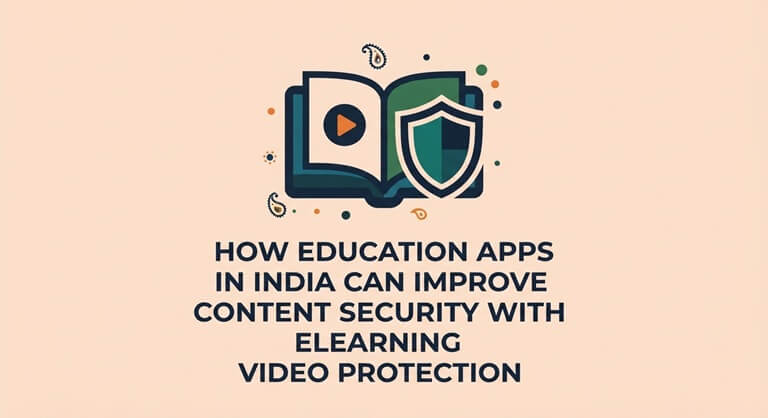
Why Video Security Matters for Education Platforms
Most of the companies involved in online learning spend a great deal of time and effort on producing recorded lectures, tutorials, demonstrations, and materials to help with exam preparation. However, after this kind of content has been uploaded onto the internet, merely putting it behind a login page is not sufficient for protection.
Users may share credentials, copy video links, attempt to download files, or redistribute recorded content through other channels. For Education apps in India, this can become a serious problem when the business model depends on paid access to courses.
A more robust security strategy should therefore secure not just the web page but also the video.
How eLearning Video Protection Works
E-learning video protection generally involves encrypting video files and controlling who can decrypt and play them; instead of sending a video file that can be used directly, the system streams encrypted media that can be played only after valid authorization.
As a result, it becomes more difficult for someone to copy the video URL and then view the content outside of the authorized platform.
Security can also be combined with user authentication, along with restrictions on devices, session controls, geographic restrictions, and the expiry of access. All of these measures assist education providers in exercising greater control over the way in which their courses are consumed.
The Role of DRM in Online Learning
DRM protection is particularly useful when it comes to platforms that distribute high-value educational content since it is able to encrypt the media and demand a valid licence before the video is played on the viewer’s device.
This method offers better protection than simply using hidden URLs or ordinary access restrictions; even if someone gets the streaming link, the encrypted video will still need valid authorization.
VdoCipher offers secure video hosting, incorporating DRM-based protection as well as other security features that are suitable for use by online learning platforms; it thus enables course providers to safeguard their recorded lessons without compromising smooth playback for legitimate students.
Adding More Layers of Security
Security through video is most effective when a number of different measures are used together. For instance, dynamic watermarking can display user-specific information while the video plays, which discourages screen recording and unauthorized redistribution.
In a similar way, restricting the number of devices that are linked to an account can help reduce the practice of sharing credentials. Access rules based on time can also make it so that students only keep their access for the length of their subscription or course period.
Building a More Secure Learning Experience
Security shouldn’t make the learning experience unnecessarily difficult since the aim is to have protection operate in the background while students are able to access the videos smoothly on the supported devices.
For Education apps in India, investing in reliable elearning Video Protection can help reduce content leakage, protect course revenue, and preserve the value of original educational material.
As online learning continues to expand, combining secure video delivery, DRM, authentication, and other access controls can build a stronger foundation for sustainable digital education.
Popular on OTW Right Now!


About The Author

Gagan Bhangu
Founder of otechworld.com and managing editor. He is a tech geek, web-developer, and blogger. He holds a master's degree in computer applications and making money online since 2015.