
10 Best Virtual Receptionist Services for Medical Offices
A missed call might indicate that an appointment has been missed. Small clinics have three main options for ensuring that their phones are answered: they can use live answering services, which are charged on a per-minute basis; employ dedicated remote assistants who are paid on an hourly or monthly basis; or opt for hybrid services that include triage or the use of AI.
With regard to U.S. practices covered by HIPAA, privacy requirements take priority. A vendor serving as your business associate must sign a Business Associate Agreement before they handle protected health information. You should make sure that the agreement includes the service you intend to use, and not merely a separate healthcare service.
Key Takeaways
- You should decide if you need continuous administrative ownership or overflow phone coverage, the two models having completely different prices.
- An ABA is required in the case where the vendor is a business associate, but it does not by itself prove compliance. The HHS guidance for business associates specifies the contents that the contract must include.
- Until you look at the overage rates—their range is from $1.28 to $2.50 among the various services—plans on a per-minute basis appear cheap.
- Bilingual coverage is now offered as a standard feature by a number of vendors, so instead assess the way it is provided rather than merely checking that it exists.
- Clinical triage is not the same as message-taking, and among the options listed, only one provides nurse triage.
What to compare
- The coverage is available 24 hours a day, on an overflow basis only, or it can be provided consistently during the day.
- The safeguards provided by HIPAA, the published security certifications, and a clear procedure for signing a BAA.
- The capability of working within your electronic health record system or with an approved scheduling tool.
- The total cost, which included the setup fees as well as the minutes and any overage charges, was as stated.
- The ability to provide language support, the capacity for triage, and a well-defined procedure for directing urgent calls to your on-call team.
Quick guidance before the list
Ongoing scheduling and administrative work: A dedicated assistant usually fits better than a message-taking service.
Overflow or after-hours calls: Compare per-minute plans against your actual call volume and average call length.
Clinical triage: Confirm who is on the line. Nurse triage and on-call dispatch are distinct services and are not included by default.
The six options
The services address a variety of requirements, ranging from having personal assistants to using shared answering teams. Since the rates and terms listed by the vendors may change, it is necessary to check the current pricing, coverage, and BAA terms before agreeing.
1. Wing Assistant
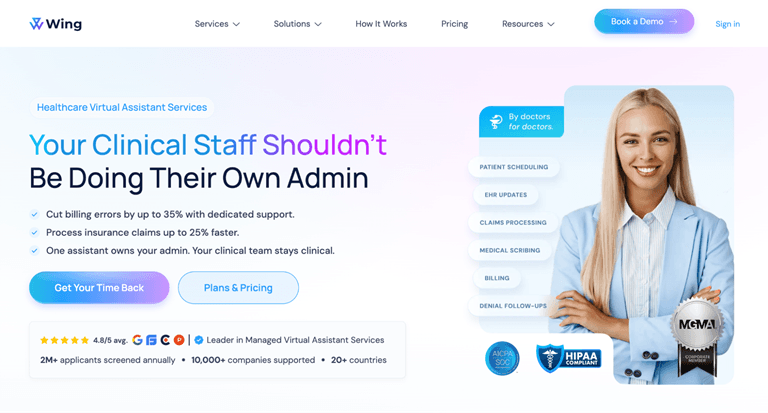
What it is: It is a managed and dedicated assistant service designed for clinics. The company provides support with regard to patient scheduling, updating the EMR, handling insurance claims, and coordinating laboratory services, and its assistants work within Epic, Athenahealth, and Kareo. The quoted prices are $1,099 a month for part-time work at 80 hours and $1,799 for full-time work at 160 hours; these prices depend on experience, location, and the need for bilingual services. Security documentation states that the company is ISO 27001 compliant, is SOC 2 certified, and has HIPAA-compliant workflows together with role-based access controls.
Best for: Situations in which a single individual is designated to take responsibility for the ongoing front-desk and back-office tasks rather than having them shared among a group of people.
Watch for: Plans are monthly hour blocks, so do not assume 24/7 coverage. Clinics evaluating a managed virtual medical secretary from Wing Assistant should request BAA terms directly, since the healthcare page publishes NDAs and access controls rather than the agreement itself.
2. Ruby
What it is: U.S.-based live receptionists who provide an optional HIPAA-compliant service to healthcare clients. The company says that its agents carry out intake procedures, scheduling, the handling of payments, and answering non-medical questions around the clock every day of the year and adds that a member of the team will issue a Business Associate Agreement when the service agreement has been completed. It also mentions that there is no additional charge for the HIPAA-compliant service other than the usual receptionist or chat fees.
Best for: Clinics that want to have human staff available 24 hours a day without having to use a separate healthcare pricing tier.
Watch for: When considering per-minute economics, the plan should be matched to the real call volume. If HIPAA mode is in effect, messages and call details are sent to the app and the online portal rather than by email or text, and several third-party integrations are not available on HIPAA-compliant accounts.
3. AnswerConnect
What it is: A service that answers calls around the clock and whose standard plans are listed on its healthcare section. The Entry plan is priced at $350 a month for 200 minutes, together with a $49.99 setup fee and $2.50 for each extra minute. The Growth plan is $395 a month for 300 minutes, with no setup fee and $1.85 for each additional minute. The company states that HIPAA compliance can be turned on in the portal, which in turn turns off the call recordings feature.
Best for: Practices that want their plan prices published and have 24-hour-a-day coverage on each tier.
Watch for: Although these are general plans, they are not specifically geared towards healthcare. Since interactions are rounded up and billed in one-minute intervals, you should separately verify the secure message delivery and the BAA process. Turning on a portal setting does not in any way replace the agreement.
4. MAP Communications
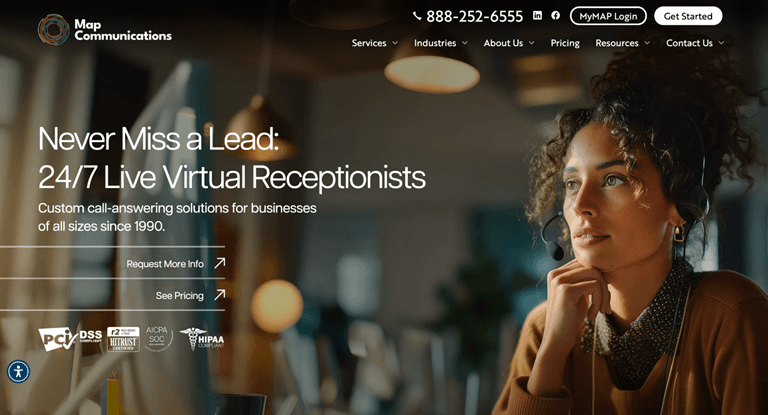
What it is: A live answering service that publishes its HITRUST r2, SOC 2, and PCI-DSS certifications and provides HIPAA-compliant communications, claiming that it was the first answering service to obtain HITRUST r2 certification. The prices are available in four different tiers, ranging from Pay As You Go at $49 per month with no minutes included and $1.37 for each additional minute, to Premium at $649 for 500 minutes at $1.28 per minute. All of the plans include 24-hour-a-day coverage, offer fluency in both English and Spanish, and have no long-term contracts.
Best for: Organizations that wish to have an answering service together with security documentation which they can actually examine when choosing a vendor.
Watch for: Overage rates drive the real monthly cost on low-minute plans. Confirm BAA terms, message handling, and compatibility with your scheduling tools.
5. Nexa
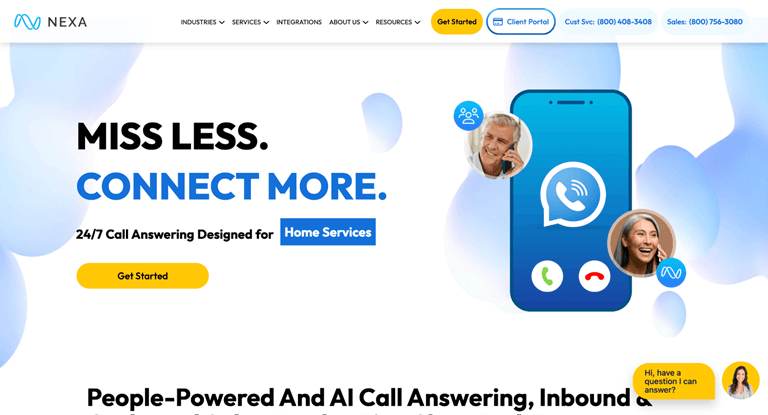
What it is: It is an answering service that combines the use of live agents with AI tools; the services it offers include, in English and in Spanish, HIPAA compliance, patient intake, appointment scheduling, and nurse triage, together with the dispatch of on-call doctors, all available around the clock throughout the year, together with integrations with a CRM and scheduling system.
Best for: Clinics that require clinical triage or the dispatch of physicians during after-hours rather than just taking messages.
Watch for: Triage is a clinical service, so confirm who performs it and under whose protocols. Ask how agents access your calendar or EHR, secure the BAA, and test how after-hours calls reach your on-call provider.
6. Hello Rache
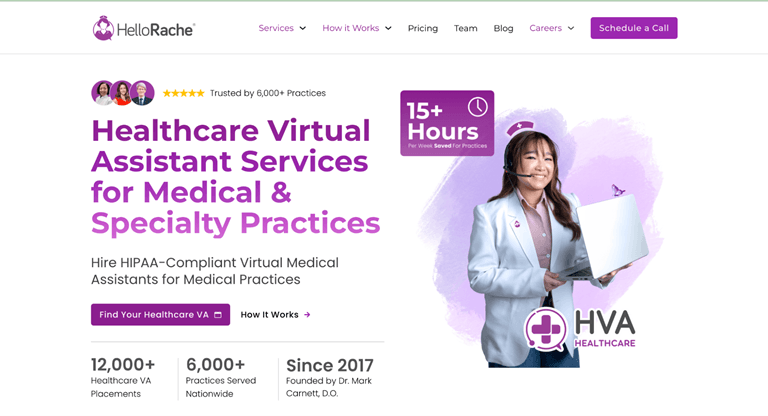
What it is: A specialized remote assistant service that charges a flat rate of $9.50 per hour, with billing occurring on a weekly basis and without requiring any contracts, setup fees, or a minimum number of hours. The company states that the assistants carry out HIPAA training and obtain certification before beginning to assist a practice, and advises clients to have the assistant sign a Business Associate Agreement since they would do so with any contractor who has access to PHI.
Best for: Consistent daytime support for scheduling, intake, and EHR updates at a predictable hourly rate.
Watch for: Dedicated staffing needs clear workflows and a practice contact who can supervise the work. Confirm access limits and whether the BAA must cover the individual, the company, or both, based on their actual roles.
How to choose
Begin by focusing on the work that your team needs to be covered, and then evaluate the vendors based on the same call volumes and task list.
Scheduling inside your EHR: Compare the dedicated options. Ask each to demonstrate your booking workflow before granting access.
Overflow or after-hours coverage: Compare answering-service plans using expected minutes, overage rates, and the cost of secure message delivery.
Bilingual calls: Nexa, Ruby, and MAP all publish English and Spanish coverage. Test the Spanish-language experience and confirm coverage hours rather than relying on a feature label.
Clinical triage: Ask who is qualified to perform it, what protocols they follow, and how escalation reaches your on-call provider.
Implementation checklist
Once you have chosen a vendor and completed the privacy review, test the workflow before sending live patient calls.
- Set up call forwarding with different routes for use during the day, in the case of overflow, and after hours.
- Clinicians should approve the scripts for urgent symptoms, the emergency instructions, and the rules regarding how to contact the on-call team. Receptionists must not give any clinical advice.
- Specify whether the different types of visits can be booked directly or if they require staff approval.
- Arrange for the secure delivery of messages and assign someone to check and respond to them.
- We can arrange a test booking, provide language support, route urgent calls, and handle after-hours situations using practice calls.
Certain clinics employ a specialist assistant on a daytime basis together with an answering service during the nights and weekends; other clinics require only extra support. Fill in any gaps in coverage and ensure that each handover has an owner, the appropriate safeguards, and any necessary BAA.
FAQ
Does a BAA make a vendor HIPAA compliant?
On the contrary, while the agreement lays out the vendor’s duties as a business associate, adherence to those duties will depend on the actual safeguards that are in place; therefore, it is necessary to review staff access, message delivery, data storage, and any subcontractors together with the contract.
Can a virtual receptionist perform triage?
The service has to have staff on board. Taking messages and booking appointments are administrative tasks. Nurse triage and on-call dispatch are clinical services provided by a certain number of vendors, and in each case there must be clinician-approved protocols.
Which pricing model costs less?
It depends. It all comes down to the number of calls. Plans based on a per-minute basis are better suited to low and fluctuating volumes, whereas hourly or monthly dedicated staffing is more appropriate for consistent administrative workloads. You should compare the two models against your actual monthly usage before making a decision.
Popular on OTW Right Now!
-
 Looking to understand the types of SEO promotion or how to transform a healthcare business?
-
 What Should You Consider When Choosing a Low-Cost Interlock Provider?
-
 How to Choose the Best Criminal Lawyer in the Digital Age: A Complete Tech-Driven Guide for First-Time Clients
-
 One-Stop PCB Assembly: What It Includes and Why a Single Partner Cuts Cost, Errors



About The Author

Gagan Bhangu
Founder of otechworld.com and managing editor. He is a tech geek, web-developer, and blogger. He holds a master's degree in computer applications and making money online since 2015.