
Why Controlled Environments Matter in Modern Research and Manufacturing
Today’s laboratories and manufacturing plants are more and more reliant on controlled environments in order to ensure product quality, safeguard delicate processes, and obtain reliable results. In sectors including pharmaceuticals, biotechnology, electronics, food production, and scientific research, minor variations in environmental conditions can affect the performance of a product or of an experiment.
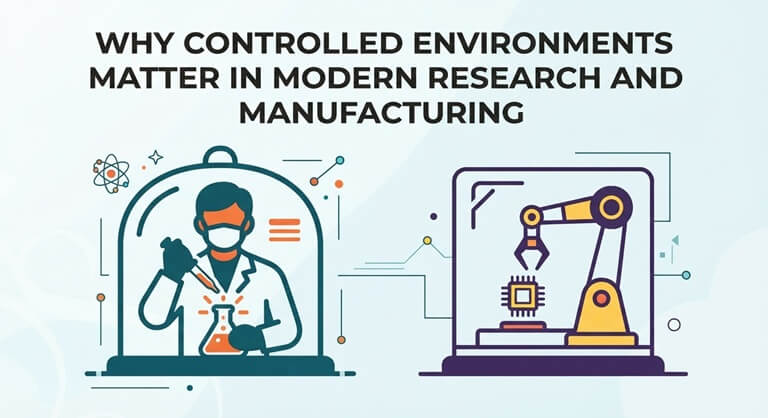
Temperature, humidity, the number of airborne particles, pressure, and other environmental factors must therefore be carefully managed, and controlled environments offer organizations with the necessary infrastructure for maintaining these conditions consistently.
What Is a Controlled Environment?
A controlled environment is a space which is designed to keep certain environmental conditions within predetermined limits.
Depending on the application, these conditions may include:
- Temperature
- Relative humidity
- Air cleanliness
- Air pressure
- Particle concentration
- Lighting
- Airflow
- Microbiological conditions
The specific requirements vary according to the process occurring within the facility.
For instance, a pharmaceutical laboratory might have strict requirements regarding particulate and microbial control, while a research facility would place great emphasis on temperature and humidity stability.
The Role of Cleanrooms
Cleanrooms are one of the most important types of controlled environments.
A cleanroom is constructed in such a way as to control airborne particles and other environmental factors, using specialized filtration systems, airflow systems, pressure control measures, and monitoring equipment to keep the necessary conditions.
Organizations looking for a Canada clean room need to consider more than the physical room itself. The design should correspond to the processes being performed, applicable standards, equipment requirements, and the level of environmental control needed.
A well-designed cleanroom can help to reduce the chances of contamination and enhance the consistency of the process.
Why Airflow Matters
The movement of air is an important element in the design of cleanrooms.
Controlled airflow aids in the management of airborne particles and helps to achieve the required cleanliness levels. In different facilities, the airflow can be arranged to follow certain patterns in order to reduce contamination and ensure that the environmental conditions remain consistent.
Filtration systems are just as important; high-efficiency filters are able to remove tiny particles from the air before it reaches the controlled areas.
Filtration by itself is not sufficient since door movement, the actions of personnel, the position of equipment, cleaning procedures, and room pressure may all have an effect on environmental performance.
Temperature and Humidity Control
The temperature and humidity can have an effect on a great many industrial and laboratory processes.
High humidity can lead to condensation or have an effect on materials, while in some cases extremely dry conditions may cause static electricity problems.
Temperature variations can also influence experiments, chemical processes, biological samples, and product stability.
For this reason, monitoring systems are often integrated into controlled environments to identify deviations and provide data for quality assurance.
Understanding Stability Chambers
A stability chamber is another important type of controlled environment used in research and product development.
Organizations can use stability chambers to subject samples or products to predetermined conditions of temperature and humidity for certain periods of time. This enables researchers to assess how products perform under particular environmental conditions over time.
Stability studies are important in the pharmaceutical and related industries when it comes to understanding product characteristics, shelf life and storage requirements.
Monitoring Environmental Conditions
Only if the conditions in a controlled environment can be measured and monitored accurately is it of any use.
Modern facilities can make use of sensors and data logging systems to monitor temperature, humidity, pressure, and other parameters.
Continuous monitoring is able to detect deviations more quickly than periodic manual inspections alone.
Historical data can likewise offer useful information; if a facility has a temperature or humidity excursion, the records can enable the teams to find out when the incident took place and for how long the conditions stayed outside the prescribed range.
The Importance of Calibration
The monitoring equipment has to give accurate measurements.
The accuracy of sensors and instruments can decrease bit by bit with time, which is why calibration and verification are essential parts of environmental monitoring.
Calibration programmes should be set up in accordance with the equipment, the application, the regulatory expectations and the facility requirements.
Reliable measurements allow organizations to make decisions based on trustworthy environmental data.
Designing for Operational Requirements
Environments that are under control should be designed with the activities which will occur within them in mind.
When planning it is necessary to take into account factors such as personnel movement, equipment size, material flow, cleaning requirements, and maintenance access.
Even if a room is technically advanced it may still cause operational difficulties when employees are unable to move around efficiently or when the equipment cannot be maintained without disrupting the controlled conditions.
Good design therefore combines environmental performance with practical usability.
Energy Efficiency and Modern Facilities
Environmental control can require significant energy, particularly in facilities that operate continuously.
Modern engineering approaches increasingly focus on improving energy efficiency without compromising environmental requirements.
All the things that can help with energy management include efficient HVAC systems, properly optimized airflow, suitable insulation, intelligent monitoring, and control of the equipment.
The aim is to combine the need to meet operational requirements with the need to ensure good long-term facility performance.
Preventive Maintenance
Environments that are under control need to be maintained continuously.
Filters, HVAC equipment, sensors, monitoring systems, doors, seals, and other components can affect environmental performance.
Preventive maintenance helps identify potential problems before they become significant operational failures.
Maintenance schedules should be based on equipment requirements and facility procedures, with appropriate records maintained for critical systems.
The Future of Controlled Environments
Technology is making controlled environments increasingly measurable and connected.
Digital monitoring systems can provide real-time information, while automated alerts can notify facility teams when conditions move outside defined parameters.
Data analytics can also help organizations identify recurring patterns and optimize environmental controls.
As industries continue to demand greater consistency, quality, and traceability, controlled environments will remain an important part of modern research and manufacturing infrastructure.
The key is not simply building a room with environmental controls. Successful facilities require appropriate design, reliable equipment, accurate monitoring, preventive maintenance, and procedures that are aligned with the processes being performed.
If these various elements are combined, organisations will be able to set up controlled environments which support product quality, the reliability of research, operational efficiency, and long-term process consistency.
Popular on OTW Right Now!


About The Author

Gagan Bhangu
Founder of otechworld.com and managing editor. He is a tech geek, web-developer, and blogger. He holds a master's degree in computer applications and making money online since 2015.