
How Smart Thermostats Actually Talk to Your AC — and the Settings Most Homeowners Get Wrong
The average certified smart thermostat shaves about 8% off a home’s heating and cooling bill, or roughly $50 a year. Useful, sure. But it’s a long way from the revolution the packaging promises, and the reason the number lands so far below the hype is almost always the same: the thermostat is wired, placed, or programmed in a way that undercuts what it can do.
The small computer with a radio and some relays that is situated on your wall is sending signals to your air conditioning system; if you understand the message it is sending and know the areas where it cannot reach, you will be able to make better use of it while ceasing to struggle with your own equipment.
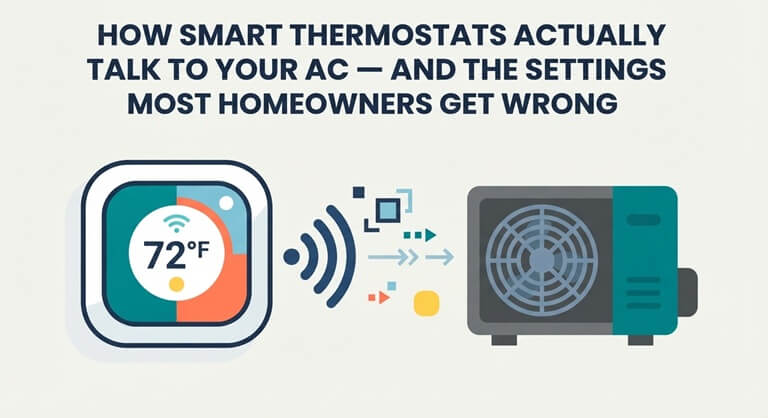
The situation behind the screen and the settings which cost you money even though you didn’t notice them.
What Is Your Thermostat Actually Doing?
The thermostat is a low-voltage switch and not a dimmer for the air conditioning system. As the temperature in the room rises above the setting you have chosen, it completes a 24-volt circuit which causes both the outdoor condenser and the indoor blower to switch on. When the room reaches the desired temperature, the circuit is opened and all operation stops.
Earlier thermostats achieved this using two or three wires and a pair of AA batteries. In order to keep its Wi-Fi radio, colour display, and processor running continuously, a smart thermostat needs a constant supply of power from the HVAC system itself, and that is what the C-wire, or common wire, is meant for.
In houses that were built over the past few decades the C-wire is generally already positioned behind the wallplate; however, if it isn’t there, certain smart thermostats obtain power from the heating or cooling wires instead, and it is generally in this situation that complaints about unreliable Wi-Fi, spontaneous reboots and short-cycling occur.
Why Placement Matters More Than the Brand
The thermostat is only aware of the temperature detected by its own sensor. If it is hung on a wall that receives sunlight, above a lamp, by the kitchen, or opposite a supply register, it will display a temperature that the rest of the house never experiences. The air conditioning system will therefore operate in short, intense bursts in an attempt to meet a figure that isn’t real.
The fact is that short cycling occurs. The system turns on, operates for a few minutes, switches off, and then repeats itself. It doesn’t run long enough to remove the humidity from the air, and each time it restarts the compressor has to take a much larger inrush of current than during steady operation. As a result, the bills go up, the rooms feel damp, and the equipment fails prematurely.
Fix the thermostat to an interior wall, at about chest height and away from vents and direct sunlight. The amount of money you’ll save by making that one choice will exceed anything you could save by referring to a feature comparison chart.
The Settings Most Homeowners Get Wrong
The hardware rarely costs you money on its own. Five settings do most of the damage, and people either ignore them or actively fight them:
- Fan set to ON. Running the fan continuously while the compressor cycles pushes warm, humid attic air through leaky ducts and re-evaporates moisture off the coil back into the house. Use AUTO unless you have a specific air-quality reason not to.
- Aggressive setbacks. A setback of about 7–10°F while you’re out or asleep is the sweet spot for cooling savings. Swing 15° or 20° and the system has to run flat out for an hour to recover, wiping out most of what you saved and leaving the house humid when you walk in.
- Permanent hold. Tapping HOLD to override the schedule “just for today” and then forgetting about it is the single most common way a smart thermostat becomes a dumb one. Check that you’re on schedule, not on hold, every week or two.
- Ignoring geofencing. If your phone can tell the thermostat when the house is empty, let it. A learned schedule guesses at your routine; your phone’s location knows it.
- Chasing a magic number. There is no single “correct” summer setpoint that applies to every home. Pick the warmest temperature you’re genuinely comfortable at, then use setbacks around it. Each degree higher saves noticeably more than picking a trendier brand.
When to Call Somebody
A smart thermostat won’t be able to cure a dirty coil, a low refrigerant charge, or ductwork that is losing one-third of its air into the attic. When the house fails to maintain a steady temperature regardless of the setting, if the outdoor unit is beginning to ice over, or if the bills continue to go up even though the runtime is increasing, then the thermostat is acting as a messenger rather than being the source of the problem. That’s the point where a seasonal AC tune-up earns its keep. The technician can take a reading of the static pressure, check the charge, and verify that the wiring at the equipment matches what the thermostat is expecting. Once the basic aspects are correctly addressed, the smart features will then have something to optimize.
Popular on OTW Right Now!




About The Author

Gagan Bhangu
Founder of otechworld.com and managing editor. He is a tech geek, web-developer, and blogger. He holds a master's degree in computer applications and making money online since 2015.