
9 Fullstack Web Development Fundamentals That Never Go Out of Date
Introduction
When senior engineers are evaluating fullstack abilities, their decision is seldom based on familiarity with various frameworks. Instead, what is more important is the degree to which the frontend and backend communicate smoothly, a point that becomes all the more crucial as collaboration increases. In 2025 GitHub’s Octoverse report showed that more than 43 million pull requests were merged each month on the platform, a level of scale which means that having clean interfaces between the different layers is absolutely essential. The way in which the underlying data is modelled, whether security has been built into each layer rather than being added on later, and whether the testing and deployment process works reliably when real users are actually using the system all stem from this same principle. None of these qualities can be seen in a portfolio review; they appear during code reviews, in the speed at which problems are diagnosed and fixed, and in the way well a product performs months after it has been launched. The nine fundamentals that are outlined below show precisely on what that judgment is based.
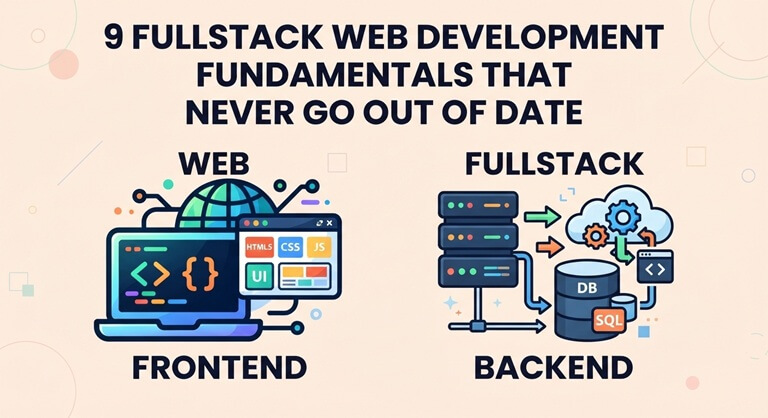
Fullstack Fundamentals Worth Getting Right Every Time
The following nine practices form the foundation of reliable fullstack work, independent of which languages or frameworks a team uses.
Clear Frontend-Backend Separation and Communication
Tangled logic is usually the first sign of a codebase in trouble. When the presentation layer and the business logic stay properly separated, updating one side does not mean touching the other. Teams that get this right can hand off frontend and backend work independently. Teams that do not end up debugging across five unrelated files just to fix one button, which is one reason many businesses choose to work with a full stack development company rather than assembling this discipline in-house from scratch.
Strong API Design and Contract-first Thinking
Each API is a promise to those who use it. By drawing up the contract before carrying out the implementation, both sides of the team can work on the basis of a stable agreement rather than having to guess at the other’s changes. If you omit this step, breaking changes will happen monthly rather than being a rare occurrence.
Scalable Database Design and Data Modeling
Incorrect schema choices usually remain silent until the circumstances surrounding them change. A table that has been poorly indexed may work well when the system is first launched but then become very slow six months later when the actual volume of data starts to affect it. Developers who focus on normalization, relationships, and future query patterns are planning with year two in mind, not on the day of the demonstration.
Performance Optimization Across the Stack
Nobody cares whether a slow page is the frontend’s fault or the database’s fault, since the result looks the same either way. Unoptimized images, chatty API calls, and unindexed queries all add up to the same abandoned session, a clear example of how custom web development improves website performance when performance is treated as a shared job across the stack, not a frontend chore.
Security built into Every Layer
Security flaws occur when authentication is added the week before going live. Input validation at the API level, proper access control in the database, and reasonable session management on the frontend each fill a different gap; if one of them is overlooked the other two will not make up for it.
Version Control and Collaborative Workflows
Anyone can run git commit, but that alone does not make someone proficient with version control. Fewer people can write a commit history someone else can actually read six months later, or run a branching strategy that does not turn merge day into a fire drill. This is the difference between using Git and using it well, and it’s a strong signal to check for when you hire web developers who will maintain a codebase long after launch.
Testing Strategy Across Frontend and Backend
Failure to write tests is a debt that grows over time. Unit tests pick up logical errors and are inexpensive to correct. Integration tests ensure that the various components actually function together, not merely individually. Those who regard this as a standard practice detect problems when a pull request is submitted, whereas those who omit it discover the problems in production.
Observability, Logging, and Debugging Practices
Production will certainly fail at some point, and that isn’t an expression of pessimism but simply a fact about how software functions. The teams which recover most quickly are those that established visibility right from the start—by implementing structured logs, providing clear error messages, and setting up alerts that trigger before a customer is forced to file a ticket.
Deployment pipelines and environment management
It is in the manual deployment steps that human error is likely to occur; one of the most frequent ways in which bugs manage to get through without being detected is when a configuration turns out to be different between staging and production, and automated pipelines that are consistent eliminate that element of guesswork completely.
How These Fundamentals Shape Long-Term Product Success
These basic principles do not function separately from each other. Even if a team takes the time to model their data, regressions will still occur if testing is regarded as optional. Similarly, a team that has designed their APIs well will still have difficulties when traffic rises if observability had never been considered. A product’s ability to remain stable long after its launch is generally less the result of any one particular decision and more the result of these fundamentals having been adopted as standard practice right from the start, rather than being introduced later in response to problems that had already arisen.
Conclusion
Fullstack web development is usually talked about in the context of frameworks, but dependable software is the result of developers who regard these nine fundamentals as part of their standard practice rather than something to tick off an interview list. Having a clear separation between the frontend and the backend ensures that the codebase remains manageable as it grows. Proper data modelling and making secure decisions early on stop issues from arising that would later become very expensive to fix. Because of testing, observability, and careful deployment, a product is able to continue running correctly long after the original team has left. Although the tools will always be changing, products based on these fundamentals tend to last longer, while those not based on them end up with a growing number of costly problems.
Popular on OTW Right Now!



About The Author

Gagan Bhangu
Founder of otechworld.com and managing editor. He is a tech geek, web-developer, and blogger. He holds a master's degree in computer applications and making money online since 2015.