
How AddressHub Helps You Organize and Access All Your Web Links in One Place
Load sufficient browser tabs, and eventually the internet becomes more of a scavenger hunt than a useful tool. It does not matter whether you are professionals, researchers, or casual internet surfers; the story remains the same, as you are jumping between several tabs, an outdated bookmarks list, and maybe even a piece of paper with a hyperlink printed on it.
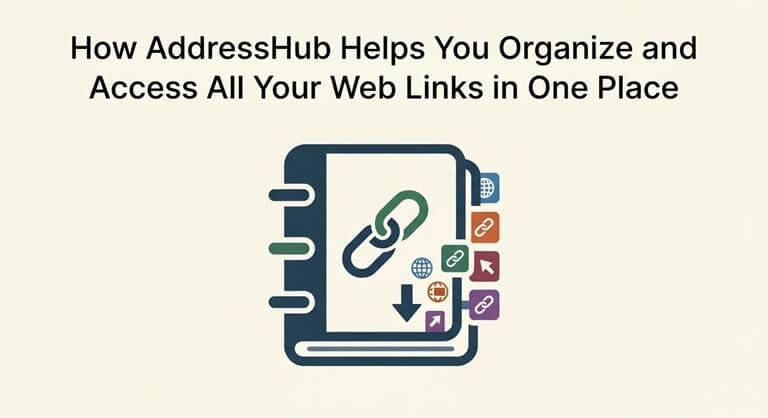
The cumulative effect of this is that each device you use worsens the problem. For example, a URL that you saved on your laptop on Monday morning can no longer be found on your phone by Monday night, and the seconds you spend looking for it gradually diminish your ability to concentrate. This is the exact gap that link management tools like https://링크허브.com/ are built to close — turning scattered browsing into a single, navigable dashboard.
The Problem With Modern Browsing
Browsers were created with the intention of opening a single web page at a time and were not intended to keep record of the entire process flow; as a result, a number of people have adopted tabs for use as temporary to-do lists. This is known as the Zeigarnik effect. The mental tension caused by tasks that have not been completed—such as those represented by a tab left open in the corner of your screen—continues to affect working memory long after you have stopped consciously thinking about them.
Bookmark folders don’t help in this situation either; they usually end up as quiet graveyards, areas where links go to be forgotten rather than remembered. Research into human-computer interaction carried out at Carnegie Mellon University reaches the same conclusion, namely that browser tabs do not have the necessary structural depth to handle anything more complicated than a simple lookup. Because of this, people keep their tabs open indefinitely, out of fear of losing something important, and the browser ends up suffering as a result—experiencing lag, crashes, and a kind of mild digital fatigue that develops during the course of a workday.
| Navigation Method | Storage Nature | Searchability | Cross-Device Sync | Cognitive Impact |
| Open Browser Tabs | Temporary / Volatile | None (Visual Scan) | Poor / Manual | High Stress & Tab Overload |
| Browser Bookmarks | Static / Hidden | Text-based Only | Browser Specific | Low Visibility / Folder Clutter |
| AddressHub(주소허브) Dashboard | Centralized / Visual | Instantly Searchable | Universal Web Access | Low Stress & Clear Workflow |
Centralizing Your Digital Workspace
A unified hub changes the underlying habit. Instead of digging through nested folders or scrolling past the same forty tabs looking for one, you get a structured, visual entry point — links grouped the way you actually think about them, whether that’s by project, by client, by personal finance, or just “things I read at lunch.”
Setting up such an environment in AddressHub (주소허브) requires no great deal beyond a bit of initial organisation. After your links have been arranged into visual groups, decision fatigue is quickly reduced. You cease seeing each destination as merely a temporary browsing session and begin to regard it as part of a permanent and easily navigable foundation for your digital life.
Unifying Access Across Devices
It is in this area that most people actually experience pain: the gap between desktop and mobile. A link that you save during a period of concentrated work on your laptop can really be difficult to find later on that same evening when using your phone. Although native browser sync is supposed to resolve this problem it usually only partly does so, particularly when different operating systems, browsers, or a restricted work network are involved.
A web-based portal avoids all of that. Since your link structure is stored online rather than in a single browser, you can access it from whichever device you happen to be using—whether it’s a work laptop, a personal phone, or even a terminal you’ve borrowed. You can log into AddressHub(주소허브) and everything will be there. There’s no need to email yourself a link, no longer have to use a messaging app as a temporary notes tool, and no longer have to manually keep the bookmarks from four browsers in sync.
Streamlining Everyday Web Workflows
Deep focus is easily disrupted and can be broken by minor issues; for example, by a missing link in a spreadsheet or by not remembering the URL for a login portal. The time it takes to search for these small interruptions is less than the amount of mental context that has to be reconstructed afterwards. This is supported by research carried out at the National Center for Biotechnology Information, which says that interruptions while carrying out a specific task have a negative effect on cognitive control and result in more errors when carrying out complex tasks.
When https://링크허브.com/ is incorporated into a daily schedule, such interruptions are eliminated. All important information is well-organized, readily available, and can be accessed within one click. It is not merely convenient but also represents the difference between using one’s entire toolset in a matter of seconds each morning or spending the first ten minutes looking for it.
FAQs
How does a link management platform differ from standard browser bookmarks?
Standard browser bookmarks keep static URLs in hidden folder trees that are specific to a certain browser, while a special AddressHub (AddressHub) platform offers a visual, searchable, and cross-platform dashboard which can be accessed from any browser or device without the organizational structure being lost.
Will organizing web links help reduce browser lag and memory usage?
That’s usually the case. When your links are stored somewhere outside of the browser, you can close the extra tabs without being concerned about losing track of them—and by closing dozens of inactive tabs you free up actual system memory, which in turn reduces the number of crashes and slowdowns.
Can I access my saved links across different operating systems?
Yes, since the hubs operate completely within the browser, there is nothing needing to be installed and your saved links appear in the same way on Windows, macOS, iOS, Android or Linux.
How does centralizing links improve digital security and link verification?
By using a self-curated and centralised portal you decrease the chances of ending up on a phishing site, since you are accessing places that you have previously checked rather than retyping URLs or browsing through your browser’s history.
Is a custom link portal suitable for both personal and professional use?
Yes, the majority of people end up with two workspaces next to each other, one of which contains the client’s resources, project links, and admin portals while the other contains news feeds, streaming sites, and the personal items that shouldn’t be mixed in with work.
Optimizing Modern Web Navigation
None of this digital clutter is inevitable. It’s a symptom of tools that were never designed for how much we actually do online now, and the fix isn’t complicated — it’s structure. The creation of a centralized and visual linking space eliminates the clutter of tabs, cleans out the dead bookmarks, and gives you more control over how your online day will go. It does all this and runs automatically every time you log in.
Popular on OTW Right Now!



About The Author

Gagan Bhangu
Founder of otechworld.com and managing editor. He is a tech geek, web-developer, and blogger. He holds a master's degree in computer applications and making money online since 2015.