
Why Automotive Companies Are Investing in Custom Software Development
Automotive companies are under increasing pressure to scale up innovation while keeping technology risks, operational complexity, and development costs under control. Customers now expect intelligent in-vehicle interfaces, connected features, continuous software updates, and seamless digital experiences. At the same time, manufacturers still need to manage regulatory requirements, complex hardware platforms, long product development cycles, and legacy systems.
Together, these pressures create a fundamental business challenge for automotive companies. As vehicles become more connected, software-defined, and electric, software development has emerged as an important competitive priority for traditional OEMs (Original Equipment Manufacturers). Many face growing challenges related to software quality, development speed, and cost as legacy systems and architectures become harder to maintain.
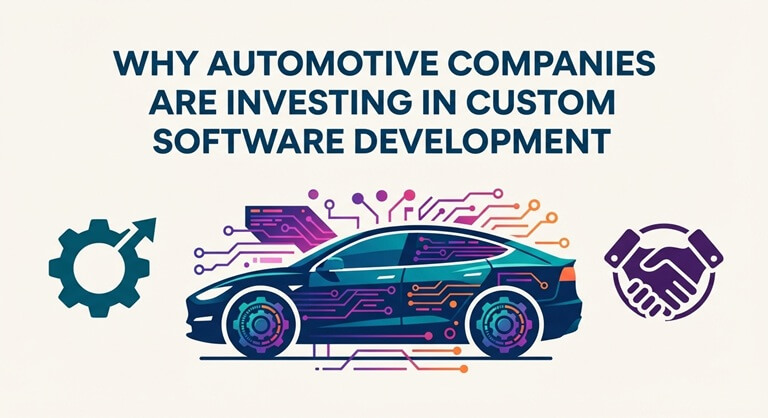
This shift is driving automotive companies to invest in custom software development. Business-specific software allows manufacturers to foster product innovation, improve operational efficiency, integrate fragmented systems, strengthen customer experiences, and create new digital revenue opportunities.
This guide discusses why automotive companies are making this investment and what decision-makers should consider before proceeding.
4 Reasons Automotive Companies Are Investing in Custom Software Development
For manufacturers, choosing a skilled and experienced automotive software development company can shift software from a supporting function to a strategic business capability. The following four factors explain why organizations are investing.
1. Accelerate Product Innovation
Traditional vehicle development follows a hardware-led cycle, which slows innovation and makes it harder to adapt. Custom software development lets automotive companies develop and release digital capabilities, such as improving infotainment, connectivity, vehicle monitoring, driver assistance, and customization without tying every software enhancement to major hardware changes. As a result, manufacturers can shorten the development lifecycle while continuously enhancing eligible vehicle features.
For example, an OEM could build a software platform that lets eligible vehicle features receive over-the-air software updates. The company can keep improving the customer experience throughout the vehicle’s lifecycle.
This creates a competitive advantage over competitors because customers increasingly expect digital experiences or software-driven features that continue to improve even after the purchase.
2. Improve Manufacturing and Operational Efficiency
Automotive software extends beyond vehicle functionality. It can also improve how manufacturers oversee production, quality, maintenance, post-sale, and lifecycle service operations.
Manufacturers can use custom software to connect production data, machinery information, quality metrics, inventory systems, and operational workflows. This gives leaders greater visibility into production performance and upcoming challenges, such as equipment failures or inventory shortages.
Consider a factory where quality teams identify production issues only after inspection. A custom system can integrate production-line data with quality analysis and alert the teams earlier.
The business benefits go far beyond basic automation. Detecting problems sooner can reduce rework, material waste, delays, and quality-related costs.
Custom software can help with:
- Production monitoring
- Quality management
- Inventory visibility
- Predictive maintenance
- Supplier coordination
- Workforce management
- Production analytics
With reliable data across these systems, leaders can make decisions faster and with greater confidence.
3. Enable Software-Defined Vehicles
In a software-defined vehicle, software plays a vital role in delivering and controlling functionality. It also enables continuous improvements throughout the vehicle lifecycle. According to Deloitte, the shift is towards a software-defined architecture that leverages cloud platforms and over-the-air updates.
This architecture can help automakers:
- Deliver OTA software updates
- Add new features after vehicle purchase
- Personalize the in-vehicle experience
- Enhance vehicle functionality and performance
- Allow remote vehicle health monitoring
- Enable connected device services
- Create new software-driven revenue opportunities.
The impact goes far beyond the initial vehicle sale. An automobile can become a long-term digital touchpoint between the manufacturer and the customer.
This creates opportunities for paid upgrades, connected services, subscription services, personalized features, and other revenue streams throughout the vehicle lifecycle.
4. Reduce Long-Term Technology Costs
A custom software solution requires upfront investment, but manufacturers can assess total cost of ownership by tracking operational, retirement, and maintenance expenses across an asset’s 5-to-7 multi-year lifecycle.
A fragmented system can create hidden costs through manual processes, duplicate data, complex integrations, data inconsistencies, maintenance overhead, additional development costs, and ongoing maintenance requirements.
Custom software can eliminate all these challenges and hidden liabilities together within a business-specific technology architecture.
For example, an automotive company uses separate systems for vehicle diagnostics, customer service, dealer operations, and fleet data. A well-designed custom software solution can integrate these silos and enable reliable, smooth data exchange.
Custom software doesn’t mean replacing every legacy system. Its main purpose is to determine opportunities for automation and integration that minimize operational friction and drive measurable cost savings.
A few key areas of potential business impact include:
| Investment Area | Potential Business Impact |
| Process automation | Lower operating costs and minimized manual effort |
| System integration | Better data visibility and reduced duplicate work |
| Predictive analytics | Lower maintenance costs and decreased downtime |
| OTA capabilities | Reduced service intervention for eligible software updates. |
| Customer platforms | Higher customer retention and engagement |
| Digital services | New recurring revenue opportunities |
Key Factors to Evaluate Before Investing in Custom Software Development
Custom software can deliver significant business value, but automotive leaders need to treat it as a strategic business initiative rather than just another IT project.
● Define Clear Business Objectives
Before investing in any custom software, manufacturers should clearly define the business objectives they actually want to address.
Automotive companies’ goals may include reducing production downtime, shortening development cycles, or increasing service revenue. Maybe customer retention is a business’s top priority, or maybe they’re trying to expand into digital services.
When a manufacturer is clearer about its goals, it’s easier to determine whether the investment delivers the expected business value and return.
● Design for Scalability
The software built for one vehicle model won’t automatically scale across an entire vehicle portfolio.
The architecture should adapt to evolving integrations, features, data requirements, and vehicle configurations across models and future product generations.
A scalable architecture enables manufacturers to add new features without repeatedly rebuilding the underlying technology.
● Prioritize Security and Compliance
Connected vehicles raise the technology attack surface and boost the importance of cybersecurity as well as regulatory compliance throughout their software lifecycle.
Security should remain a top priority throughout the lifecycle, from preparing code to launch and post-launch updates.
This requires secure development practices aligned with ISO/SAE 21434, access controls that satisfy UN R155 mandates, data protection that meets regional privacy laws, continuous security monitoring, and vulnerability management.
Security and compliance audits should be part of every architectural and development decision from the start, not like a post-development consideration.
● Pick the Right Development Partner
Every company needs the right development partner that smoothly integrates software engineering with an understanding of its automotive business to drive true digital transformation. Relevant experience must include complex integrations, scalable architectures, data platforms, cybersecurity, cloud environments, and automotive-specific software requirements.
In other words, the partner knows how to build software for the automotive industry that can evolve with product requirements and business over a long period of time.
Companies should consider potential partners on the basis of delivery capabilities, case studies, demonstrated results, and technical expertise.
Wrapping Up
Automotive companies are increasingly investing in custom software development because software these days affects far more than just how vehicles work. Its impact extends across operational management, manufacturing, connected services, customer engagement, and data-driven decision-making. It even helps bring new features to market and generates revenue.
The investments that deliver lasting value solve measurable business challenges. Custom software strengthens customer relationships, accelerates innovation, addresses operational inefficiencies, and supports the evolution towards software-defined vehicles. In addition, it establishes a technology foundation that can help companies scale, adapt to market changes, and pursue new digital opportunities.
Author Bio:
Riley Brooks is a B2B content strategist and enterprise technology writer specializing in software development, digital transformation, AI, and emerging technologies. She creates research-driven content that helps business leaders understand complex technology decisions, evaluate opportunities, and identify practical paths to digital growth.
Popular on OTW Right Now!



About The Author

Gagan Bhangu
Founder of otechworld.com and managing editor. He is a tech geek, web-developer, and blogger. He holds a master's degree in computer applications and making money online since 2015.