
Workers’ Compensation vs. Personal Injury Claims: Why They Are Not the Same
A workplace injury and a personal injury often begin similarly: someone gets hurt, medical treatment follows, and lost income becomes a concern. Legally, though, the two types of claims follow different paths. Workers’ compensation focuses on employment-related injuries, while personal injury law generally examines who caused the harm and whether negligence was involved. That difference affects everything from the evidence required and the types of compensation available to the need for representation at formal proceedings if a dispute develops.
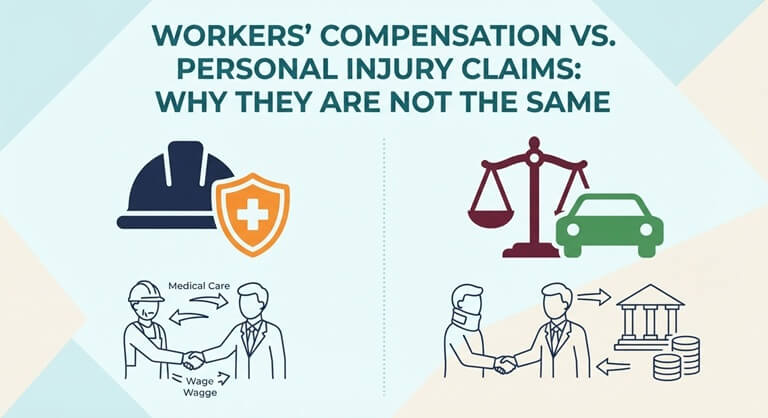
Workers’ Compensation Starts With the Job
Workers’ compensation is intended for workers who have suffered an injury or illness that is “work-related” and qualifies for compensation. Any worker could be covered by the workers’ compensation system, such as someone working in a warehouse who is injured while lifting heavy materials, an office worker who suffers from a repetitive strain injury, or a construction worker who is injured by a piece of equipment.
Typically, the employer’s fault is not the issue, but rather whether he did so carelessly. Rather, the focus is on whether the injury arose from the job and if the employee is qualified to receive benefits.
Those benefits frequently cover medical care, a portion of the employee’s lost wages, rehabilitation, and compensation for any permanent impairment. Deadlines, medical records, and reporting procedures are particularly important as the rules vary from jurisdiction to jurisdiction.
Personal Injury Claims Focus on Fault
Unlike other types of claims, a personal injury claim typically involves negligence at its core. The injured party will typically require proof of a duty of care owed by another person or entity, a breach of that duty of care, and proof of an injury caused by that breach of duty.
One of the more common accidents involves a motor vehicle accident caused by a driver’s negligence. The other is unsafe property conditions that result in a significant fall. Photos, witness statements, medical records, accident reports, expert opinions, and any documentation that demonstrates how the injury has impacted the person’s life are typically part of the evidence.
In addition to financial damages, personal injury damages also include other aspects. Compensation can cover pain and suffering, emotional distress, loss of quality of life, or other non-economic damages depending on the situation and the applicable laws. The benefits of workers’ compensation are more clearly defined.
Fault Is the Biggest Divide
The distinction becomes more apparent when two individuals get a similar injury in two different situations.
Suppose an employee injures their back while doing their job. A driver negligently hits another driver on duty, and they suffer the same back injury. A driver negligently hits another driver who is on duty and suffers the same back injury. The medical diagnosis may be the same, but the cases are vastly different.
Typically, injured employees are focused on workers’ compensation benefits. The injured driver sues the negligent driver for personal injury under the theory of negligence. One has to do with the link between injury and work. The other one is focused on establishing fault.
That distinction is what makes workers’ compensation claims not generally seem like a lawsuit against an employer. The system is not based on the concept of traditional negligence damages; it is based around employment-related benefits.
Where Workers’ Compensation Lawyers Fit In
The paperwork involved in workers’ compensation cases can seem simple until a worker claims the benefits they deserve. An insurer may attempt to determine if an injury actually occurred on the job, or challenge the amount of medical restrictions, the request for medical treatment, or the amount of wage benefits.
Workers’ compensation lawyers are particularly useful in these situations. Injured employees dealing with a disputed claim often turn to California Workers’ Compensation Lawyers, APC serving Riverside, CA, to make sense of how medical evidence, job duties, benefit calculations, deadlines, and hearing procedures fit together. Experienced attorneys also recognize problems injured workers often overlook while focusing on treatment and returning to work.
Legal representation is especially important when benefits are denied, the employee has a permanent impairment, work restrictions conflict with the employer, or the worker receives settlement paperwork. An experienced lawyer examines the record as a legal claim, rather than as a document by itself.
One Accident Sometimes Creates More Than One Claim
In some workplace accidents, the people who are involved are not the employer/employee. Another party, such as a delivery driver, equipment manufacturer, property owner, subcontractor, or third party, may be responsible for an injury.
In that case, the injured worker may have a workers’ compensation claim that is linked to his or her employment claim, and a personal injury claim against the liable third party. In spite of the two claims being associated with the same incident, both are still considered to be separate claims.
Why Early Case Review is important: selecting the wrong legal category, or even missing a single claim, may affect the compensation that would otherwise have been available.
A Small Detail With a Big Legal Effect
Fun fact: Two individuals who were injured in the same accident can end up utilizing completely different legal systems! Even if both were treated for the same injuries, if one was working and the other may not have been, their claims may be subject to different rules.
The Right Claim Depends on How the Injury Happened
The injury itself isn’t what matters; it’s the label attached to it. The legal process that applies depends on the person who is involved, what they were doing at the time of the accident, where they were, and how the accident occurred.
Workers’ compensation attorneys can help resolve that question before paperwork, timelines, or conflicting medical evidence get in the way for injured workers. From the start, knowing which system to use gets the claim on the right track – and keeps the focus on the benefits or damages that should be the focus of the claim.
Popular on OTW Right Now!




About The Author

Gagan Bhangu
Founder of otechworld.com and managing editor. He is a tech geek, web-developer, and blogger. He holds a master's degree in computer applications and making money online since 2015.