
Best Ways to Use Databricks for Business Intelligence Reporting
Business intelligence reporting on modern cloud platforms has reached a pivotal moment. Historically, enterprise leaders treated data lakes as cold storage for data science, relying on separate, proprietary cloud data warehouses for executive dashboards. This architectural split created data duplication, latency gaps, complex transformation pipelines, and inconsistent metric definitions across business units.
With advancements in Databricks SQL, Serverless Compute, Liquid Clustering, Unity Catalog, and Databricks AI/BI, organizations can now execute high-concurrency, low-latency business intelligence reporting directly on an open Lakehouse architecture. Partnering with specialized Databricks consulting services enables enterprises to implement these capabilities and eliminate legacy data siloes rapidly.
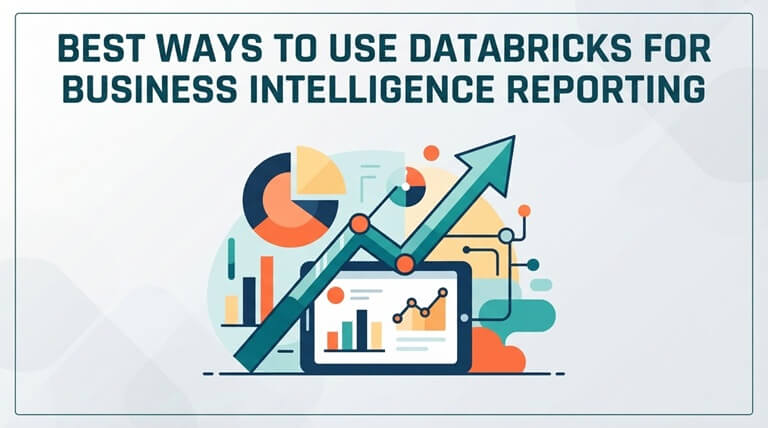
The Evolution of Business Intelligence on the Data Lakehouse
Moving Beyond Disjointed Cloud Data Warehouses
Traditional analytics architectures require extracting raw operational data from cloud object stores and loading it into proprietary data warehouses. This continuous extraction loop introduces significant risks. Data synchronization delays leave decision-makers looking at outdated figures, storage costs double across environments, and security policies become fragmented.
Modern data engineering and modernization solves this bottleneck by unifying storage, transformation, and reporting on open Delta Lake storage. By running business intelligence workloads directly on cloud object storage, enterprises eliminate data movement while maintaining a single, consistent source of truth.
How Databricks SQL Delivers High-Concurrency Analytics
A common objection to data lake reporting was query execution speed. Databricks SQL eliminates this limitation through the Photon engine, a vectorized execution engine written in C++ that processes large-scale SQL workloads at high speed. Photon optimizes scan rates, joins, and aggregations, allowing Databricks SQL to handle hundreds of concurrent dashboard users without performance degradation.
5 Proven Strategies to Optimize Databricks for BI Reporting
To achieve sub-second dashboard responses and optimize cost efficiency, enterprise data teams should apply five core strategies.
- Strategy 1: Serverless SQL warehouses provide instant scaling with zero cold starts.
- Strategy 2: Liquid Clustering dynamically replaces static Hive partitioning.
- Strategy 3: Materialized Views pre-computes heavy aggregations upstream.
- Strategy 4: Pushdown Connectors pushes BI tool filters directly into the Lakehouse.
- Strategy 5: Native AI/BI enables conversational querying and low-code dashboards.
Strategy 1: Leverage Serverless SQL Warehouses for Instant Scaling.
Serverless SQL warehouses eliminate compute provisioning delays. Compute resources scale up automatically in seconds when multiple users open dashboards simultaneously, and scale down instantly during idle periods. This elasticity prevents query queuing during peak morning reporting hours while preventing idle compute costs.
Strategy 2: Implement Liquid Clustering Over Traditional Partitioning
Older table optimization techniques like Hive partitioning or manual Z-Ordering create maintenance overhead and small file issues. Liquid Clustering dynamic layout optimization adjusts file structures based on active query patterns. By using clustering keys matching your reporting filters, Databricks skips irrelevant data blocks during execution, dramatically speeding up query response times.
Strategy 3: Materialize Complex Aggregations for Fast Dashboard Painting
Rather than forcing front-end reporting tools to calculate raw joins and distinct counts on the fly, build Gold-layer Materialized Views. Pre-aggregating key business metrics reduces data processing volume at query time, allowing dashboards to load almost instantly.
Strategy 4: Optimize Third-Party BI Connectors (Power BI and Tableau)
When connecting external visualization tools, push predicate filters down into Databricks SQL before transferring data over the network. For Microsoft Power BI, utilizing composite models combines imported summary data for top-level cards with DirectQuery drill-downs into Databricks for granular transaction records.
Strategy 5: Deploy Databricks Native AI/BI (Dashboards and Genie Agents)
Databricks AI/BI introduces built-in reporting capabilities:
- AI/BI Dashboards: Low-code, AI-assisted dashboards requiring no extra server infrastructure.
- Genie Agents: Conversational spaces that translate natural language queries into verified SQL queries for business users.
Architectural Comparison: Native Databricks AI/BI vs. Power BI and Tableau
Choosing between native Databricks reporting tools and established third-party platforms depends on user requirements and existing investments.
| Evaluation Criteria | Databricks AI/BI Dashboards | Databricks Genie Agents | Power BI (DirectQuery and Composite) | Tableau (Live Connect) |
| Primary User Target | Operational teams, executives needing fixed KPIs | Non-technical business users seeking ad-hoc answers | Enterprise reporting, specialized DAX developers | Visual analysts, deep exploratory designers |
| Data Movement | Zero (Executes natively on Lakehouse) | Zero (Executes natively on Lakehouse) | Minimal (DirectQuery) or Cached (Import) | Minimal (Live) or Cached (Extract) |
| Governance Engine | Native Unity Catalog | Native Unity Catalog | Hybrid via gateways and workspaces | Hybrid via published data sources |
| Query Latency Profile | Sub-second via Serverless SQL | Interactive conversational response | Optimized by DAX pushdown and aggregations | Optimized by SQL pushdown and extracts |
| Licensing Impact | Included with Databricks SQL compute | Included with Databricks SQL compute | Requires separate Power BI user seats | Requires separate Tableau user licenses |
Eliminating Metric Drift with Unity Catalog Data Governance
Discrepancies in metric calculations across departments damage trust in enterprise reporting. Effective data governance through Unity Catalog eliminates this issue by centralizing business logic.
- Centrally Defined Views: Establishes metric logic in a single catalog location.
- Dynamic Row-Level Security: Filters regional data based on user identity.
- Column-Level Data Masking: Redacts sensitive PII and financial metrics automatically.
- Automated Lineage: Tracks complete data flow from ingestion down to individual dashboard widgets.
Centralizing Business Logic and Semantic Metric Definitions
Instead of defining complex logic inside separate BI desktop files, enterprise data engineering teams establish standardized metric views directly in Unity Catalog. When sales, finance, and marketing dashboards query the same underlying metric view, everyone sees identical numbers regardless of their front-end reporting tool.
Enforcing Security and Lineage for BI Reports
Unity Catalog applies fine-grained access policies at query execution:
- Dynamic Row-Level Security: Restricts dashboard visibility based on user roles or regional assignments.
- Column-Level Masking: Redacts sensitive PII or financial fields automatically.
- Automated End-to-End Lineage: Tracks data dependencies from raw ingestion pipelines down to individual dashboard widgets.
Performance and Cost Optimization: Maximizing DBU Efficiency
Sound data management requires balancing reporting performance with cloud infrastructure costs. Databricks SQL achieves this through a multi-tiered caching architecture.
Understanding the Three-Tier Caching Architecture
- Browser Cache (Client-Side): Handles small datasets locally in memory, enabling instant cross-filtering without querying the warehouse.
- Remote Result Cache (Warehouse): Stores query results workspace-wide, returning cached outputs instantly when users load identical dashboard configurations.
- Delta Disk Cache (SSD Cache): Accelerates raw data scans on compute nodes by keeping frequently accessed table files on local SSD storage.
Intelligent Workload Management and Auto-Scaling Rules
Databricks SQL Intelligent Workload Management monitors incoming query spikes and automatically allocates compute capacity. Setting auto-stop timeouts ensures idle warehouses shut down promptly, preventing unnecessary Databricks Unit consumption.
Accelerating Value with Databricks Consulting Services
Common Implementation Hurdles in Internal Engineering Teams
Internal data engineering teams often encounter friction during BI modernization. Common pitfalls include treating Databricks like a standard relational database, misconfiguring cluster sizes, ignoring Liquid Clustering, and failing to standardize metric definitions in Unity Catalog.
Partnering with experienced Databricks Consulting Services helps organizations overcome these hurdles. Specialized consultants provide proven architectural blueprints, query optimization techniques, and cost management controls that ensure a successful platform rollout.
The Sinki Databricks BI Modernization Framework
A structured engagement led by professional Databricks consulting experts follows five practical phases:
- Discovery and BI Architecture Audit: Evaluating existing reporting queries, data schemas, and dashboard performance bottlenecks.
- Data Layer and Semantic Optimization: Restructuring reporting tables into liquid-clustered star schemas and Gold-layer views.
- Unity Catalog Governance Integration: Codifying metric logic, access permissions, and automated lineage.
- Dashboard Pushdown and Migration: Tuning third-party connectors or deploying native Databricks AI/BI solutions.
- FinOps and Performance Monitoring: Implementing automated cost tags, cluster scaling limits, and continuous performance tracking.
Frequently Asked Questions (FAQs)
Q1: Can Databricks replace traditional cloud data warehouses for business intelligence?
Yes. Databricks SQL delivers high-concurrency, low-latency business intelligence reporting directly on open Delta Lake storage using the Photon execution engine, eliminating the need for separate proprietary warehouses.
Q2: How do I speed up Power BI reports connected to Databricks?
Speed up Power BI reports by applying Liquid Clustering on reporting tables, materializing heavy aggregations in Databricks, pushing filter logic down to SQL, and using composite models for drill-down analytics.
Q3: What is the difference between Databricks AI/BI Dashboards and Genie Agents?
Databricks AI/BI Dashboards provide low-code, AI-assisted visual reports for fixed KPIs. Genie Agents are conversational spaces that convert natural language questions from business users into verified SQL queries.
Q4: Why should an enterprise engage Databricks consulting experts?
Specialized Databricks consulting experts supply pre-tested architectural frameworks, query optimization skills, and FinOps controls. Their guidance prevents compute cost overruns, speeds up implementation, and ensures robust data governance.
Why Sinki for Your Databricks BI Journey?
Successfully executing a business intelligence modernization strategy requires a trusted technology partner who understands enterprise data architectures, cloud performance tuning, and governance integration.
Sinki.ai provides end-to-end data engineering, cloud consulting, and advanced analytics services built for modern enterprise demands. With deep technical capabilities across cloud infrastructure, big data engineering, and business intelligence modernization, Sinki helps organizations convert complex, fragmented data lakes into fast, reliable reporting systems.
Whether your team is planning a platform migration, optimizing slow Power BI dashboards, or establishing centralized metric governance on Databricks, Sinki provides the architectural expertise required to achieve your business goals.
Ready to transform your business intelligence infrastructure? Contact Sinki today to discuss your reporting roadmap with our senior data architects.
Popular on OTW Right Now!


About The Author

Gagan Bhangu
Founder of otechworld.com and managing editor. He is a tech geek, web-developer, and blogger. He holds a master's degree in computer applications and making money online since 2015.